American Crime Story: Gianni Versace Season 1 Episode 4 Review & Reaction | AfterBuzz TV
Hosts discuss American Crime Story for the episode “House by the Lake.” | 7 February 2018
(Source: https://www.youtube.com/)
Hosts discuss American Crime Story for the episode “House by the Lake.” | 7 February 2018
@ConstanceJones: I’ll be in my trailer Here’s a quick tour of my private tiny trailer for my role on @AmericanCrimestoryFX! My episode airs soon- but don’t forget to watch tonight! #ACSVersace
Via Darren’s Instagram Story (February 7th, 2018)
bharrisk: Tonight’s thriller episode of #acsversace#acstheassassinationofgianniversacefeatures a cameo from one of my favorite musician/songwriters – 2018 Grammy winner #aimeemann. Bring the Kleenex 😢 10pm on FX
Wednesday’s all-new episode of The Assassination of Gianni Versace: American Crime Story is the most emotional episode yet!
The fourth episode of American Crime Story season two is titled “House By The Lake,” and the official synopsis from FX is: “Minneapolis architect David Madson is forced to go on the run with Andrew Cunanan.” The episode was written by Tom Rob Smith and directed by Dan Minahan.
So what can you expect? We have binged-watched the first eight episodes of the season to bring you an advanced preview each week of what you’ll see! Avoiding all spoilers? This is your last chance to turn away now!
Who were David Madson (Cody Fern) and Jeffrey Trail (Finn Wittrock)? “House By The Lake” will keep us in the dark about Jeffrey Trail (for now), but we’ll learn all about Madson. This is the most emotional episode to date, and, if memory serves me right, the entire season.
The fourth episode will also feature a very bloody murder. While last week we witnessed Lee Miglin’s murder and declared it the most brutal in the series, Wednesday’s Versace: American Crime Story is definitely the bloodiest. The weapon used is a hammer (27 blows), so you can imagine the damage.
Lines to look out for, can you guess who delivers them?
- “He asked me to marry him. Said I was the man of his dream. Last chance of happiness.”
- “I’ll get 30 years. But you’ll get 10. I can’t allow that to happen, David. This wasn’t your fault.”
- “No one else will get hurt, as long as you’re by my side.”
- “You’ve never worked for anything. It was an act.”
“So often, we are told the American Dream is dead,” the fragrance mogul Marilyn Miglin tells the crowd at a fundraiser in this week’s installment of American Crime Story. (At this point, it is hard to tell if I’m the one who’s heavy-handedly foreshadowing the next episode’s themes, or if it’s Ryan Murphy.) Played by Judith Light with alternating hopelessness and chill hauteur, she’s seen first in the kind of uptight pastel-pink suit jacket that can’t help but make a woman look a) like a business-savvy mom, and b) as though she thinks the g-spot is a nightclub in the seedy part of town. She is the wife of the real estate tycoon—and Catholic, closeted gay man—Lee Miglin.
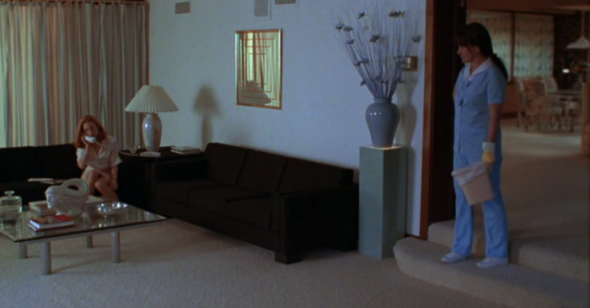
There are no scenes with Gianni in this episode, and none with the Versace family, either. What we see instead is the startling murder that appears to be a killer’s stepping-stone to full psychosis; and a lavender marriage that does not appear to be an outright sham, but merely unconventional. When Marilyn, away on business, calls the house and does not get an answer from her husband, it’s unusual enough for her to worry. When she gets back home, she finds an open, dripping ice-cream carton—chocolate-flavored, as much a visual contagion in their ivory-on-cream-on-alabaster space as the pair of gloomy couches in Todd Haynes’s Safe. It’s a sinister enough development to leave her rattled.
By the time the opening credits roll, she has been widowed, and we’ve guessed that Miglin is another victim of Versace’s killer, Andrew Cunanan; and we’ve guessed, too, how they knew each other. Marilyn says only, in the softest voice and to herself: “I knew it.” How much Marilyn Miglin really knew is never made apparent to us. What is made apparent is that Marilyn and Lee, whatever their dynamic, loved each other. How many men, she asks the TV camera, in a dynamite appearance on a shopping channel not long after Lee is killed, support their wives’ ambitions? How many men lift women up, instead of bring them down?
Conversely, it is never clear if Cunanan kills Miglin and exposes him because he thinks that Miglin is a hypocrite for being closeted, or because he thinks that homosexuality is shameful, something to be punished and reduced to ridicule. “I want you to know that when they find your body, you will be wearing ladies’ panties,” he hisses, “surrounded by gay porn. I want the world to see that the great Lee Miglin is a sissy.” Just after we see Cunanan beside the body, we cut to him carving, and then eating, some great hunk of red meat on the Miglins’ spotless kitchen table; it’s designed to make us think, if only for a second, that he’s actually eating Lee. The trope that a cannibal can eat a great man and absorb his powers seems tailor-made for a social-climbing sociopath who steals from every wealthy man he kills. (Think, too, of wendigos, the mythic demons in the shape of men who eat men, designed to represent the very ordinary human flaw of greed.) He is as guilty of the very Catholic sin of covetousness as he is of the legal crime of murder.
After Marilyn refers to the rumored death of the American dream—just days before the actual death of her husband—she is moved to issue a rebuttal: “Except—look at my husband, Lee. One of seven children. The son of an Illinois coal miner. He began his career selling premixed pancake batter out of the trunk of a beat-up old car. And today Lee manages 32 million square feet of commercial property across the Midwest.” The message is as clear and keenly bourgeois as a cut-glass punch bowl: rags are honorable, an inspiring plot-point, when they end in untold riches and acclaim. It was hardly accurate to say before that there had been no sign of the Versace family in this episode, when its themes of modest origins, of betterment and growth and the anointing power of lovely or expensive things, were the cornerstones of Gianni’s myth—“[originally] from a small village in Calabria overrun with poverty and corruption,” says a recent piece in Numero, “Gianni Versace built a destiny that was the complete opposite [of] his humble beginnings.”
It feels worth mentioning that the episode is called A Random Killing. I had thought at first that this referred to Marilyn’s description of her husband’s death as a random robbery—her defense against the knowledge or suspicion that he had in fact been killed by a man he’d solicited for sex. In fact, the random murder comes in the last five minutes of the show, when Cunanan escapes the scene and realizes he needs a new car. Pulling over and then following a man into a church, he leads him down into to the basement. After listening to him say, politely, that he has a wife and child, that he would very much like it, sir, if he could only see them again, the killer shoots him point-blank in the back of the skull. It is the ugliest and most indelible scene so far in a story filled with brutal, memorable vignettes of pain; and by the time we know what’s happening, it’s far too late to turn our heads away—to disengage.
The Assassination of Gianni Versace: More People Are Dead But the American Dream is Still Alive
Stills of Darren Criss and Cody Fern in episode 4 “House by the Lake” of The Assassination of Gianni Versace: American Crime Story (February 6th, 2018) | Source
 ACS news