isabellecampone: My friends often ask me what I do when I’m with Edouard on set… Here is the answer. I always bring work and books and things I have to catch up on. But at the end of the day it’s always the same, the computer stays in the bag and I spend the day watching. So many people working so many different and fascinating jobs, so much energy, it is still mesmerizing to me. I love so much watching movies being made… especially when @edouardholdener is playing and @mattbomer is directing. #acs#acsversace #youngandrew#hollywoodmom
It’s hard to believe that we are one week away until the finale of The Assassination of Gianni Versace: American Crime Story. And while it’s been one hell of a ride with one hell of an acting tour de force from Darren Criss as Andrew Cunanan, I must say that there are times that I wish the episodes had shared equal focus on both the leads of the show. For a program to be named after the famed designer, he hasn’t appeared much in it.
Luckily in this episode, both the men were featured as we have gotten to the very end of the flashbacks as far as the events leading up to Gianni’s death go. In the Matt Bomer directed episode and featuring an amazing turn by Jon Jon Briones, we finally got to meet Cunanan’s father, and it is safe to say that the apple did not fall far from the tree as far as behaviors go.
Gather round and let’s discuss the episode aptly titled “Creator/Destroyer”.
Daddy Dearest: Cunanan’s childhood, as it turned out, wasn’t as bad as one might have thought it to be, at first anyway. His dad worked for Merrill Lynch, talking his way into a highly coveted job with his professed work ethic and track record of upward mobility. Cunanan’s father also spoiled him terribly: the would-be killer got the master bedroom of the house and a car before he was even old enough to drive. His father constantly told him that he was better than anyone else, even though Andrew had siblings.
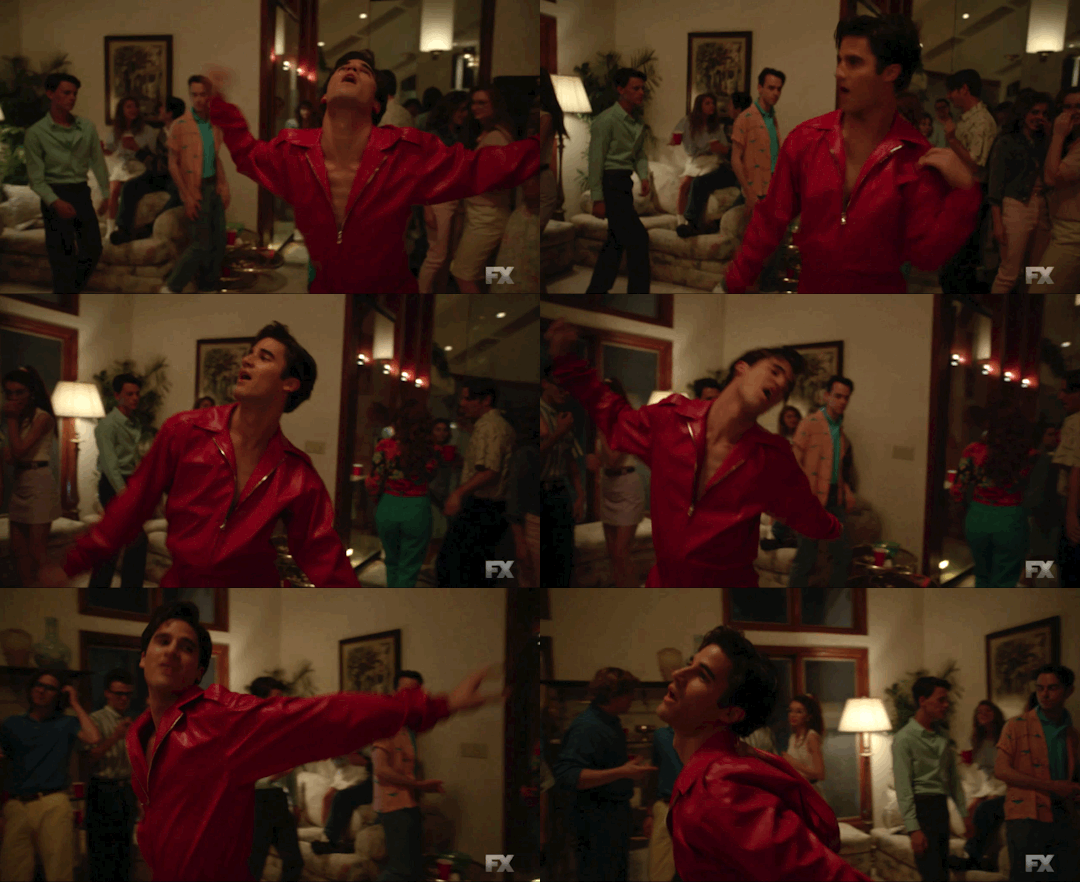
Life Of The Party: Cunanan’s luck doesn’t end at the house with his father either as he gets into a prestigious private school, where he’s voted “most likely to be remembered.” We also get to see how he meets Lizzie at a house party while spinning on the dance floor in a red, leather one-piece jumpsuit. This version of Cunanan isn’t quite the liar just yet; just a charmer who dated older men.
Two Worlds: We get one glimpse of Gianni Versace’s childhood, mostly as a means to contrast Cunanan’s. When Versace is sketching, and called a “pansy” in school, his mother comforts him and promises to teach him. “You must do what you love, Gianni,” she says. As for Cunanan, he doesn’t get that kind of love and support, especially when Cunanan tells his father he dreams of being a writer, his dad reminds him that writing isn’t an effective way to make money.
End Of A Fairytale: We then flash forward to see Modesto “Pete” Cunanan working not at Merrill Lynch, but in a cubicle, scamming the elderly out of their money. The FBI comes for him sooner than anyone might have expected as they pop up to his office, barely giving Modesto enough time to escape home, pry out some cash from underneath floorboards, and exit through a backdoor before flying away to Manila and leaving his family with nothing. They lose the house but Cunanan still believes in his father so he packs his case and leaves his mother to go to Manila alone to find his father, where he confronts him for his crimes. “Weak, like your mother,” Modesto tells him when Cunanan makes it to the shack where he has been living right before spitting in his face.
A Liar Is Born: When Cunanan returns home and gets a job at the pharmacy where we saw him at the beginning of last week’s episode, he’s a defeated person. That sense of utter rock bottom doesn’t last long as Cunanan tells his first lie, which gives him the idea that he can build his own future based on said lies. His yearbook quote was in French after all, and as it turned out, oddly prophetic: “After me, destruction.”
Quote of the night:
“You’re not upset that I stole; you’re upset that I stopped.” Modesto
Brett, Meredith, Brett and Alonso review the eighth episode of American Crime Stories second season about the assassination of Gianni Versace. | 15 March 2018
That’s the tragedy of “Creator/Destroyer,” the penultimate episode of this extraordinary season of television. By the time we see Andrew in his full glory as one of the wildest guys at his high school, we’ve also seen his father Modesto, who debuts in this episode, get his hooks deep into the kid. Andrew has seen his father harangue and assault his mother. He’s borne the weight of all his dad’s dreams, knowing this comes at the expense of his siblings, sensing on some level it’s not right to have this kind of pressure placed on him but, because the pressure is couched as praise, not knowing how to fight back. He’s been…well, the show is cagey on this, but saying he’s been molested by his father would not be out of bounds.
And even now, as an ebullient and confident teenager, he’s begun certain behavior patterns that will get him in trouble in the end: he has a sugar daddy, and he becomes fast friends with Lizzie, his future bestie, because she shows up at a high-school house party pretending to be a kid rather than the married adult she really is. (“I’m an impostor.” “All the best people are.”) He’s picking up little tidbits on how to deceive (including his go-to pseudonym, DeSilva, the name of the people who own the house where the party takes place) and why (because “when you feel special, success will follow” as his father teaches him).
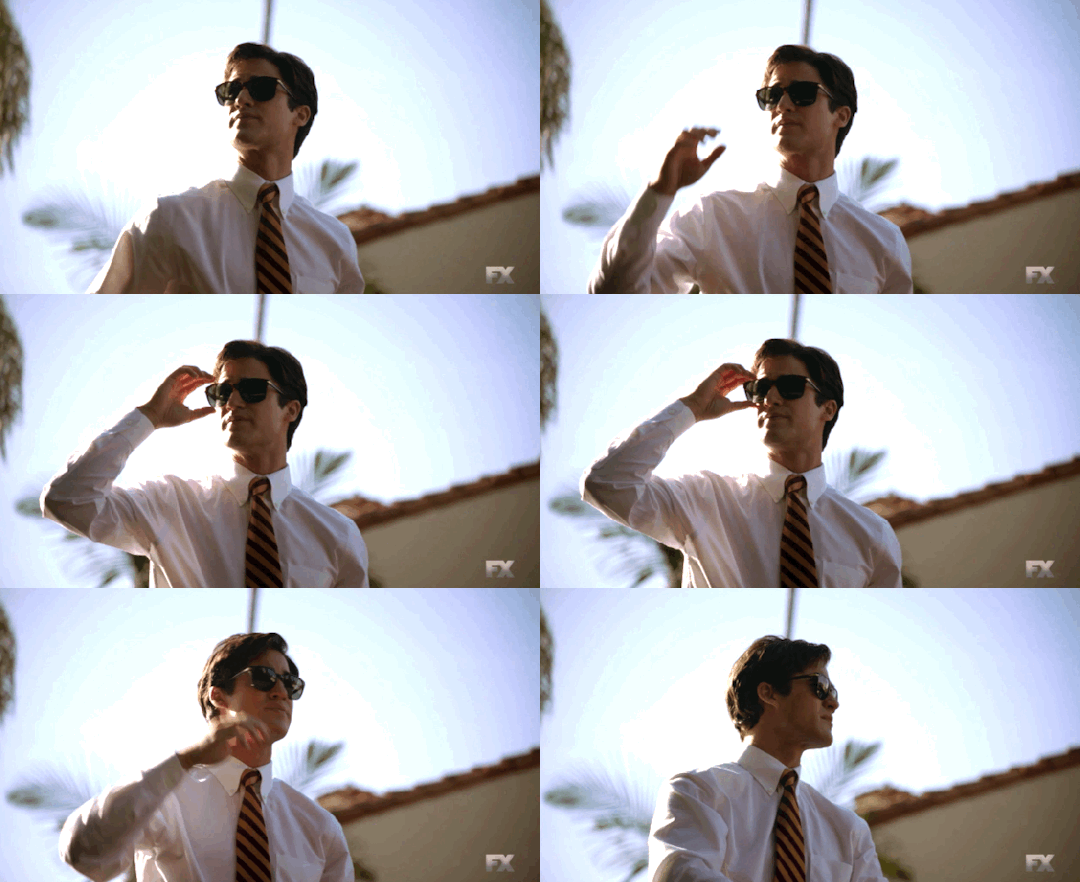
But for a brief time, he’s just a cool, slightly weird, slightly obnoxious, slightly closeted teenager, and if you weren’t at least two of those things during your high school career I don’t wanna know you. He stands up to homophobes in a familiar way, by camping it up even further, going so far as to pose for his class photo with his shirt all the way unbuttoned to show off his (impressive!) torso. He’s prophetically chosen to be “Most Likely to Be Remembered,” and equally prophetically selects “Après moi, le déluge” as his yearbook quote. He rolls into the parking lot like a refugee from Less Than Zero (complete with that movie’s soundtrack staple, the Bangles’ cover of “Hazy Shade of Winter”; the film was his IRL fave) and shows up at the house party in an Eddie Murphy red-leather jumpsuit. (Finally it’s clear why so many of his music cues over the course of the ‘90s portion of the series were anachronistically ’80s: The ’80s were his time.) This Andrew could be loved. This Andrew could be saved.
In that sense, Andrew’s not so far away from our episode-opening glimpse of Gianni Versace as a kid, though that’s the least successful segment of the episode, if not the whole season. This has been a bugbear of mine all season long, but for real: Anytime native Italian-speakers start talking to one another when there’s no one else around, those conversations scenes reallyshould take place in Italian. It’s next to impossible to feel a connection to young Gianni and his mother when they’re talking in absurdly accented English like they’re doing a nostalgic spaghetti-sauce commercial. The old-country lighting and color palette doesn’t help either, nor does the dialogue that Mama Versace and Young Gianni are forced to spout — an uplifting, after-school-special lesson about not letting bullies and homophobes and sexists stop you from pursuing your dreams, the importance of hard work, yadda yadda yadda.
Knowing this show, the excess schmaltz here is probably deliberate, intended to drive home the contrast between Gianni’s genuinely supportive mother, who instills in him the belief that effort, talent, and success are all interconnceted, with Andrew’s faux-supportive parents, who treat him like a god when they’re not terrifying him with pressure and spousal abuse and who brainwash him into believing that success is handed out to innately special people like a party favor. I get that, I appreciate that. But in a time when shows from The Americans to Narcos can spend half an episode or more using another language — or when shows like Game of Thrones shoot scenes in languages that are completely imaginary! — going with the “when the moon hits your eye like a big pizza-pie” approach displays a baffling lack of confidence in the audience. (This is the only episode where Tom Rob Smith shares the writing credit with another person, Maggie Cohn, and I wonder if that’s got something to do with it.)
Fortunately the show is on firmer ground with Andrew’s father. As Modesto “Pete” Cunanan, Jon Jon Briones faces the daunting task of airdropping into the series in its penultimate episode, in a role with no more or less responsibility than revealing the foundational traumas that turned Andrew Cunanan who and what he is. He makes it work so well that it starts to feel like he’s been there all along. He inhabits the era perfectly, for one thing: With his impeccable coiffed hair, double-breasted suits, tight-fitting leisure ware, and grown-ass-man mustache, he looks like every uncle in your family’s old faded photo album. He has a fireplug physicality and a crisp vocal cadence that can project confidence and dynamism one moment, then weirdness and menace the next. Frequently he’s called upon to shift between modes almost within a single sentence, as when he chokeslams Andrew’s mother Mary Ann to the ground and then immediately starts celebrating the purchase of his son’s new car once again.
And like many Horatio Alger cases, his belief in pulling himself up by his own bootstraps (as his superiors at Merrill Lynch put it) comes with undue contempt for those he considers weak. He brings up his childhood poverty in the Philippines as a talking point; he brings up Mary Ann’s postpartum depression and hospitalization as a weapon. Unsurprisingly for such a figure, at no time does he seem capable of addressing or even acknowledging his own weaknesses, his own pain. For one thing, he’s clearly experienced anti-Asian racism; that’s the unmistakable subtext of his interview with Merrill, where he’s the only candidate who isn’t white, as well as his relentless drive to assimilate and Americanize. It’s hinted at in the way he refers to his family home as a place his would-be employers could purchase with the cash in their wallets; when we finally see it, it’s not a mansion to be sure, but it’s no hellhole either. It’s a house, but it happens to be a house in a place other than America, which makes it a hovel in his eyes. He passes this self-hatred on to his son, who when asked by a relative in Manila if this is his “first time home” can’t even bring himself to respond. Only by concocting the legend of his father the pineapple magnate (plantations “as far as the eye can see,” he tells his Filipino boss at the pharmacy, for whom he holds nothing but contempt) can Andrew reconcile his heritage with his and his father’s hunger for the American dream.
Moreover, while Modesto’s justification for why the feds are out to bust him for theft but not his bosses — “They’re all stealing. My crime was that I stole too small…If I had stolen $100 million, they would have promoted me” — is pretty much completely accurate, it doesn’t explain why he left his family holding the bag. Watch him when he returns to his cubicle after learning his fraud has been uncovered: He grips the desk, grimaces, puts his head down for about two seconds, and by the time he raises it again he’s decided to buy tickets to Manila and abandon his wife and children. Not even his wall full of photos of Andrew (the style of which should look familiar at this point given all of his son’s similar shrines to Gianni Versace, and what does that tell you about this relationship) prevents him from telling his travel agent to book that flight.
I think there’s a moment that portrays the damage Modesto does to his son more clearly and powerfully than the car incident, than the bit where he pretends not to have gotten the job at Merrily Lynch and then berates Mary Ann for believing him, than his escape and exile, than his homophobic confrontation with his son when Andrew (in a rare and genuinely impressive display of hard work and emotional uncertainty) tracks him down in Manila, or even during the bedside scene that very heavily implies child molestation (implied again when, in ostensible reference to becoming reaccustomed to the Manila heat, he purrs to Andrew that “You can pretend you belong somewhere else, but the body knows”). And Modesto’s not even on screen for it at first.
In a scene that’s achingly familiar to any former young overachiever waiting for confirmation that they’ve gotten the thing they’re supposed to want, Andrew grabs the days mail directly from the postal worker and flips envelopes to the floor until he finds one from Bishop’s School, the prestigious secondary school Modesto has made it his life’s mission to get Andrew into. The next time we and his mother Mary Ann see him, he’s in tears. “Why are you crying?” Mary Ann asks, her toothy grin shaping the words. “You got in!”
Andrew is crying the way you might cry when you hear a certain test result came back negative, or receive word that your kid is alright after a bus accident. The pressure of being Modesto Cunan’s special son — so special that his father literally gets down and kisses his feet upon hearing the news — was slowly crushing him. Now that he’s made it, he’s sobbing from the decompression. What misery it must have been for him a few years later, then, when he realized he’d fought all his life to live up to a fraud. “I’m the world’s greatest opportunist,” his father once told him. We’ll see about that, Dad. We’ll see about that.
The Assassination of Gianni Versace: American Crime Story is known more so for its coverage of Andrew Cunanan than the man himself, but it also should be known for its utter disregard to anything and everything Italian.
As someone who grew up in an Italian household, Versace is a pretty big deal (especially since my mother works in fashion). So to see a show completely ignore the fact that he’s Italian and then not even bother using actual Italian in a scene set in Italy is pretty outrageous.
But don’t worry, the show goes back to covering Andrew shortly afterward because I’m 99 percent sure the only reason this show is a thing is because Ryan Murphy wanted Darren Criss to play Cunanan and didn’t care about Versace at all.
Week after week, it seems like the assassination is almost an afterthought. Which, it isn’t exactly surprising because Ryan Murphy tends to miss the point of what people want to see anyway. Remember Glee?
This week we got more of the backstory of Andrew and his “struggle” growing up as a gay man; we even got a house party scene where he danced to Michael Jackson. But again, I have to stress, who cares? I know that I wanted this show because of Gianni Versace, not because Darren Criss was aiming to win a Golden Globe (that I don’t think he’ll even get a nomination for).
Ryan Murphy continues to let me down, and I feel like this is college all over again where I’m trying to defend Glee to people. Maybe Ryan Murphy shouldn’t sell us a show about Versace if the show itself isn’t about Versace.
carlinjames917: Me and my crazy TV pops! Had to post in honor of his ridiculously captivating performance…and all of the comments i got on this awesome yellow sleeveless henley. 😂 • #ACSVersace #JonJonBriones #FX #TBT#ModestoCunanan #ActorsLife #Blessed#Actor #ThrowbackThursday #TheEighties
zedrickrestauro: Thanks @americancrimestoryfx for having me! I’ve been a guest actor on 13 TV shows, and these guys @mattbomer & @darrencrissare easily 2 of the nicest people I’ve met in the biz. I had a great time on this set, they were a great cast & crew! So grateful for this whole experience 🙏
edouardholdener: Now you finally got see Andrew’s childhood. How did you like yesterday’s episode? #americancrimestory #versace #fx





 ACS news

