‘ACS Versace’ Never Caught On Like ‘O.J.’, Because It Was After Something Darker

Ryan Murphy’s American Crime Story ended its second season on Wednesday night, bringing with it the conclusion to The Assassination of Gianni Versace. After a season’s worth of reverse chronology, the series snapped back to the aftermath of Versace’s death at the hands of Cunanan, followed his devastated family — including sister Donatella and lover Antonio — as they prepared to bury him, while also portraying the suddenly-urgent manhunt that (eventually) tracked Cunanan to the house boat he’d been hiding out on. Versace’s star studded funeral preceded Cunanan’s self-inflicted end, closing out the series on a rather operatic note.

So, not to paraphrase Aaron Sorkin to intentionally or anything, but: what kind of season has it been? Quantitatively, The Assassination of Gianni Versace has underperformed relative to the 2016 juggernaut The People vs. O.J. Simpson. This is true in both ratings and reviews. O.J. averaged 3.29 million viewers per episode, while Versace has averaged 1.09 mil; O.J. scored a 96 from Rotten Tomatoes and a 90 on Metacritic, while Versace did slightly worse at 86 and 74, respectively. Moreover, you can just feel it in the conversations, or lack thereof, in the media. The People vs. O.J. Simpson was a phenomenon. The nation was going through a national re-experiencing of the Simpson scandal, with a competing documentary on ESPN countless retrospectives. We followed every cigarette Sarah Paulson lit up as Marcia Clark, remembered every tertiary character as they crossed our screen, and stayed riveted even though we all knew how it would end. That treatment didn’t extend to The Assassination of Gianni Versace, and at least in this viewer’s opinion, it’s not because it was a major drop-off in quality.

Part of it we can chalk up to unavoidable factors. The murder of fashion designer Gianni Versace by serial killer Andrew Cunanan in the summer of 1997 was an infamous piece of tabloid news, but it didn’t come close to approaching the levels of notoriety that the O.J. Simpson trial got. That was a national soap opera that lasted well over a year and incorporated dozens of side characters who we all had tucked away in the recesses of our memories, ready for American Crime Story to unearth them. The Versace murder was not like that. We knew about the victim and the killer, and if you managed to read Maureen Orth’s book Vulgar Favors (upon which Murphy and writer Tom Rob Smith based Versace), you knew about a few more. But there were no Kato Kaelins or F. Lee Baileys or Mark Fuhrmans to be found. The People vs. O.J. Simpson was great because it tackled the racial, societal, media, and entertainment angles of the Simpson case and made us all re-examine it through new eyes. But it was popular, in large part, because it let the rapidly fracturing and fragmenting American audience re-experience something we had all watched together. That was not a card that the Versace series could play. (If anything, the closest we got to an O.J.-style sensation in the last year was the Harding/Kerrigan revival that accompanied I, Tonya.)

But I think part of it was also that Versace failed the expectation game for a lot of viewers. In tackling the Versace murder under his American Crime Story banner, Murphy unavoidably promised a certain level of over-the-top camp and kitschiness. For all of O.J.‘s raves and respect from the critical community, it still delivered winking scenes with the Kardashians and Connie Britton as Faye Resnick explaining the finer points of the Brentwood Hello. Versace seemed to be promising something similar just by virtue of its cast, including Glee‘s prep-school heartthrob going against type as Andrew Cunanan and out gay pop hunk Ricky Martin as Versace’s longtime beau. And by casting the role of Donatella — by far the campiest character in this story’s orbit — with Academy Award-winner Penelope Cruz, Murphy seemed to be tacitly promising something at least a little bit gaudy.

Viewers hoping for the operatic, quasi-campy version of The Assassination of Gianni Versace could probably have just watched the first and last episodes and have been satisfied. Those are the episodes that feel most like the kind of show people were expecting. The decadent Versace lifestyle, the soapy intrigue surrounding Donatella and Antonio’s prickly relationship, the did-they-or-didn’t-they recreations of an imagined past encounter between Versace and Cunanan, and ultimately Andrew Cunanan stalking around the perimeter of Gianni Versace’s gilded lifestyle and destroying everything in the process. Smash those two episodes together, watch them like a TV movie, let Penelope Cruz in mourning snatch all your wigs off, and you’ll be good.

But what made The Assassination of Gianni Versace such a special season of television was what came in between those first and last episodes. That was where Murphy and Smith stepped away from the glitz and glamour and celebrity and camp and peered into the darker recesses of Andrew Cunanan’s story. The story that they sketch out, sometimes via firsthand accounts, sometimes via speculation, ultimately tells a sinister but deeply grounded story about he corrosive effects of homophobia. How the closet shames and warps; how institutional homophobia silences gay victims and inadvertently abets their killers; how the twin prisons of masculinity and status can wreak havoc on so many lives. The story in these middle episodes pretty much set aside the likes of Penelope Cruz and Ricky Martin so they could tell a story about tortured soldiers, frightened sons, prideful widows, and, yes, the making of a murderer. The result was some of the most restrained work of Murphy’s prolific career. And maybe that was the problem.

You can’t know for sure, of course. Nobody sends in a signed affidavit to the network when they choose not to watch something. But when ratings for Versace began to dip much lower than O.J., I had to wonder about Ryan Murphy’s traditionally robust FX audiences. Whether they were happy to watch Murphy’s queer extravaganzas when they were put into the service of grotesque horror stories and dishy tabloid tales about actresses’ animosities, but backed away when he decided to shine a more sober spotlight on the cruel homophobia of the not-very-distant past. Happy to watch Finn Wittrock camp it up as a queer-coded killer but not as a victim of the Don’t Ask, Don’t Tell bureaucracy. Andrew Cunanan was a queer killer too, of course, but his killings offered no catharsis nor campy thrill. The killings were sad or brutal or unnecessarily cruel. O.J. Simpson got away with murder, but the circus was still pretty fun to watch. Not as much fun to be had here.

So, again, maybe Versace was never meant to catch fire in the culture the way that O.J. did. Maybe in an alternate universe, the Gianni-and-Donatella Fashion Hour told the story of the building of an empire that was cut down by a queer monster. By deciding to peel back the face of that queer monster and stare into the void inside, Murphy and Smith delivered a show that was much darker, though ironically no less illuminating, that the first American Crime Story season. Here’s hoping that with all the possibilities that suddenly lay before him, Ryan Murphy doesn’t take the relative quiet of season 2 as a reason to stay away from this kind of storytelling.

‘ACS Versace’ Never Caught On Like ‘O.J.’, Because It Was After Something Darker
‘The Assassination of Gianni Versace: American Crime Story’ Episode 8 Recap: Oh Father

Andrew Cunanan was cool.

Like, really cool.

image

Sincerely, legitimately awesome.

image

That’s the tragedy of “Creator/Destroyer,” the penultimate episode of this extraordinary season of television. By the time we see Andrew in his full glory as one of the wildest guys at his high school, we’ve also seen his father Modesto, who debuts in this episode, get his hooks deep into the kid. Andrew has seen his father harangue and assault his mother. He’s borne the weight of all his dad’s dreams, knowing this comes at the expense of his siblings, sensing on some level it’s not right to have this kind of pressure placed on him but, because the pressure is couched as praise, not knowing how to fight back. He’s been…well, the show is cagey on this, but saying he’s been molested by his father would not be out of bounds.

And even now, as an ebullient and confident teenager, he’s begun certain behavior patterns that will get him in trouble in the end: he has a sugar daddy, and he becomes fast friends with Lizzie, his future bestie, because she shows up at a high-school house party pretending to be a kid rather than the married adult she really is. (“I’m an impostor.” “All the best people are.”) He’s picking up little tidbits on how to deceive (including his go-to pseudonym, DeSilva, the name of the people who own the house where the party takes place) and why (because “when you feel special, success will follow” as his father teaches him).

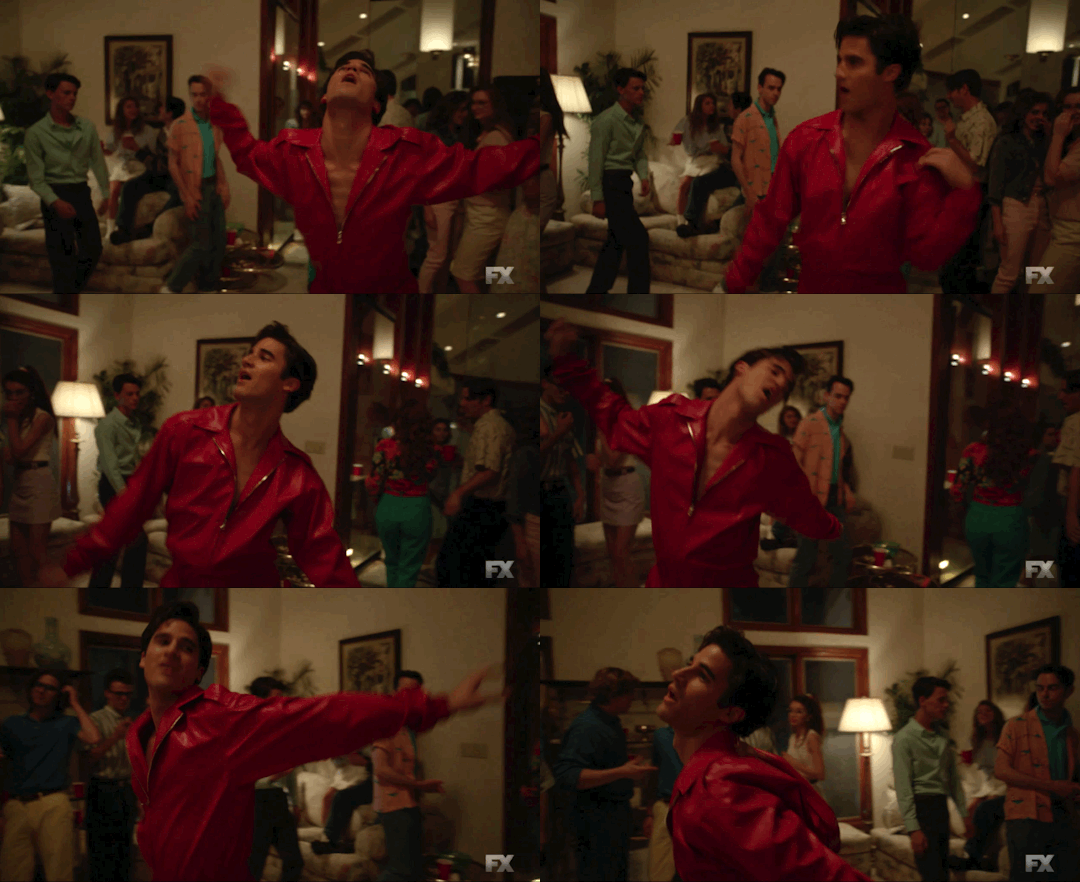
But for a brief time, he’s just a cool, slightly weird, slightly obnoxious, slightly closeted teenager, and if you weren’t at least two of those things during your high school career I don’t wanna know you. He stands up to homophobes in a familiar way, by camping it up even further, going so far as to pose for his class photo with his shirt all the way unbuttoned to show off his (impressive!) torso. He’s prophetically chosen to be “Most Likely to Be Remembered,” and equally prophetically selects “Après moi, le déluge” as his yearbook quote. He rolls into the parking lot like a refugee from Less Than Zero (complete with that movie’s soundtrack staple, the Bangles’ cover of “Hazy Shade of Winter”; the film was his IRL fave) and shows up at the house party in an Eddie Murphy red-leather jumpsuit. (Finally it’s clear why so many of his music cues over the course of the ‘90s portion of the series were anachronistically ’80s: The ’80s were his time.) This Andrew could be loved. This Andrew could be saved.

In that sense, Andrew’s not so far away from our episode-opening glimpse of Gianni Versace as a kid, though that’s the least successful segment of the episode, if not the whole season. This has been a bugbear of mine all season long, but for real: Anytime native Italian-speakers start talking to one another when there’s no one else around, those conversations scenes reallyshould take place in Italian. It’s next to impossible to feel a connection to young Gianni and his mother when they’re talking in absurdly accented English like they’re doing a nostalgic spaghetti-sauce commercial. The old-country lighting and color palette doesn’t help either, nor does the dialogue that Mama Versace and Young Gianni are forced to spout — an uplifting, after-school-special lesson about not letting bullies and homophobes and sexists stop you from pursuing your dreams, the importance of hard work, yadda yadda yadda.

Knowing this show, the excess schmaltz here is probably deliberate, intended to drive home the contrast between Gianni’s genuinely supportive mother, who instills in him the belief that effort, talent, and success are all interconnceted, with Andrew’s faux-supportive parents, who treat him like a god when they’re not terrifying him with pressure and spousal abuse and who brainwash him into believing that success is handed out to innately special people like a party favor. I get that, I appreciate that. But in a time when shows from The Americans to Narcos can spend half an episode or more using another language — or when shows like Game of Thrones shoot scenes in languages that are completely imaginary! — going with the “when the moon hits your eye like a big pizza-pie” approach displays a baffling lack of confidence in the audience. (This is the only episode where Tom Rob Smith shares the writing credit with another person, Maggie Cohn, and I wonder if that’s got something to do with it.)

Fortunately the show is on firmer ground with Andrew’s father. As Modesto “Pete” Cunanan, Jon Jon Briones faces the daunting task of airdropping into the series in its penultimate episode, in a role with no more or less responsibility than revealing the foundational traumas that turned Andrew Cunanan who and what he is. He makes it work so well that it starts to feel like he’s been there all along. He inhabits the era perfectly, for one thing: With his impeccable coiffed hair, double-breasted suits, tight-fitting leisure ware, and grown-ass-man mustache, he looks like every uncle in your family’s old faded photo album. He has a fireplug physicality and a crisp vocal cadence that can project confidence and dynamism one moment, then weirdness and menace the next. Frequently he’s called upon to shift between modes almost within a single sentence, as when he chokeslams Andrew’s mother Mary Ann to the ground and then immediately starts celebrating the purchase of his son’s new car once again.

And like many Horatio Alger cases, his belief in pulling himself up by his own bootstraps (as his superiors at Merrill Lynch put it) comes with undue contempt for those he considers weak. He brings up his childhood poverty in the Philippines as a talking point; he brings up Mary Ann’s postpartum depression and hospitalization as a weapon. Unsurprisingly for such a figure, at no time does he seem capable of addressing or even acknowledging his own weaknesses, his own pain. For one thing, he’s clearly experienced anti-Asian racism; that’s the unmistakable subtext of his interview with Merrill, where he’s the only candidate who isn’t white, as well as his relentless drive to assimilate and Americanize. It’s hinted at in the way he refers to his family home as a place his would-be employers could purchase with the cash in their wallets; when we finally see it, it’s not a mansion to be sure, but it’s no hellhole either. It’s a house, but it happens to be a house in a place other than America, which makes it a hovel in his eyes. He passes this self-hatred on to his son, who when asked by a relative in Manila if this is his “first time home” can’t even bring himself to respond. Only by concocting the legend of his father the pineapple magnate (plantations “as far as the eye can see,” he tells his Filipino boss at the pharmacy, for whom he holds nothing but contempt) can Andrew reconcile his heritage with his and his father’s hunger for the American dream.

Moreover, while Modesto’s justification for why the feds are out to bust him for theft but not his bosses — “They’re all stealing. My crime was that I stole too small…If I had stolen $100 million, they would have promoted me” — is pretty much completely accurate, it doesn’t explain why he left his family holding the bag. Watch him when he returns to his cubicle after learning his fraud has been uncovered: He grips the desk, grimaces, puts his head down for about two seconds, and by the time he raises it again he’s decided to buy tickets to Manila and abandon his wife and children. Not even his wall full of photos of Andrew (the style of which should look familiar at this point given all of his son’s similar shrines to Gianni Versace, and what does that tell you about this relationship) prevents him from telling his travel agent to book that flight.

I think there’s a moment that portrays the damage Modesto does to his son more clearly and powerfully than the car incident, than the bit where he pretends not to have gotten the job at Merrily Lynch and then berates Mary Ann for believing him, than his escape and exile, than his homophobic confrontation with his son when Andrew (in a rare and genuinely impressive display of hard work and emotional uncertainty) tracks him down in Manila, or even during the bedside scene that very heavily implies child molestation (implied again when, in ostensible reference to becoming reaccustomed to the Manila heat, he purrs to Andrew that “You can pretend you belong somewhere else, but the body knows”). And Modesto’s not even on screen for it at first.

In a scene that’s achingly familiar to any former young overachiever waiting for confirmation that they’ve gotten the thing they’re supposed to want, Andrew grabs the days mail directly from the postal worker and flips envelopes to the floor until he finds one from Bishop’s School, the prestigious secondary school Modesto has made it his life’s mission to get Andrew into. The next time we and his mother Mary Ann see him, he’s in tears. “Why are you crying?” Mary Ann asks, her toothy grin shaping the words. “You got in!”

Andrew is crying the way you might cry when you hear a certain test result came back negative, or receive word that your kid is alright after a bus accident. The pressure of being Modesto Cunan’s special son — so special that his father literally gets down and kisses his feet upon hearing the news — was slowly crushing him. Now that he’s made it, he’s sobbing from the decompression. What misery it must have been for him a few years later, then, when he realized he’d fought all his life to live up to a fraud. “I’m the world’s greatest opportunist,” his father once told him. We’ll see about that, Dad. We’ll see about that.

‘The Assassination of Gianni Versace: American Crime Story’ Episode 8 Recap: Oh Father

‘American Crime Story: Versace’ Had A Surprising ‘American Horror Story’ Vet Behind The Camera

There have been a lot of visually and emotionally beautiful episodes of The Assassination of Gianni Versace: American Crime Story, but few are more important than “Creator / Destroyer.” For hours and weeks now, the Ryan Murphyshow has explored the lives Andrew Cunanan has ruined, but in its final two episodes, the series has shifted its focus to finally land on the killer himself. At the center of this heartfelt and disturbing examination of a serial killer is Matt Bomer in his directorial debut.

Though Bomer is likely best known for portraying Neal Caffrey on White Collar, the Magic Mike and Chuck actor actually has a fairly long history working with Murphy. In 2014 he starred in HBO‘s The Normal Heart, a TV movie that followed a writer and activist as he sought to expose the truth about the emerging AIDs crisis. Bomer starred as Felix Turner, the love interest of Mark Ruffalo‘s Ned Weeks. However, his journey through Murphy’s many projects was far from over. Later that year Bomer starred as the prostitute Andy in American Horror Story: Freak Show, and the next year he made an extremely memorable appearance in American Horror Story: Hotel when he was raped to death by a demon with a drillbit dildo. Based on those appearances, you may assume that the Bomer-directed episode of American Crime Story would be just as flashy as those past roles. You would be wrong.

“Creator / Destroyer” is packed with disappointment, a theme the show has played with but has never really embraced until this point. The hour starts on a young Gianni Versace (Wolf Fleetwood-Ross) as he follows his seamstress mother around. During a particularly emotional moment, Gianni’s mother tells him that though she was told she could never pursue her dreams, things would be different for him. If he wants to learn how to sew, she will teach him.

The episode then jumps decades ahead into the future where it follows two other parents set on giving their child the world — Mary Ann (Joanna Adler) and Modesto (Jon Jon Briones) Cunanan. From Modesto commanding a young Andrew (Edouard Holdener) to say goodbye to his home to the tears our murderous protagonist sheds over getting into his dream school, the episode is immediately established to inspire failure. It lives up to those down-facing expectations time and time again. It’s not just Andrew (Darren Criss) who fails to live up to the pedestal of his parents’ expectations. At the end of the episode, Modesto is just as much of a failure in his son’s eyes.

These themes are wonderfully highlighted through Bomer’s direction. When the camera focuses on Mary Ann or Modesto’s tenser scenes, it’s more active, echoing their anxieties about barely achieving the aspirations they have for themselves. However, when the camera is on Andrew, its steady, sweeping angles are even more anxiety-inducing. When Modesto first shows his son the master bedroom that is destined to belong to him, there’s a sense of pride that’s not unlike when Mufasa first showed Simba everything that the light touches. However, we already know how this story ends. Everyone is going to be deeply disappointed.

That is nothing to say of the episode’s excellent use of color. In an interview with Nina Jacobson and Brad Simpson, the executive producers told Decider that using pinks was very important to the creative direction of the show. The warm color palette  was supposed to represent homosexuality and opulence while echoing the colors of Miami. In contrast, “Creator / Destroyer” dwells almost exclusively in radioactive greens and harsh, office-lit yellows. It’s a decidedly mundane and borderline gross-looking episode in an otherwise breathtakingly gorgeous show. And that’s the point.

For seven episodes now, The Assassination of Gianni Versace has hinted at this idea that Gianni Versace and Andrew Cunanan were never really so different. However, it’s “Creator / Destroyer” that quite literally spells out that relationship. Both men came from fairly humble beginnings. Both seemed to have loving parents who wanted what was best for them. Both were gay men during a time when that was still culturally taboo, and yet one man inspired joy, made art, and built an empire while the other took the lives of five innocent men. To fully understand the horrors of the Andrew Cunanan case, we have to eventually try to understand Andrew Cunanan. In Versace‘s second to last episode, Bomer has captured the frustration, disappointment, and shock attached to this historical figure in a way that’s emotional while capturing Murphy’s signature camp at just the right moments.

‘American Crime Story: Versace’ Had A Surprising ‘American Horror Story’ Vet Behind The Camera

‘The Assassination of Gianni Versace: American Crime Story’ Episode 7 Recap: Two of a Kind

“We must be talked about, or we are nothing.” —Donatella Versace, to the Versace staff

“For me, being told ‘no’ is like being told I don’t exist. It’s like I disappeared or something.” —Andrew Cunanan, to Jeff Trail

“Is this normal? Is this normal enough?” —Gianni Versace to his sister Donatella, on creating a less unique version ready-to-wear version of the haute couture dress they designed together for her

“It’s just a name they made up to sound special.” —Andrew Cunanan to his mother Mary Anne, on Häagen-Dazs ice cream

“It needs confidence.” “It gives confidence.” —Donatella and Gianni, on the dress

“So you can hold your own at a dinner table conversation.” “I am the dinner table conversation.” —an escort agency owner and Andrew Cunanan, on Andrew Cunanan

“I want the world to see you in a way that you have never been seen before.” —Gianni to Donatella

“Oh, if they could see me now.” “Who?” “Everyone.” —Andrew Cunanan to Norman Blachford

“This dress is not my legacy. You are.” —Gianni to Donatella

“He’s a good boy. He’s always been a good boy.” —Mary Anne on Andrew Cunanan

“Ascent,” the seventh episode of ACS Versace, is the one where my admiration for what writer Tom Rob Smith has accomplished with his scripts and structure for the series shifted into something approaching awe. Returning to the Versaces’ world of high fashion for the first time since Episode 2 (their appearance in Episode 5 centered on Gianni’s coming out, not their work as designers), it creates a series of parallels between the the artist and the man who would murder him that are all the more striking for how different they are in intention and affect.

When Donatella tells her employees “We must be talked about, or we are nothing,” it’s a demand that they raise their collective artistic bar, creating things that are bold and new. When Andrew tells his friend and future victim Jeff that rejection makes him feel like he doesn’t exist, it’s a cry for help that neither Jeff nor Andrew recognize as such — a sign that if who he is isn’t working, he’ll simply steal ideas from others to create a man who gets told “yes” instead of “no.”

And that’s exactly what he spends the episode doing. When his Filipino heritage costs him a job with an escort agent who cloaks anti-Asian racism in capitalist realism — she says her clients don’t want “Asians With Attitude,” then mocks his promise to work harder than all her other escorts with “this isn’t a sweatshop, sweetheart” — he rechristens himself Andrew DeSilva, Portugese-Italian-American. When he hears a beautiful story about promising to build a loved one in pain a house where they can be safe from his new flame David Madson, he claims the story for his own and repeats it almost verbatim to Norman Blachford, his latest rich older conquest. Donatella and Gianni busted their asses to shift the fashion paradigm; Andrew works just as hard to shift into whatever paradigm other men have already created for him.

“Andrew DeSilva,” meanwhile, echoes the Häagen-Dazs incident, in which Andrew throws the off-brand ice cream his mother bought for them to the floor rather than eat an inferior product, even though he knows every last detail of how the name “Häagen-Dazs” is a fugazi selected by the company’s Polish-Jewish immigrant founder to sound vaguely Danish (it doesn’t, but you can convince people it does), both in tribute to Denmark’s actions in protecting Jews during World War II and to sound like a high-end dairy product to American consumers.

His angry shout of “I WANT THE BEST!” when he destroys the cheaper ice cream (which his mother, heartbreakingly, eats off the floor without batting an eyelash) shows that he feels as strong about this as Gianni does about the integrity of his showstopping design when Donatella suggests making a simpler version to increase sales to women who are less bold about being “the center of attention.” “Well then this is not a dress for them!” he yells, in part because he’s angry, and in part because his illness has begun to affect his hearing to the point of near-deafness. (When he breaks down and cries after realizing he suddenly can no longer hear his sister and his partner Antonio talking to him, it’s a magisterially upsetting performance from Édgar Ramírez…as is Darren Criss‘s performance when Andrew breaks down after his mother covers for him when he shoves her into a wall and breaks her shoulder blade.)

Both men are obsessed with having the best, and suspicious of normies. But Gianni is intent on creating greatness himself; he resents the faking of greatness to please the masses. Andrew, by contrast, will happily accept fake greatness if that’s what it takes to separate him from the hoi polloi.

Here we reach the nature of their statements about how others see them and their loved ones. Andrew weasels his way into the life of millionaire Norman Blachford, encouraging him to move to San Diego, purchase a preposterous house, and let Andrew live in and decorate it with him. When he stands on the balcony he didn’t buy, he believes it’s his ticket to the place where, as he told his mom, “They all look up at us, and we look down on them.” The triumph and the resentment are inextricably linked. That’s a world apart from Gianni, who genuinely doesn’t care how other people feel about him. He simply wants to express himself and celebrate everything he finds wonderful about his sister — her talent, her intelligence, her drive, her looks, her power — so that others can celebrate it too.

Gianni isn’t kidding when he tells Donatella she is his legacy. She’s his muse, his business partner, his co-creator, and (as we see in an adorable anecdote about holding her on his shoulders so she could watch a performance) his kid sister. If, as it seemed at the time, he might succumb to his illness, this brilliant and beloved woman will take their shared name and make it her own, carrying his company into the future by transforming it into her company. To quote another great show about a killer, family is everything.

Andrew thinks so, too. He brings up his father in conversation constantly, but tells a different story every time. He dotes on his mother, when he’s not leaving her behind or berating her ice-cream purchases or shoving her across the room. In a very real way he’s his mother’s son: He has all of her desperate need to be needed, but unlike her he has the cunning and charisma to do something about it. And given how different things might have gone had she reported the true origin of the injury she sustained at his hands, she winds up being just as crucial to the Cunanan legacy as Donatella is to Versace’s.

There’s one more thing to say about this remarkable piece of work, once again directed with stately elegance by Gwyneth Horder-Payton; one last parallel to point out. This one doesn’t involve the Versaces. It involves Lincoln Aston, the real estate and oil mogul Andrew hooks up with the night he first tracked down and made a move on his intended target, Norman. (Norman had a business trip to make the next night, and Andrew decided to make the best of it.) It also involves a drifter Lincoln picks up at a gay bar and brings home, who then does this to him:

Andrew witnesses the attack, and the killer witnesses him, but neither wind up saying anything about their encounter to the police after the killer flees and turns himself in. There’s a potentially obvious reason for that: the encounter most likely never happened, and it’s an invention of the show that rhymes the macabre coincidence of Aston’s murder by a stranger with the similar bludgeoning death Andrew inflicted on Jeff Trail years later.

But ACS Versace only invents when all the parts are right there in front of them. We spend the entire episode using the resonating frequencies of Andrew and the Versaces to illustrate how Andrew would do anything to be noticed, admired, loved, remembered, special; how fury kicks in when he isn’t; how he’ll lie, cheat, and steal ideas and identities to ensure his success. Why wouldn’t his career as a murderer require a little outside inspiration, just like everything else he does?
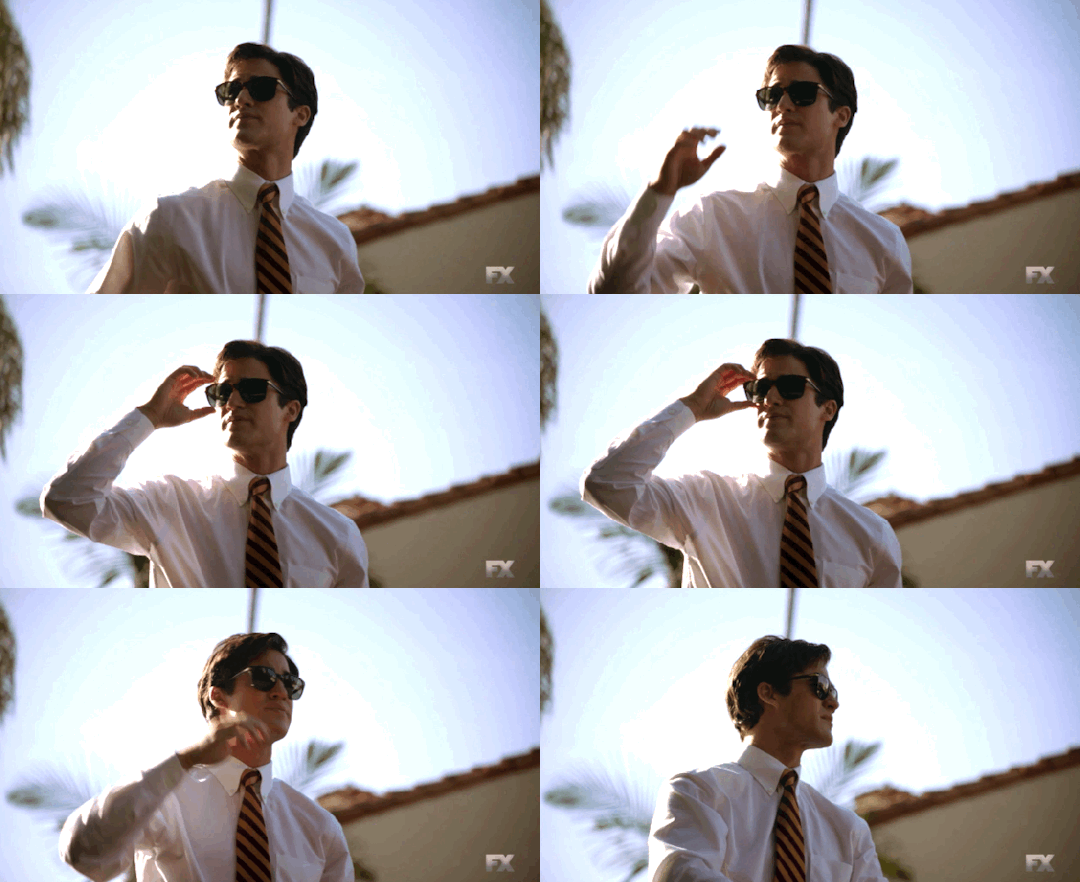
Which brings us to the final parallel, a callback to an event that hasn’t even happened yet. The ambition, the ego, the anger, the chameleonic ability this episode portrays — they’re what transforms this…

image

…into this.

image

‘The Assassination of Gianni Versace: American Crime Story’ Episode 7 Recap: Two of a Kind

‘The Assassination of Gianni Versace: American Crime Story’ Episode 6 Recap: Somebody to Love

“He’s a house. He’s a home. He’s a yard and a family and picking kids up from school…he’s a future.”

“They say this man…this man has nothing left to give. And a man with nothing to give is a nothing man….This world has wasted me.”

Ominously directed by Gwyneth Horder-Payton and featuring absolutely stunning dialogue from series writer Tom Rob Smith, “Descent,” the sixth episode of The Assassination of Gianni Versace: American Crime Story, is the first and only episode so far to steer entirely clear of murder and its aftermath. Yet somewhere between those two statements above — the first is a description of his beloved David Madsen to his friend Lizzie, the second a description of himself to a meth-induced nightmare vision of Gianni Versace — Andrew Cunanan dies. The old Andrew, anyway, the Andrew capable of warmth and charm and moments of honesty amid the lies. It’s not hard to identify the specific spark of vitality that gets snuffed out to make his dark rebirth into the new, lethal Andrew happen, either. When his hope dies, the old Andrew dies with it.

“Descent” depicts some of the final normal, happy moments of Andrew’s life, or at least as normal and happy as Andrew’s life ever really gets. In splendid fashion, it introduces us first to the high-rolling luxury lifestyle afforded him by his status as the live-in designer/decorator/boyfriend of his wealthy benefactor Norman Blachford (Michael Nouri, dignified and excellent), then to Norman himself, on the eve of a lavish birthday party being thrown in Andrew’s honor. There’s even a return to the slightly fisheyed lens that captured the Versace palace in Miami during the cold open of the premiere, a visual indicator of splendor that’s almost too big to be contained by the camera. At this point Cunanan is living like an idle member of a wealthy Game of Thrones house, lounging naked on the balcony before swimming naked in the pool while Laura Branigan’s shit-hot single “Self Control” gives him an air of anachronistic ’80s cool.

But even if this cold open doesn’t end with a murder the way the first episode’s did, it does end with this stark reminder of the horror soon to come.

How do we get there from here? A combination of factors. Like the dark clouds that loom in the background of the otherwise perfect party in the hills (a weather detail Horder-Payton makes subtle but stunning use of), trouble is brewing in paradise. Andrew is beginning to drive away his friend Jeff Trail with his constant embellishments and lies; in this case, they involve dummying up a fancy fake gift for Jeff to present him as a present in lieu of a real one, just so he looks better in front of David Madson, the would-be love of his life and the unwitting guest of honor at the party.

Andrew also forces Jeff into the painful position of pretending to still be an officer in the Navy, a wound you can see is still very raw with him. (“It just sounds so impressive.” “I know it does.” Oof.) “I just need him to see that I’m loved,” Andrew tells Jeff as he presents him the ringer gift. “I do love you, buddy!” Jeff says, attempting both to reassure Andrew that this is true and, it seems, reassure himself that Andrew deserves it.

This is a fixation for Cunanan, and not one he simply cites while forcing friends to be complicit in his lies. He’s more open and direct about it with Lizzie, when she asks him point blank “Who are you trying to be?” “Someone he can love,” he replies. The sadness here is deep enough to fill an in-ground pool. In his own weird way, he’s reaching out desperately for genuine affection. You can’t help but wonder if, had he been more genuine himself, he would have gotten it.

Meanwhile, Andrew’s relationship with Norman is beginning to sour, even relative to its already transactional nature. Smitten as he is with David, Andrew can’t help but become more obvious about his lack of interest in Norman and his attempt to woo his other man. Norman’s friend David Gallo (SNL vet Terry Sweeney, thoroughly delightful here) is a true queen of thorns, and he’s got Andrew’s number from the jump. The two men exchange catty, cutting insults like an antagonistic pair of characters in a sitcom, but it takes a turn for the serious when Gallo corners Andrew outside the bathroom where he’s just gotten high. Norman, Gallo says, built a company from scratch, then reeled with grief after watching his previous, more serious partner waste away and die from AIDS, a horror he feels Andrew couldn’t possibly comprehend. Gallo himself sounds like he’d rather die than see his friend hurt again, an innate core of decency that shines through all the Wildean put-downs and bon mots. “That room,” Andrew says as he withdraws from the confrontation, “is full of people who love me.” “Then that room is full of people who don’t know you,” Gallo calls after him.

And what does Andrew do after fleeing his enemy’s brutal read? He runs interference between David and Jeff, two people he ostensibly cares about, because he sees they’re hitting it off. There’s a great bit where Andrew cockblocks by mentioning Jeff’s boyfriend, who may or may not actually exists. “Is he still working at that mall?” he says with false good cheer. Without missing a beat, Jeff replies “…he works for a living, yes.” It’s not clear if Andrew, whom Gallo says is “too lazy to work, too proud to be kept,” realizes he’s just been insulted again. He then blows off none other than Lee Miglin, whose presence at the party makes it more difficult for Andrew to make his move on David. Finally he stages a photo op with Norman, Lee, David, and Jeff — “All the people I love!” Gallo was right, man. Gallo was right about all of it.

Anyway, at some point after the party Andrew presents Norman with a preposterous list of demands if he is to continue gracing the older man with his presence. Norman, firmly but not unkindly, replies by revealing that he knows everything Andrew has told him about his life, including his last name, is a lie. “You investigated me?” Andrew says indigantly. “Youinvestigated me,” Norman replies. He understands that Cunanan researched and targeted him to gain access to his wealth. The thing is, he doesn’t even really care! He cares more about the lies (“I already have a PhD.” “You do not have a PhD!”), the laziness (“What is it about having an education and the idea of work that you find so insulting?”), and the squandered potential (“Being smart is useless unless it’s in the service of something.”). So, despite his affection and admiration for Andrew, which is sincere despite it all, he breaks things off. In response, Andrew breaks a glass table. Violence is starting to creep in around the edges.

It bleeds through more strongly when Jeff comes to see Andrew in his new, barren apartment, furious that Cunanan sent a postcard to his parents’ house that nearly outed him. “How funny,” Andrew replies with a sneer. Jeff slams him up against a wall, ordering him to stay away from his family; “I never thought that you were capable of being violent,” Cunanan replies with self-righteous shock. But when he hears Jeff is moving to Minneapolis for a job David hooked him up with, his own command that Jeff stay away from David has the unmistakable tinge of violence to it as well. Andrew’s last-ditch attempt to spark something with David by blowing all his credit on an absurdly lavish hotel weekend, where even his attempts to be honest about his upbringing sound, sadly, like utter horseshit, is not enough to convince David that Andrew’s marriage material.

Then come the drugs — serious, shooting-up drugs — the hallucinations about Versace as a man who just got lucky while Andrew didn’t, and a scene straight out of Less Than Zero (the real-life Andrew’s favorite movie) in which he stumbles, fucked-up and desperate, through the hills and onto Norman’s estate, pounding on the glass door and begging for help as his ex calls the cops on him. Things are literally going downhill. That’s the difference between Versace and Andrew, according to the dream-Gianni: “I’m loved.” Andrew is not.

The episode ends where, perhaps, it has to: at Andrew’s mother’s place. She’s the one person who will always love him, in her own revolting way, but it’s love he doesn’t want, can barely stand. It’s painful to watch as she treats him like a child, sexualizes her care for him, uses his fake success in the costume-design industry as a cudgel with which to beat frienemies she resents, expresses horror at his assertion that he’ll never have children. She bathes him like baby, the inverse of his nude solo pool swim.

He leaves for his final rendezvous with Jeff and David the next day. His voice as he says “Goodbye, Mom,” is not harsh, but it’s hopeless. And what rough beast, its hour come round at last, slouches toward Minneapolis to be born?

‘The Assassination of Gianni Versace: American Crime Story’ Episode 6 Recap: Somebody to Love

Who Was Andrew Cunanan’s Former Lover? Your Guide To ‘The Assassination Of Gianni Versace’ Episode 6

It was almost nice that The Assassination of Gianni Versace: American Crime Story took last week off. After the one-two punch that was “House by the Lake” and “Don’t Ask, Don’t Tell”, audiences probably needed some time to emotionally recover from the series. However, rest time is over, and FX’s bleak, soulful, and murderous crime drama is back; from now on, things are getting more personal than ever.

Whereas the first half of the Versace season of American Crime Story focused almost exclusively on exploring Andrew Cunanan‘s five tragic victims, the second half is primarily about Cunanan. The source material for this series, Maureen Orth’s Vulgar Favors, devotes many chapters to Cunanan’s early life, influences, and mistakes, and American Crime Story is no different, starting with Episode 6, “Descent.” Consider this your fact-filled guide to the new and old characters introduced in this episode as well as any other lingering questions you may have.

Who was Norman, Andrew Cunanan’s former lover?

The main drama in “Descent” revolves around a previously unknown older man named Norman. That would be Norman Blachford, a conservative retired millionaire who made his fortune on sound-abatement equipment and knew Cunanan while he was in his 60s. They were presumably in a relationship together and discussed by the media a fair amount. According to Maureen Orth’s article about the Cunanan case for Vanity Fair, “The Killer’s Trail”, Blachford reportedly gave Cunanan $2,000 a month as well as a 1996 Infiniti I30T. The pair would travel around the world, and they also joined Gamma Mu, a private fraternity of “very rich, mostly Republican, and often closeted gay men.”

It was allegedly Cunanan who convinced Blachford to sell his home in Scottsdale Ariz., to buy a mansion in La Jolla, which is where “Descent” primarily takes place. The two had broken up by September of 1996. According to Orth, the relationship between David Madson, Jeff Trail, and Andrew Cunanan had also become strained during this time.

Who plays Norman Blachford?

That would be Michael Nouri. He’s perhaps best known for his roles in The Hidden, Flashdance, and The Terminal.

Who was the disapproving man at Cunanan’s birthday party?

While Andrew (Darren Criss) runs around his birthday party attempting to make David Madson jealous, The Assassination of Gianni Versace presents a guest who calls out Cunanan for the liar he is on multiple occasions. This man doesn’t seem to have a direct doppelgänger. However, he does echo the concerns some acquaintances had about Blackford and Cunanan’s relationship.

In the Orth article, one man described Cunanan as “sad on two levels: He’s got a lot going for him, I thought. He doesn’t need all this sham.… He was also a young man ultimately with no career ambitions in any direction. He pretty much said he was interested in older men for their financial situations. He made no bones about that, and he would say it in front of Norman.”

Who is Elizabeth Cote, Andrew Cunanan’s friend?

Cunanan and Cote knew each other from junior high school. Later after Cote got married and had a daughter, the young couple took Cunanan in as his sort of “patrons.” Cunanan was the godfather of Cote’s daughter, and he would often lie about her, saying that she was his ex-wife.

Who plays Elizabeth Cote?

That would be Annaleigh Ashford. She’s perhaps best known for playing Betty DiMello in Masters of Sex, but she also starred in the TV movie version of The Rocky Horror Picture Show.

What was Andrew Cunanan’s relationship with his parents like?

It was complicated to say the least. Cunanan was born to Modesto “Pete” Cunanan and Mary Anne Schillaci, and though he was the youngest of the couple’s four children, by all accounts he was spoiled by them. He would often lie about his family’s financial status, making up grandiose stories about their wealth so he could better fit in with his peers at The Bishop’s School.

Most chillingly, Orth revealed that Cunanan was violent to his mother on at least one occasion. In the Vanity Fair piece, she writes, “But it didn’t take long for neighbors to reveal to me that Andrew had once slammed his mother against a wall so hard that he dislocated her shoulder.”

Who plays Andrew Cunanan’s mom?

You can thank Joanna Adler for that chilling performance. Adler is perhaps best known for her role as Detective Farmer on The Sinner and as Young Kaplan on The Blacklist.

Who Was Andrew Cunanan’s Former Lover? Your Guide To ‘The Assassination Of Gianni Versace’ Episode 6

Looking Back On ‘American Horror Story’s School Shooting Episode

[…]

Likewise, American Crime Story has created a whole critically-praised brand for taking exploitative stories and turning them into powerful and reflective works of art. The O.J. case was one of the most overly covered and circus-like trials in American history, but under the hand of Murphy’s team, The People v. O.J. Simpson: American Crime Story stands as a thoughtful and sad reflection about the clash of racism, sexism, and the power of celebrity in America. The currently running Versace season of American Crime Story is an even better example of the creator’s contextualizing gift. Over the course of a handful of episodes, The Assassination of Gianni Versace has transformed Andrew Cunanan’s victims from forgotten names in an article to fully fleshed out, tragic victims taken before their time. “Don’t Ask Don’t Tell” took Jeff Trail, a murdered man whose death was largely ignored, and portrayed him as an outstanding naval hero. “House by the Lake”, the series’ episode on the death of David Madson, may be one of the saddest and most emotionally charged episodes of the year.

There have been many projects for Murphy and many years between the first season of American Horror Story and the Versace season of American Crime Story. When American Horror Story first premiered, Murphy was still only really known for Nip/Tuck and Glee. He wasn’t known as a horror-focused creator at all, so it wouldn’t be surprising if he and his team felt like they had to be as shocking as possible to cement the anthology series’ place on television. It’s more difficult to overlook the misstep of Glee, a show known for painting a candy coating on even the deepest of issues. Glee‘s attempt to address the complicated emotions of Sandy Hook was too much, too soon. Of course Murphy wasn’t totally new to the game when either AHS or the Glee episode dropped; but his previous projects erred on the side of shocking broadness, instead of real depth. Murphy is nearly a decade older now, wiser, and with more seasons of television under his belt. Add in that he, and others on his team, have had time to understand the impact of the O.J. case, Andrew Cunanan’s murders, and — unfortunately — the repeated cost of mass shootings, and you start to see why more recent Murphy projects have a more nuanced approached than Tate’s skull-faced attack.

There may be a way to depict school shooting on television. These stories are part of our societal narrative, whether we like them or not, and depicting the horrors of the world is something that art should do. As proven by the American Crime Story franchise, there’s even a chance that Murphy can be the creator to figure out this complicated and somber topic successfully. But at the moment, arguably one of the best remembered examples of school shootings in modern TV history still falls short.

Looking Back On ‘American Horror Story’s School Shooting Episode

‘The Assassination of Gianni Versace: American Crime Story’ Episode 3 Recap: A Death in the Family

I caught the flu the day this episode of The Assassination of Gianni Versace aired. In the (almost) a week it’s taken me to write this review, I’ve (almost) gotten over the illness. I have not gotten over the episode.

Journey back in time to the third and fourth slayings in Andrew Cunanan’s five-person killing spree, “A Random Killing” bears a half-truth as a title. Victim number four was random indeed, needlessly slain for his truck after a careless leak tipped Andrew off that his stolen car was being tracked. The need felt by victim number five’s surviving loved ones to paint his murder, too, as random — and Andrew’s need to make this impossible for them to do — is the crux of the story. The resulting hour is as menacing, as moving, as good as live-action drama about murder can get.

Any discussion of this extraordinary episode of television must begin with the casting of its two new principals, millionaire Chicago real estate developer Lee Miglin and his beauty-queen turned home-shopping entrepreneur wife Marilyn. Hiring Mike Farrell, M*A*S*H‘s B.J. Hunnicutt, and Judith Light, Who’s the Boss‘s “Angeluhhh,” isn’t quite the stunt showrunner Ryan Murphy pulled off when, say, he made John Travolta and David Schwimmer part of Cuba Gooding Jr.’s defense team and made a masterpiece out of the result. For one thing, the career peaks that trio were hitting around the time of the actual O.J. Simpson case added to The People v. O.J.‘s ’90s-retro frisson. For another, Farrell lacks the “hey, it’s that guy!” cachet held by the others for today’s viewers, while on the other hand, shows from Law & Order: Special Victims Unit to Transparent have given Light ample opportunity to show off her dramatic chops.

What matters, then, isn’t merely the fact that famous faces animate both Andrew Cunanan’s closeted client and target and that target’s determined yet devastated widow. What matters is what those faces do, and the remarkable degree to which writer Tom Rob Smith and directer Gwyneth Horder-Payton allow them to do it.

As Lee, Farrell is revelatory, his kindly face registering a heartbreakingly familiar range of emotions. Pride in his wife’s accomplishments and gratitude for her pride in his. Coldness at the prospect of actual physical intimacy with her but comfort and relief for her continued friendship. The agonizing, eroticized decision to lie to her and allow her to make a business trip without him so he can arrange a liaison with his young escort lover. (His strange, hard-to-watch mini-breakdown when she asks him to join her and he realizes he’s going to refuse is just unbelievably strong work.) The unshakeable religious guilt he feels as an older Catholic man keeping his orientation in the closet, a pain akin to a chronic illness. (“I try,” he whimpers to Jesus and Joseph in his private basement chapel. “I…try…”)

Puppydog enthusiasm for Andrew’s presence and affection, so strong that not even Cunanan’s sour sarcasm and cruelty about the transactional nature of their relationship can truly dampen it. (“I feel alive! You make it seem so real!”) Genuine, almost childlike love of architecture, particularly his world’s-largest-building dream project and his vision of anonymously hanging around on the observation deck, enjoying others’ enjoyment of the results.

It’s this last bit more than anything else that triggers Andrew’s homicidal rage, not that it would take much at this point at any rate; Andrew actually holds his gun on Lee behind the man’s back, just to feel the power he imagines Lee feeling. “I want it to inspire people to reach up,” Lee says of his “Sky Needle.” “It’s about that, not about me.” To Andrew, the very idea that any achievement is not about the immediate glory of the person responsible for it, much less the tallest building in the word, is a heresy of the highest order, and must be punished as such.

So Andrew drags his aroused, oblivious partner into the garage, tools arrayed ominously in the background, and debuts the face-tape routine we remember from the previous episode’s “Easy Lover” sequence. “You like being pathetic, don’t you?” he sneers, before showing Lee how truly helpless he is by suddenly smashing his face in. By now that marvelously expressive face is totally obscured by the tape, so we are only left to imagine the horror, panic, and pain in his eyes by cross-referencing it with his muffled whimpers — worse, perhaps, than seeing it straight up. As Lee lies there, Andrew announces that he’s killed two people already, he’ll stage his soon-to-be corpse with women’s underwear and gay porn, outing him through the act of murder. “You know, disgrace isn’t that bad, once you settle into it,” he says, before lugging over a bag of concrete mix, staving in the man’s chest, and then stabbing him repeatedly. To add insult to this fatal injury, Andrew uses Lee’s beloved blueprints as a placemat for a meal of meat before burning them up. No dreams get out of here alive.

Farrell’s role is interactional, emerging from conversations with his wife, his killer, and his God. It’s a dialogue. Light’s Marilyn is a monologue. She’s constantly speaking to other people, to be sure — to more of them than Lee, in fact. She’s got an television audience for her home-shopping show, a live crowd for her speech introducing her husband at a fundraiser where she touts him as the embodiment of the American Dream, a host of neighbors and cops with whom she must interact as they first discover and then investigate the crime. She even has a son, on hand as glum-faced comic relief when she touts his ostensibly burgeoning acting career. (“He plays a pilot!” “A Russian pilot. There’s lots of pilots in the movie.”)

But except in the few intimate moments she shares with Lee — and even then she’s arguably more focused on her behind-the-scenes suspicions than the here and now — Marilyn’s main task is the Sisyphean labor of maintaining outward appearances. She’s not shy about this, either. “How can a woman who cares so much about appearances appear not to care?” she rhetorically asks at one point, when she realizes her lack of visible signs of grief must be apparent to others.

What makes this character, and Light’s performance, so crushing is the opposite of what you’d expect, though. It’s not that she’s a perfectly put-together Woman With It All who’s trying to cover up her husband’s homosexuality by any means necessary — the kind of part Light, with her severe facial structure and stentorian voice, could play in her sleep. It’s that she’s trying to reveal the real bond she had with this man, despite what she knows to be true and cannot say — a bond that Cunanan’s actions have made it harder and harder for her to get other people to believe in. She finally breaks down not when confronted with evidence of Lee and Andrew’s preexisting relationship, contra to her preferred narrative of a break-in and burglary, but when she starts telling a cop about the “adventures” they had together back in the day, all hot-air balloon rides and romantic desert rescues. “I loved him,” she sobs, starting to smear her makeup. “I loved him very much! There. Is that betterrrr?” Her bitterness stretches out that terminal -r like she’s ripping flesh from a carcass. “Am I a real wife now?” Her pain isn’t over the lie, it’s over what was true. During the harrowing opening sequence, when Marilyn returns home from her trip and realizes something is amiss when Lee fails to pick her up from the airport, that truth is what haunts her face the whole time.

I’m glad, in that beautiful terrible way tragedy can make you glad, that she gets the last word of the episode, even as Andrew continues shopping and driving and killing on the way to his appointment in Miami. (Cunanan misses the chance to carjack and older woman and winds up hunting down and shooting truck-driving family man William R. Reese instead, pulling the trigger almost as soon as the frightened father tries to turn his assailant’s heart by saying he’s a married man with a son. He had no way of knowing how little Andrew wanted to hear that particular song. With a taste for killing in his mouth, he’ll destroy stability on sight.)

Marilyn returns to her gig hawking her signature line of fragrances on the home shopping channel almost immediately — a gutsy move with which the show challenges us to continue to feel empathy for her as she slips into the uncanny valley between sincerity and showmanship, just as the mere presence of any older woman with a glamorous background triggers our societally induced suspicion and revulsion at female failure to remain young. “He believed in me,” she tells her audience, completely honestly. “How many husbands believe in their wive’s dreams? How many treat us as partners? As equals? We were a team for thirty-eight years.” That’s what they were, even if it’s all they were. That’s an achievement. That’s what Andrew destroyed.

Marilyn ends the episode by recounting the advice she got when she first began selling stuff on TV, a technique for connecting with the camera and the people on the other side. “Just hink of the little red light as the man you love.” She stares at the light, at the camera, at us, and as the impenetrable black mascara of her wet eyes closes and the scene cuts to black, her thoughts are ours to imagine.

‘The Assassination of Gianni Versace: American Crime Story’ Episode 3 Recap: A Death in the Family

‘The Assassination of Gianni Versace: American Crime Story’ Episode 5 Recap: Navy Blue

“Don’t Ask, Don’t Tell” may not hit the tear-down-the-sky heights of the previous two episodes of The Assassination of Gianni Versace: American Crime Story, but simply not feeling like a letdown after those two magnificent hours is itself a victory. The grim tale of how the dehumanizing Clinton-era policy on gays in the military destroyed Jeff Trail’s dreams and helped place him in Cunanan’s crosshairs isn’t as stomach-churningly chilling and sad as the show’s depiction of the last hours of Lee Miglin and David Madson, to be sure. But the stakes wind up being just as high, as is the cost in wasted human potential and life.

“DADT” is one of the most temporally complex episodes of the series so far, bouncing back and forth in time and between protagonists. In out-of-order fashion, it traces the life of Jeff Trail from the waning days of his career in the military through the night he first meets Andrew to the hours after his murder, with special attention paid to his and David’s interactions with Cunanan in the days leading up to their killings. (Andrew has a blowout fight with Jeff and has his marriage proposal rejected by David. There’s also a polka bar.) Meanwhile, a side plot chronicles Gianni Versace’s decision to come out as gay in the press, with the support of his partner and to the chagrin of his sister.

But with Andrew himself pushed mostly to the margins and no threat of new murders hanging over our heads, it falls to Finn Wittrock to carry the weight of the episode as Jeff, investing the story of how institutionalized homophobia helped lead to his death with the same sense of tragedy and intensity as a serial-killer narrative. It’s a testament to his note-perfect casting — he simply has the exact physical and psychological mien of a military man, from the cadence of his voice to the way he walks around in his nondescript civvies — that he pulls it off.

With Wittrock’s Jeff as the bedrock, a thematic layering emerges that’s even more impressive than the time-shifting storyline. Throughout the episode, Jeff is painted as a parallel figure to both his eventual killer and his killer’s most famous victim. The comparison with Versace is as direct as possible: Writer Tom Rob Smith structures the episode by juxtaposing Gianni’s triumphant coming-out interview with the Advocate with Jeff’s anonymous, silhouetted testimonial in a CBS News special about closeted soldiers and sailors. Both interviews take place in hotels, though Versace’s is in the Ritz Carlton while Trail’s is in a seedy motel. Both men are also shown talking with their clearly beloved sisters, each of whom is deeply concerned about her respective brother. Donatella advises Gianni not to go through with the Advocate profile (I do wish they’d speak Italian with subtitles in their scenes together — trust your audience, Ryan Murphy! — but whatever), while Jeff’s very pregnant sister, herself career military, jokingly issues “a direct order as your commanding officer” for him to finally come out to their parents years after the recording session.

Jeff and Gianni’s fates following their respective interviews were as divergent as their accommodations and their sisters, yet Andrew finds something equally infuriating about both. His beef with Versace is obvious enough. The stalker-wall of newspaper and magazine clippings that Andrew maintains, many of them about Gianni’s life as an out and proud gay man with his longtime partner Antonio, indicates resentment. Why should this man have it all, while Andrew has to lie about fame and fortune and can’t find anyone who loves him back?

Jeff, by contrast, is a crash-and-burn case. The military’s discovery that he was gay has left him “a washed-up queer in a shitty job and a shitty condo, bitching about how you could have been somebody,” as Andrew cuttingly puts it. “You’re not wrong about that,” Jeff replies fatalistically — he won’t even bother to deny it. Of course, you’re not wrong to see shades of Andrew himself in that description, except insofar as he has no job and no condo at all anymore, not even shitty ones.

But it’s not self-recognition that drives Andrew to kill Jeff, or at least not self-recognition alone. Earlier, we see Andrew advise Jeff not to do the interview at all, unwittingly playing Donatella to his Gianni. Like Donatella, he’s concerned about career fallout for his friend. More importantly to Andrew, though, Jeff’s interview is pointless because he’s just some sailor and nobody special or famous. “Who cares what you have to say?” he asks incredulously, not even noticing the insult he’s delivering. He genuinely doesn’t understand why anyone would be interested in a non-mover-and-shaker’s thoughts on the topic, or why a non-mover-and-shaker would be interested in sharing them. “It’s something I need to do,” Jeff replies. “I can’t explain it any better than that.” For Jeff, it’s a question of honor: being true to himself, to the Navy, to his country, to the lifelong dream that binds them all together for him. He might as well be speaking an alien dialect for all Andrew is able to understand that kind of idealism.

So Andrew appears to first formulate murderous intent toward his former friend and protégé when he watches a VHS recording. The belief in a cause bothers him. Jeff’s stated belief that saving a fellow gay sailor from a vicious beating at the hands of their crewmates gave his own homosexuality away — leading to an attempt to carve away a tattoo that could incriminate him and a failed suicide attempt as well as his eventual discharge — bothers Andrew even more intensely.

It’s during this portion of the interview, where a stricken Jeff says “I did a good thing, the bravest thing I’ve ever done, and I can’t tell you how many times I’ve dreamed about taking that moment back and letting him die, just so people wouldn’t know about me,” that Andrew, wearing the white hat from Jeff’s uniform, points Jeff’s gun at the screen, starting to psych himself into the idea of murder.

Watching Jeff’s final confrontation with Andrew prior to the murder is painful, then, both because of what he gets right and what he gets wrong. “I don’t know what you stand for,” he shouts at Cunanan. “I don’t know who you are. You’re a liar. You have no honor.” Correct on all counts — possibly lethally, so if you figure this contrast in their outlook is a big part of what drove Andrew to kill. But when Andrew rightfully points out that he believed in and supported Jeff while his beloved Navy treated him like shit — “I saved you!” — Jeff bitterly retorts “You destroyed me. I wish I’d never walked into that bar. I wish I’d never met you.” He says he wants his life back, as if Andrew took it from him, instead of Bill Clinton and Uncle Sam. Andrew does take his life away, eventually, mere hours from that moment in fact. But in a sense, he was just an accessory after the fact. Jeff signed his own death warrant the moment he decided, in the face of society’s hatred, that some principles are worth fighting for anyway.

‘The Assassination of Gianni Versace: American Crime Story’ Episode 5 Recap: Navy Blue

‘The Assassination of Gianni Versace: American Crime Story’ Episode 4 Recap: Drive

“You can’t do it, can you?” “I can’t what?” “Stop.”

The Assassination of Gianni Versace: American Crime Story is what Matt Zoller Seitz once described, by way of a subtitle to his blog, as “a long, strange journey toward a retrospectively inevitable destination” — the titular murder, seen in the cold open of the very first episode. We’ve already seen where we’re going; what’s left to the show is to depict how we got there. Even those swept along and killed by Andrew Cunanan during the journey seem to sense it. Hence the exchange above. Promising young architect David Madson is the love of Andrew’s life, to hear Andrew tell it. He’s a man to whom the murderer is so fanatically committed that he not only slaughters his rival for David’s affections, his own former love interest Jeff Trail, with a hammer, thus beginning his murder spree, but then manages to convince the shellshocked David that he has some how become an accomplice to the crime and must flee by his side. As time wears on and the shock wears off, David grows less pliable to Andrew’s nonsensical advice and admonishments, but also more honest with himself about where his journey as the Bonnie to Andrew’s would-be Clyde will end. He has no more hope of survival than Andrew has a chance of shutting the fuck up and telling the truth. He can’t do it, can he.

Or can he? “House by the Lake” is the second “murder spotlight” episode of ACS Versace in a row, revealing the fate of victims one and two and tantalizingly hinting at the paths the two men walked to put them in Cunanan’s crosshairs in the first place. They’re old California acquaintances since relocated to Minneapolis, where David seems reasonably well-situated to begin a career on a par with the soon-to-be late Lee Miglin’s. Andrew can’t have that — not unless he can have David too, which Jeff renders impossible. So Andrew hoodwinks David into luring Jeff to his death, venting a lifetime of frustration, resentment, and hatred into the man’s skull. “I lost control,” he manages to reassure David half-apologetically, after he bathes the stunned witness clean of all the blood he’s been splattered with. “I love you.” Later, as they walk David’s dog together to keep up appearances, Andrew says “I promise you no one else will get hurt as long as you’re by my side.” They begin a road trip. You can guess how it ends.

The most compelling contrast between “House by the Lake” and its predecessor, “A Random Killing” — as well as the assassination of Gianni Versace itself — is that at this point, Andrew may well believe what he’s saying. He killed Jeff to punish Jeff, yes, that’s clear enough. But he also killed him as a means to an end: a fantasy life with David over the border into Mexico. The operative word there is, of course, life. At this early stage in the spree, Andrew still harbors delusions about being able to move on, escape, perhaps even thrive. To paraphrase his final words to Lee Miglin before he crushed the man’s chest with construction materials, he’s not out to simply destroy. He still wants to build.

What brings it all crashing down is David’s ability to see through it, even if Andrew himself can’t bring himself to do so. Eventually, David realizes that Andrew sent him to let Jeff into his apartment building that awful night rather than doing it himself so that he could incriminate David in the eyes of the law. (Which indeed he did, as well-intentioned but obliviously bigoted cops treat David like a suspect and sex freak at every point in their investigation, wasting time they could have spent saving his life.) He unsuccessfully seizes the wheel of their getaway car, demands they call the police about the murder even as Andrew draws a gun on him in the middle of nowhere. “It’s not real,” he insists. “It could have been,” Andrew replies. “No,” he insists once more. “It couldn’t.”

The episode is structured by writer Tom Rob Smith and director Daniel Minahan (an early Game of Thrones veteran) to contrast the flight of fancy constructed by the murderous Andrew, and David’s ability to see through it, with this relationship’s flipside: flashbacks to earlier times in David’s life, when he feared his deviation from traditional masculinity would incur his father’s anger, only to discover his dad was a loving, forgiving figure. When Mr. Madson takes little David hunting and the kid freaks out, it’s no big deal — hunting’s not for everyone, and besides, they can just go for a walk together. When David graduates college at the top of his class and uses the occasion to finally come out, his dad’s a bit taken aback from a moral perspective, but that takes a serious back seat to his abiding love for his son, which he expresses in no uncertain terms. He’s so sincere and supportive, in fact, that he wonders why David chose now of all times to tell him, leaving the younger man almost embarrassed at the crude “good news/bad news” approach he’d chosen to adopt. During David’s fatal flight from the law, the cops keep insisting to his parents that he’s up to no good, and that he has deep dark secrets from them. The fact that they don’t know shit is one of the most sadly satisfying moments in the whole sordid affair.

There are many darkly funny moments along the way as well. There’s Andrew’s absurd attempt to blow off David’s concerns about getting caught at the border: “Well I’ve been moving product across the border for years.” (This takes place during a lunchbreak that had me thinking the inane phrase “A man, a plan, a sandwich, Cunanan.”) There’s the entire grim splatstick routine that takes place at David’s apartment as various cops and friends and neighbors try to figure out exactly whose ruined corpse is rolled up in a carpet. There’s David’s heartsick, self-contemptuous monologue about being more worried about being disgraced than being killed, which we now know Andrew will plagiarize virtually word for word when he murders Lee Miglin in a few days. There are all the different ways the police mangle Andrew’s last name (my favorite is “Cunainoon”) and the ridiculous descriptions of himself he threw around in front of David’s friends (“a Jewish millionaire from New York”?). Here’s also as good a place as any to praise the casting of Cody Fern and Finn Wittrock as David and Jeff respectively: two all-American boys.

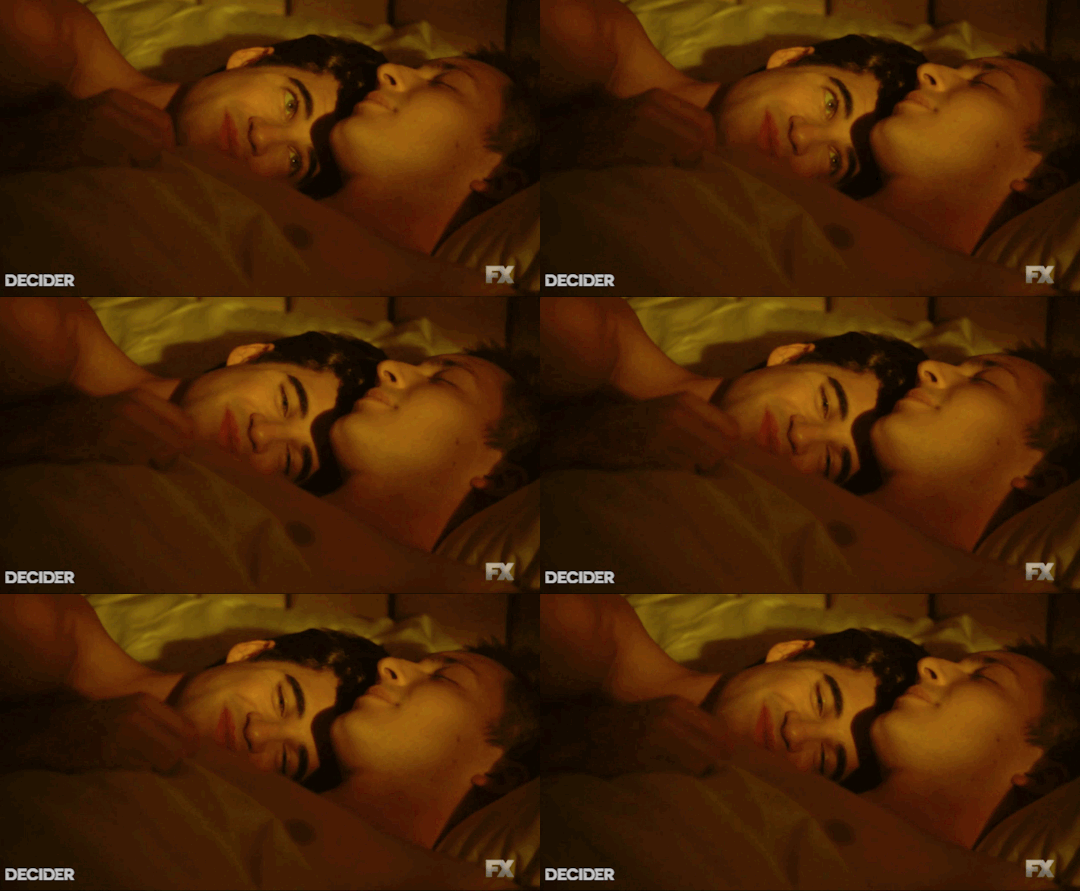
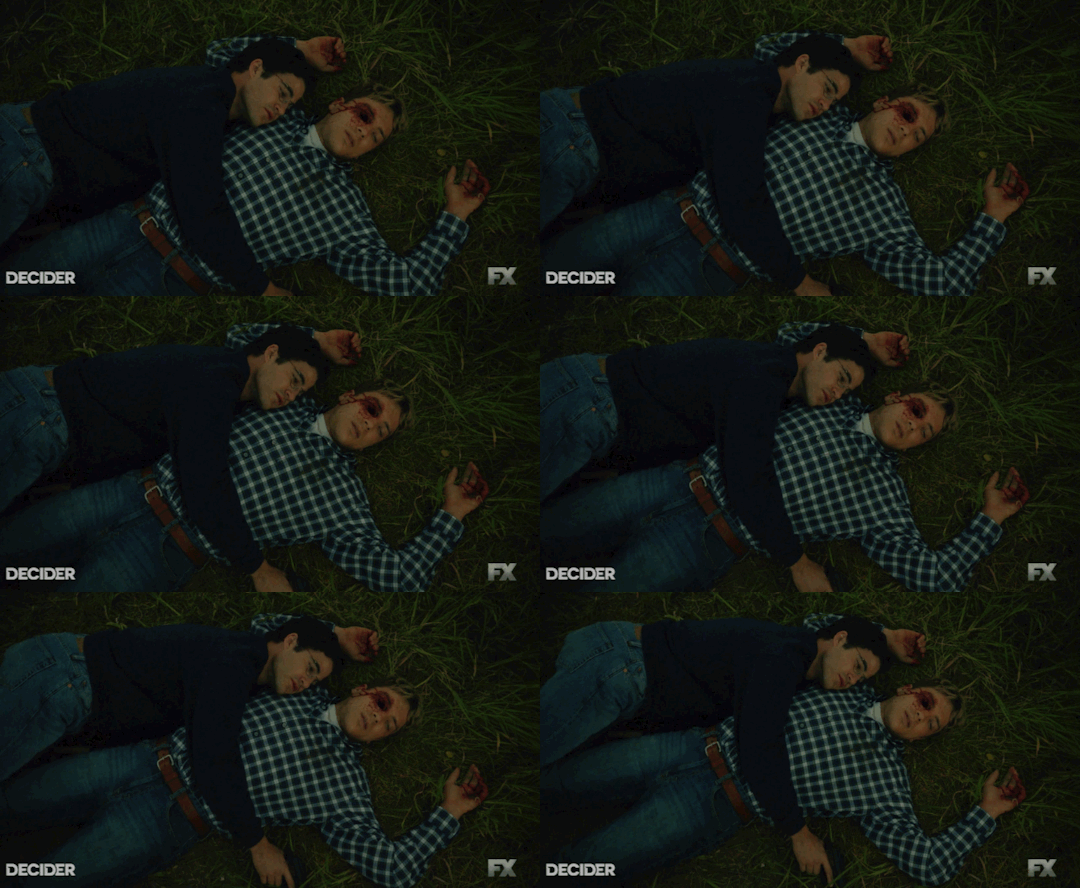
But I’m saving my final praise for Darren Criss as Andrew one more time. Not just for the delicate balance he must strike around David between unpredictable violence and careful reassurance throughout the episode, nor even for his final act of tenderness toward his victim (who’d hallucinated a reunion with his father before dying) — curling up with the corpse for a last embrace before driving away. No, the highlight here is the endless closeup on Criss/Cunanan’s face as he listens to a roadhouse performance of the Cars’ “Drive” by guest star Aimee Mann while his beloved victim sneaks off to the men’s room, debating whether or not to try and flee. He breaks before your eyes, there’s no other way to put it, and he does so over the same sentiment David will eventually express to him, getting himself killed in the process: “You can’t go on thinking nothing’s wrong.”

‘The Assassination of Gianni Versace: American Crime Story’ Episode 4 Recap: Drive