The Assassination of Gianni Versace Episode 1 Review: The Man Who Would Be Vogue

From the very first notes of music, Versace is operatic.

It has fantastic sets and locations, and it knows it. It has a justifiable reason for using opera music in primetime, and it flaunts it. The opener is directed by Ryan Murphy, and the most creative shots are loving, unexpected portrayals of the places where these two men, killer and killed, belong. The most revealing moment, and one that speaks to the larger themes of the show, shows barely any of Darren Criss’s face as killer Andrew Cunanan, accompanied by horns that sound more like a klaxon or warning than the brass section of the orchestra.

Even Gianni’s death, and the gut-punchingly grim spectacle that forms around it, is beautiful, as is the twin autopsy of Gianni and the dove that died alongside him. This kind of show is designed to be watching with Wikipedia open in one tab, but true or not, the woman who soaks up Gianni’s blood with an ad for his clothing line (which somehow makes it more beautiful?) pushes the limits on craven American responses to celebrity death.

The first episode of a true-crime limited series (a fast-growing micro-genre unto itself) has two main goals: 1) set up the central crime/mystery to be resolved, and 2)hook the audience enough that they’ll think it’s worth sinking eight or ten hours to find out the answer.

It succeeds at the first, but I’m left unsatisfied with the second.

The present tense of the second season (or “installment,” as FX likes to call it) of this limited series is centered on a manhunt, not a media frenzy masquerading as a trial. That allows the show to take on more of a feel of a thriller, with shades of The Talented Mr. Ripley and Taking Lives. The audience sees the killer – his identity is not obscured – and law enforcement learns his identity within hours of the murder. For Versace, the question is not who did it or how, but rather why. And why, if they knew it was Andrew Cunano and were ready with a trunk full of fliers (that look startlingly close to the real thing) did it take them so long to catch him?

There’s plenty to dig into with those questions, but the episode has to do so much narrative work that it nearly runs out of room to entice us to come back for more. There is so much that’s working here, from the visuals to the performances and the promise of things to come, but it feels sluggish during the oversized runtime, which is closer to an hour than the 44 minutes we’re used to with standard TV dramas.

One of the advantages to Murphy’s American Crime Story is that his flair for melodrama and camp are tempered by the reality that the cases and literally life and death, and his shrewd (though troubled) selection of subjects who naturally call for camp. So much of this installment would be ridiculous literally anywhere else on TV, which might just be Ryan Murphy’s mission statement. Here’s hoping it’s enough to ward off the usual afflictions of his second and third seasons.

Plenty has been said about the debate over ethics in true(ish) crime, but if you’re looking to fall on the right side of the line, it helps to angle your story around larger meaning. Versace has a lot to say about homosexuality and closeting in America, and Murphy’s life experience plays into that in a way he simply couldn’t with the OJ case. Some of Murphy’s best work has been when he tells stories that fundamentally belong to his community. And though to a certain kind of white, cis gay man the story of Bette and Joan might be considered part of their canon, it is fundamentally the story of two women struggling under the pressure to contort their image and personality to compete for the spotlight, and Murphy’s continued failure to properly handle those issues weakened the series.

I’m intrigued by the way the show is handling the many ambiguities inherent in this case. Unlike The People vs OJ, our would-be defendant isn’t famous and has never spoken on the record, so Murphys team and us would-be sleuths are left to imagine many of the key moments.

If we’re talking performances, this is Darren Criss’s show and everyone else is just happy to be invited. That’s not to say the others aren’t good – Edgar Ramirez’s Gianni Versace is solid and charming, Penelope Cruz is completely transformed, and I have a feeling the best is yet to come from Ricky Martin – but rather that the script gives him so much to dig into, and he’s the perfect actor to do it. He easily mimics Cunanan’s real life chameleon physicality, and most people are already in disagreement over his sexual orientation.

Donatella is our other heavy hitter, though they held back on her as long as possible. She has an impactful entrance, though I’m mostly impressed at the restraint Murphy showed here, which fits the tone of the moment within the episode perfectly, but is unusual for him.

Penelope Cruz, who is apparently a friend of Donatella’s and has her blessing, has a tall order to serve. First, the voice. Anyone who knows anything about Donatella Versace knows that her distinct looks comes with an equally distinct accent. Cruz has to play it believably, without dipping into caricature or being so true to life that the audience can’t understand her. Second, she finds herself playing the day to day villain for much of this. She’s the one who dislikes the boyfriend that we’ve all fallen in love with after the cops are so rude to him. She’s the one who cancels the IPO. She’s the one with a sizeable reputation preceding her. And yet, Cruz’s Donatella comes across as powerful, stricken, at a lost, and completely unwilling to lose an inch of her brother’s legacy.

Speaking of that cop, though it’s startling to remember that 1997 was 30 years ago, Versace has no intentions of letting us forget that when it comes to gay rights, it might as well have been lightyears. The cop pretending not to know that Gianni and Antonio are partners, what exactly “partners” means, and then trying to comprehend group sex, has got to be the straightest thing imaginable. But Ricky Martin’s performance keeps it from becoming a punchline. His hurt when the cop suggest there’s no difference between a hookup and what he has with Gianni is deeply genuine, and a startling reminder of how few rights same-sex couples had, just a few decades ago.

That is made more stark by Cunanan’s inability to live in his own skin, his seething rage at himself and those who see him for who he is, and the insinuation that he has HIV (fact-checking suggests that while the media thought he had it at the time of his death, the ME’s report says otherwise). Criss and the script play it pretty close to the vest, letting us believe one thing and then another and then catching him in lie after lie, to the point where we question everything about him.

★★★★☆

The Assassination of Gianni Versace Episode 1 Review: The Man Who Would Be Vogue

Fashion Recap: The Assassination of Gianni Versace, Episode 1

Alore! It’s here: The Assassination of Gianni Versace: American Crime Story premiered Wednesday night, whetting our palates for all things gaudy, neon, and of course, Italian. Below, a close reading of every look.

High Versus Low

Episode one begins with Gianni Versace (Édgar Ramírez) opening his eyes to carpe diem. He slides his feet into his Versace slippers, struts down the hallway of his (actual) Miami mansion in Versace silk pajama bottoms, and dons a flowing, hot pink robe before stepping out onto a balcony to survey his kingdom. Everything is easy, breezy, beautiful.

Meanwhile, Andrew Cunanan (Darren Criss) sits perched on a public beach below, looking out over the ocean with a scowl. He opens up his backpack, casually pulling out his only two possessions: a worn copy of The Man Who Was Vogue: The Life and Times of Condé Nast, and then a gun.

These first few vignettes set up Versace and Cunanan in stark contrast. Versace eats fresh fruit handed to him on a Versace-branded platter; Cunanan chugs a soda for breakfast. Versace wears linen shorts and a Versace Medusa logo tee; Cunanan wears sandy jorts and a nondescript gray shirt. Versace buys a copy of Vanity Fair, (Cunanan’s favorite magazine) featuring Princess Diana, who would later attend Versace’s funeral; Cunanan studies Condé Nast from afar.

When the Lights Go Down, We’re All the Same

The show works backwards, starting with Versace’s murder and then flashing back to 1990, when Cunanan first meets Versace in San Francisco. (In real life, the Versace family denies they ever met.) At the time, Versace was in town designing costumes for Capriccio, an opera. Cunanan enters a crowded nightclub wearing a leather jacket and a printed shirt, which looks like a Versace knockoff that’s faded in the sun. “Last Night a DJ Saved My Life” plays (ironically) as a crowd in tank tops and ass-less chaps dances to the music. Cunanan spots Versace, who is wearing a leather top far more polished than his, sitting in the VIP section. He makes a point to start a conversation, and succeeds in winning Versace’s attention.

The next morning, Cunanan tells the story of his encounter with Versace to his friend-slash-roommate Lizzie and her husband, embellishing the details a bit. One line in particular comes straight from Maureen Orth’s reporting, on which the series is based: “I say to him, ‘Honey, if you’re Versace, I’m Coco Chanel!” Of course, Cunanan knows he is, in fact, Versace. And in his mind, he fancies himself a bit of a Chanel.

“I’m not really a fan of his clothes, per se,” Cunanan continues. “It’s so bright; it’s too much. They say Armani designs clothes for wives; I think Versace designs clothes for sluts.” Despite all this, Versace has invited Cunanan to the opera. Obviously, he’s going.

Master of Disguise

When the big night comes, Lizzie returns home from work to find Cunanan wearing her husband’s suit, tie, and loafers. “I have nothing,” Cunanan says, explaining he wants to look “impressive.” Lizzie ultimately pities him, and lets him borrow her husband’s gold watch, too.

“[Cunanan’s] whole thing was being a master of disguise,” says costume designer, Lou Eyrich. “He was a chameleon. If he wanted to be in the rich world of older men, he dressed that part. If he wanted to fit in with his college buddies, he’d throw on his polo shirt and khaki shorts. He was straight with straight people and gay with gay people. Everything was a lie, and he lived behind that whole façade.”

After the opera, Versace meets Cunanan wearing a humble black turtleneck and black pants. Cunanan spins fictitious tales about his family, while Versace recounts more innocent stories about his idyllic childhood, explaining the origins of the Versace Medusa logo — he came across it while playing around in ancient ruins — and that he made his first dress for his sister, Donatella. “Maybe every dress I make is for her,” he says.

“That makes me want to cry,” says Cunanan.

Boss Bella

Flash back to the scene of the crime. Donatella (Penélope Cruz) arrives in a black limousine wearing black leather pants, a black leather blazer, and black sunglasses, making her signature blonde hair (Gianni convinced her to dye it) appear even more platinum. Despite her obvious grieving, she immediately gets down to business. Protecting her brother’s legacy is her number-one priority, and Versace was about to take the company public. (This was true in reality.) Donatella decides against it.

“This company was his life,” Donatella says in a tearful monologue. “When he was sad, it made him happy. When he was sick, it kept him alive. And my brother is still alive as long as Versace is alive. I will not allow that man — that nobody — to kill my brother twice.”

Revenge Suit

The episode ends with Versace and Cunanan’s roles reversed. While the Versace mansion is shrouded in darkness, Cunanan walks down the streets of Miami in plain sight wearing a sunny yellow monochrome outfit and Versace sunglasses. He buys a stack of newspapers with his name inside their pages this time, exactly as Versace did minutes before he was shot.

“Ryan [Murphy] wanted him to have this Talented Mr. Ripley moment, where he’s gotten away with murder,” says Eyrich. “You don’t know it from the first episode — because you’re going back in time — but it’s not until you watch that you understand why that [outfit] was significant.”

Stay tuned.

Fashion Recap: The Assassination of Gianni Versace, Episode 1

Let’s Talk About ’The Assassination Of Gianni Versace:’ Premiere

The Assassination of Gianni Versace: American Crime Story just finished airing its first episode. If you read the review I published on Monday, you know I had much more mixed feelings about this season than People v O.J. Simpson, so let’s get into a few specifics about the premiere, coming up just as soon as I work on my father’s pineapple plantation in the Phillipines…

“I’m sure you’re going to be someone really special one day.” –Gianni

Of the eight episodes FX gave critics in advance, “The Man Who Was Vogue” is the one that most closely resembles many of the things that people loved about the OJ season. Though Gianni Versace gets shot before the opening titles appear, the San Francisco flashback and the arrival of Donatella to deal with the aftermath of her brother’s murder keep the hour relatively balanced between the Versaces and Andrew Cunanan. There’s an abundance of garish real-life details, like the guy who tried to auction off a photo of Versace’s body on the gurney and the autograph hounds who scooped some of Versace’s blood into a bag. And via the manhunt for Cunanan and the interactions between the local cops and the FBI agents, we start to get a sense of how badly law-enforcement blew this one, just like the OJ prosecutors did.

Let’s Talk About ’The Assassination Of Gianni Versace:’ Premiere

American Crime Story’s Season Opener Beautifully Mines the Tension of Knowing What’s Coming

Rating: 8.9

A man in flowing pajamas ambles through an obscenely opulent villa, murmuring thanks to the silent servant waiting to hand him his orange juice. Nearby, on the beach, another man restlessly unpacks and repacks a backpack containing a biography and a gun.

The first man has breakfast on a patio inlaid with a faux-ancient mosaic of Medusa’s head. The other man vomits in a public restroom whose cubicle wall is etched with a crude drawing of two penises and an exclamation about “faggots.” In a few minutes, fashion designer Gianni Versace (Edgar Ramirez) will be shot twice in the head on the steps of his mansion and Andrew Cunanan (Darren Criss) will be giggling hysterically in the driver’s seat of a parked truck.

Miami Beach, July 1997.

It’s a weird kind of tension, when a director spools out minute after minute of lead-up to something we already know will happen because we remember that it happened. (In case we didn’t remember it, it’s the title of the show.) The pre-credit sequence of The Assassination of Gianni Versace: American Crime Story is wall-to-wall opulence, in its color saturation, its swelling music, its luxuriant pacing. The tension of knowing what’s coming is sometimes even worse than the tension of not being sure.

Once Versace is shot, the show starts going forward, into the investigation, but more significantly, backward, taking us to a 1990 episode in which Cunanan meets Versace in a gay nightclub and manages to score an invitation to the San Francisco Opera, where Versace is pulling a costume design stint. It’s immediately clear that Cunanan is a DSM-worthy example of a sociopath; even his handful of friends seem to get that he’s a pathological liar. Cunanan meets Versace after the performance, they drink Champagne, and Versace possibly ensures his own future demise by assuring Cunanan he will almost certainly “be important one day.”

Meanwhile, in 1997, the police show up and question Versace’s partner, Antonio (Ricky Martin). They seem very hung up on the fact that “other men” were invited home with the couple. It’s confusing, this “gay lifestyle” thing, apparently even in Miami Beach three years from the turn of the millennium. Were they all his “partner”? No? What’s the difference?

“Fifteen years,” Antonio says incredulously, still wearing blood-stained tennis whites, “I lived with Gianni 15 years. That’s the difference.”

The detective concedes that 15 years is a significant amount of time. Somehow they’re not running a particularly effective investigation, though. The FBI shows up, saying they suspect Cunanan. A pawn shop operator (Cathy Moriarty) calls the police to say she’d turned in paperwork days ago from a transaction with Cunanan, and gives them an address.

Versace’s sister, Donatella (Penelope Cruz), shows up, cancels the company’s public offering on the New York Stock Exchange and says they have to keep things in the family because strangers will “judge the killer, but they will also judge the victim.” She rakes poor Antonio over the coals a few times for good measure.

Police storm the address they’ve gotten from the pawn shop, but the man in the seedy hotel room isn’t Cunanan. They’ve lost him.

The Assassination of Gianni Versace is, in its opening episode, richly detailed and quite subtle. I don’t love Cruz as Donatella Versace—was Lady Gaga busy?—but then again, the real Donatella creeps me out, too. Criss, Ramirez and Martin are remarkably good, though. The episode brims with strange tensions, between wealth and non-wealth, status and non-status, and between straight and gay cultures. The 1990 scenes are tinted by the AIDS crisis in a way that feels very authentic and not at all ham-fisted. The spooling out of backstory is occasionally imperfect (usually in expository monologues, not generally in real-time scenes). The 1997 scenes have a real-feeling paparazzi-prurience, evoking our often morbid obsession with celebrity and our often subverted fear of Other-ness. (In one horrible moment, a chubby tourist breaches the police line to soak a Versace magazine ad in the blood still pooled on the steps of the villa.) The time-hopping will, I expect, continue, showing us visions of how both men, killer and killed, became who they were.

We appear to be setting up for a beautifully filmed, opulently styled investigation of self-acceptance, self-loathing, rage and unfulfilled desire. When I Googled Gianni Versace to make sure I had his death date correct, this quote floated up at me: “I am not interested in the past, except as a road to the future.”

I think it’s safe to say we’re going to be on a season-long road to the future.

American Crime Story’s Season Opener Beautifully Mines the Tension of Knowing What’s Coming

The Assassination of Gianni Versace: American Crime Story, episode 1 review: a gossipy, killer slice of docudrama

★★★★☆

An aura of decadent fabulousness lingers over The Assassination of Gianni Versace: American Crime Story. The tragic fashion designer is introduced gliding about in a blinding pink dressing gown in his Versailles-like Miami palace – a riot of stucco and sunshine over which director and show-runner Ryan Murphy overlays sonorous opera.

As if inspired by one of Versace’s swirling creations, Murphy wastes no time ratcheting up the overkill to a clanging crescendo in FX’s true crime follow up to 2016’s The People Vs. OJ Simpson.

Gunned down on his doorstep by the psychotic fabulist Andrew Cunanan (Glee’s Darren Criss), Gianni Versace bleeds to death alongside a bloodied dove similarly, if inexplicably, pierced by a bullet.

Storming on three quarters of the way in as Donatella Versace – Gianni’s beloved sister and heir –  Penélope Cruz adds to the excess with a performance as filthily ridiculous as her dirty blonde wig.  The most delicious aspect of the series, however, is its element of surprise.

Versace (Édgar Ramírez – whose performance is, weirdly, the most sober here) was a global fashion figure when cut down in July 1997 yet the details of his killing are not widely known.

That’s in contrast to the OJ Simpson case, so embedded in our memories that watching Murphy recreate the events two years ago felt like participating in a game of true crime bingo. The Ford Bronco chase, the misogynistic humbling of Marcia Clark, Johnnie Cochran’s “if glove don’t fit” speech – all were dutifully trotted out, each beat as predictable as the chorus in a Justin Bieber song.

Season two, by contrast, packs a gilded punch. The first episode bounces between the slaying of Versace to his first encounter, in a San Fransisco gay club, with Cunanan. The future killer is a Walter Mitty-like social climber whose life is wallpapered with so many habitual lies it’s unclear whether even he knows truth from fiction. Preppy of manner and soulless of gaze, he gives Murphy something the Simpson case lacked – an unambiguous villain scary even when he isn’t shooting dead international fashion designers.

As Donatella, Cruz meanwhile cuts a furious swathe. She trowels on the accent and affectations quite gleefully: a little thrill is sure to run through you every time she flutters her reptilian eye-lids or pronounces “company” as “kuuumpany” (perhaps unsurprisingly the Versace family have dismissed the series as fantasy).

Even more impressive is pop star Ricky Martin as Gianni’s devastated romantic partner Antonio D’Amico. It’s 1997 in Miami but gay rights are still an evolving concept as made clear when Detective Scrimshaw (Will Chase) casually asks the grieving D’Amico whether, after 15 years together, Versace was paying his lover for services rendered in the bedroom.

Amid the towering chintz and power-house performances, there’s a slight clumsiness to the interweaving of the murder hunt with wrangling over the future of the Versace empire (Donatella wants to delay plans to float the “kuuumpany” on the stock exchange). But the bare facts of the case are so intriguing, the evocation of Nineties Miami so searing, as to paper over the structural clunkiness.

With American Crime Story season two, Murphy has served up another killer slice of documudrama – a lush, gossipy tour de force that dazzles and tantalises in equal measure.

The Assassination of Gianni Versace: American Crime Story, episode 1 review: a gossipy, killer slice of docudrama

American Crime Story: Versace Is Pure Miami, Whether You Like It or Not

Murphy understands that Miami is as gaudy, gay, and greedy as the characters he’s put onscreen. Yes, we certainly have more depth than that (as numerous films, from the Oscar-winning Moonlight to Borscht Corp’s award-winning shorts, have shown). But the surface-level charm is prevalent, often hiding that depth from outsiders. In Versace, Murphy leans deeply into the façade.

Still, Versace, like Miami, seems to promise more than surface-level charms. It’s not just the gorgeous visuals or Penélope Cruz playing Donatella Versace without attempting to hide her Spanish accent. It’s not just Édgar Ramírez working on beautiful Versace costumes for an opera or having his shirt logo sliced open on a hospital table in the most heavy-handed death scene ever. And it’s not just Ricky Martin as Antonio D’Amico wailing for an ambulance while holding his dying lover as though they were Michelangelo’s Pietà. Versace writer Tom Rob Smith has used Maureen Orth’s book Vulgar Favors: Andrew Cunanan, Gianni Versace, and the Largest Failed Manhunt in U. S. History as a jumping-off point to create a portrait of this place that’s as loving and as critical as it should be.

The beauty of the pilot episode is in the details, its slow but smart establishing of the period we’re entering. This is the queer ‘90s: There’s sex, nightlife, and drugs. There’s also an AIDS epidemic that people still had no real clue how to deal with. It’s implied in scenes showing Versace pulling up his robe to reveal a lesion and taking medication that he was dealing with AIDS. That unease buzzes beneath scenes in which a police officer can barely communicate with D’Amico during questioning because he can’t grasp the concept of two men dating, much less two men in an open relationship. It’s in the word “faggot” written on a public beach bathroom wall.

With the episode “The Man Who Would Be Vogue,” American Crime Story delivers a promising premiere, one that announces an unashamed exploration of what it meant to be gay in the 1990s, even if it’s told partially through the lens of a sociopath who murdered at least five people during that period. We can only hope the rest of the series is as exciting as the first episode.

American Crime Story: Versace Is Pure Miami, Whether You Like It or Not

‘The Assassination of Gianni Versace: American Crime Story’ Episode 1 Recap: Starting With a Bang

Mere minutes pass in The Assassination of Gianni Versace: American Crime Story until Andrew Cunanan (Darren Criss) assassinates Gianni Versace (Edgar Ramirez). This is your first clue that you’re not really watching a show about Gianni Versace.

Welcome to Ryan Murphy’s latest exploration of 1990s celebrity crime. After sufficiently dazzling everyone with his take on a well-known story — the murder trial of O.J. Simpson — Murphy has chosen to take a broader, more difficult swing. He’s named the series after the murder of fashion designer Gianni Versace, I assume largely because it was Cunanan’s most high-profile killing. But Cunanan, and thus Criss, takes center stage in this story. The relatively balanced storytelling that puts both Cunanan and the Versaces in the spotlight this episode won’t return until we’re nearly through our nine-episode-long journey.

Criss gets plenty to do in this premiere installment: the killing, meeting Versace at a nightclub in San Francisco, stalking him to the San Francisco Opera, and even revealing his butt! But we’ll be talking mostly about him in the following weeks.

So let’s take this opportunity to focus on the Versace side of things; in particular, Penelope Cruz as Gianni’s sister, the iconic Donatella Versace.

Cruz as Donatella doesn’t step into the episode until it’s nearly over, arriving in Miami Beach via private plane upon hearing of her brother’s murder. Murphy, who directed this episode, frames her in a way perhaps only a gay man could: reverent, awestruck. Even the stairs descending from her private plane are shot with epic sweep. You’d feel compelled to let out a YAS if she weren’t there to identify the body of her dead brother.

Donatella is emotional upon arrival in her face, but none of that carries over to her body. She’s outfitted in the House of Versace’s finest, her long, blonde hair cascading over gorgeous leather. When she steps out of her limo upon arriving at the Versace residence at night, She wears sunglasses, so as to hide her tear-filled eyes from the paparazzi.

She is a wounded warrior; her brother’s clothes are her armor.

When you first hear Cruz’s take on Donatella’s accent, it sounds downright bizarre. It’s like she’s taken a long drag of a cigarette and is holding the smoke in her throat at all times. But that’s fitting; Donatella’s is a nearly impenetrable accent, which the fashion icon herself knows all too well.

Explaining her method of replicating Donatella’s speech back in October, Cruz told People she thinks the female Versace’s accent is “Italian with a very international flavor — very rock ’n’ roll.” That description doesn’t really mean anything until you hear it; once you do, it makes perfect sense, and matches the character’s presentation perfectly. Donatella sounds hardened, but her voice falters easily. She’s strong, but with tremendous emotion bursting at the seams.

After a few scenes of barely holding it together, Donatella lets her guard down, if only slightly, in a meeting with Versace’s board. She speaks emotionally but firmly about her brother, and the ways in which he will live on through his brand. “I will not allow that man, that nobody, to kill my brother twice,” she says, words trembling as they leave her mouth, tears welling in her eyes.

In her final scene of the episode, Donatella shuts down the planned public offering of the House of Versace. Gianni wanted it, and delaying would likely prevent the House from trying again for years. (Indeed, the company is still working to go public in present day.) It’s bad for business, but right for the moment.

“This is not a time for strangers,” Donatella insists. “This is a time for family.” And that’s Murphy and writer Tom Rob Smith’s idea of her in a nutshell: Donatella loves her brother deeply, and loves the people who work at the House. But she trusts no one else — her armor is fully secured to avoid giving the public an inch of herself.

Cruz will pop up in a few scenes here and there over the next few episodes, including one crucial story about Donatella and Gianni’s creative collaboration. But this first impression was her moment: how Donatella, icy goddess with a fiery heart, protected herself against the pain of her brother’s death.

‘The Assassination of Gianni Versace: American Crime Story’ Episode 1 Recap: Starting With a Bang

Recapping the First Episode of ‘American Crime Story: The Assassination of Gianni Versace’

The first thing you need to know about FX’s American Crime Story: The Assassination of Gianni Versace is that it’s not really about Gianni Versace. While O.J. Simpson—and his fame, his race and his abusive history—were central to Ryan Murphy’s true-crime anthology in its first season, this story focuses on the man who killed Versace and the society that aided in that murder.

The new season is based on Vulgar Favors: Andrew Cunanan, Gianni Versace, and the Largest Failed Manhunt in U.S. History, a 450-page tome the journalist Maureen Orth published in 1999. Much of the book is devoted to the life story of Cunanan, the 27-year-old spree killer who shot Versace in 1997. Her reporting is thorough and revealing, but much of her analysis is dated. When Orth explores Cunanan’s demimonde of meth, escorts, sugar daddies and BDSM, it feels as though she’s unaware that this milieu isn’t representative of gay male culture as a whole.

Especially considering that Murphy—who is gay and has created some groundbreaking queer characters—has also been known to perpetuate the occasional homophobic stereotypes, the interplay between the book and the series is bound to give us plenty to discuss. At the very least, Vulgar Favors is handy for determining which parts of the show are confirmed fact and which are purely conjecture. (I’ll also be using Deborah Ball’s House of Versace, a breezy history of Gianni, his family, and the brand from 2010, along with a few other sources.)

I don’t want to call these recaps “fact-checks,” though, because fiction doesn’t have any responsibility to stick to the official record. Instead, I’ll look at how the discrepancies between what Orth dug up and what Murphy depicts reveal the show’s real agenda. These pieces may take a different form from week to week, but since the premiere was mostly a reenactment of the crime and its immediate aftermath, we’ll start with some pretty basic background stuff.

July 15, 1997

Orth’s book ends with the death of Versace and the intensified hunt for Cunanan, who had already killed four men by the time he came to Miami Beach. American Crime Story begins with the murder and goes backward from there. It’s a promising approach, because the real suspense here is in the question of how the smart, charismatic, cultured young man we meet in flashbacks ended up on the FBI’s Most Wanted list.

The show sticks fairly close to the facts in recounting what happened on the day Gianni Versace (Édgar Ramírez) died. He really was returning home from an early-morning excursion to buy magazines when Andrew, played by Darren Criss in a performance that’s already riveting, gunned him down on the steps of his palatial home (more on that later). One bullet also killed a turtle dove—a symbol that initially led authorities to suspect a Mafia hit. While Versace’s longtime partner, Antonio D’Amico (Ricky Martin), stayed at the designer’s side, the couple’s neighbor Lazaro Quintana chased Andrew until Andrew pulled a gun on him. Versace was rushed to Jackson Memorial Hospital, where he was declared dead at 9:21 AM.

Cops really did spot someone who matched Andrew’s description on the roof of a parking garage around the same time, but he escaped. (Orth doesn’t mention them tackling the wrong man.) It’s not clear what he was doing later that day, when police found the stolen red truck Andrew had abandoned and he became the suspect. The scenes that show him changing into fresh clothes and watching gleefully as the media descends on Versace’s house aren’t just plausible; they underscore how easily Andrew blended in among the town’s gay beachgoers.

One character to keep an eye on is FBI agent Keith Evans (Jay R. Ferguson). The Bureau was searching for Cunanan long before he killed Versace, and Evans was its man in Miami. Sadly, he was also inexperienced and unfamiliar with the city’s gay community. Sgt. Lori Wieder, the lesbian cop played by Dascha Polanco, wasn’t on the scene that day, but the officers who were there did find boxes of undistributed Wanted flyers in Evans’ trunk. The scene where the pawnshop owner complains to police about the legally mandated transaction form she’d filed a week earlier, which included Cunanan’s full name, is another embarrassing real-life detail. But the emphasis Murphy, who directed the episode, places on Evans’ neglect of his assignment is crucial, because it’s the first suggestion that law enforcement’s homophobia—its literal fear of engaging with gay men—contributed to its failure.

October 1990

Did Versace really know his killer? Well, sort of.

It’s true that Versace designed the costumes for a production of Capriccio at the San Francisco Opera, and stayed in the city during its run in 1990. At the time, Cunanan was living rent-free in Berkeley with his friend Liz Coté (Annaleigh Ashford), who Orth describes as a “rich and spacey debutante,” and her husband, Phil Merrill (Nico Evers-Swindell)—the couple we see in the flashback. A fixture in SF’s gay scene, Andrew met Versace at a club called Colossus. But, Orth reports, it was the designer who approached him: “I know you,” said Versace. “Lago di Como, no?” he asked, referring to his Italian lake house. It was, most likely, a flimsy pickup line. Andrew, who’d never been to Italy but had also never heard a flattering lie he couldn’t get behind, went along with it. On another night, Versace, Andrew, and a local playboy named Harry de Wildt were spotted together in a limo.

That dreamy encounter after the opera, though? It’s pure fantasy, although Andrew was known to lie about his Filipino father knowing Imelda Marcos, owning pineapple plantations and having a boyfriend. What’s important here is the conversation about Andrew’s future. “You are creative?” Versace asks, and his date answers in the affirmative. In fact, the only things Andrew ever created were fictions about himself, passed off as fact. (I won’t get too deep into that, because his lying is sure to come up later in the show.) “I’m sure you’re going to be someone really special one day,” says Versace. The distance between Andrew’s ambitions and the life he ended up with—as well as the reasons why he was such a failure—is going to be important.

The Family Business

The episode’s strangest divergence from the facts comes during the same scene. Versace explains the history of his company’s Medusa logo, recounting that he first spotted the image while playing in ruins as a child in Calabria. In fact, as Ball notes in House of Versace, he borrowed his logo from a door knocker at the Milan palazzo he bought in 1981. Perhaps we’re supposed to suspect Versace is a liar, too, but I’m inclined to believe the line is pure exposition, a hint of the designer’s humble beginnings that will soon become relevant to Andrew’s story.

Meanwhile, Versace’s mourning siblings/business partners, Donatella (Penélope Cruz) and Santo (Giovanni Cirfiera) provide some insight into the company’s status in 1997. Poor Cruz, normally a fantastic actress, has a thankless role (and a distracting accent) in this episode. All she does is sob, scream and provide dry background info that writer Tom Rob Smith doesn’t bother surrounding with believable human dialogue. For the record, it’s true that Santo, the oldest Versace sibling and the company’s most pragmatic voice, wanted to take the business public. And Gianni, after accepting a large dividend to subsidize his lavish lifestyle, agreed to do so. The plan was to make an initial public offering in the summer of 1998. It never happened. Two decades later, Gianni Versace S.p.A. remains a billion-dollar private company. None of this is particularly interesting, so here’s hoping it becomes relevant to the Cunanan story eventually!

Gianni Versace’s Fucking Insane House

There isn’t much art in this workmanlike premiere, but it does begin with a shot of the clouds painted over Versace’s bed that leads to a lovely, nearly wordless sequence contrasting Gianni’s civilized morning with Andrew’s primal scream. If you paid attention to the Renaissance-style art and the stained-glass windows and the gold accents and the massive tiled courtyard, it probably occurred to you that Versace’s home was totally off the wall. (“If Donald Trump had taste,” I said to myself, “this is what Mar-a-Lago would look like.”) Surely it was exaggerated for TV?

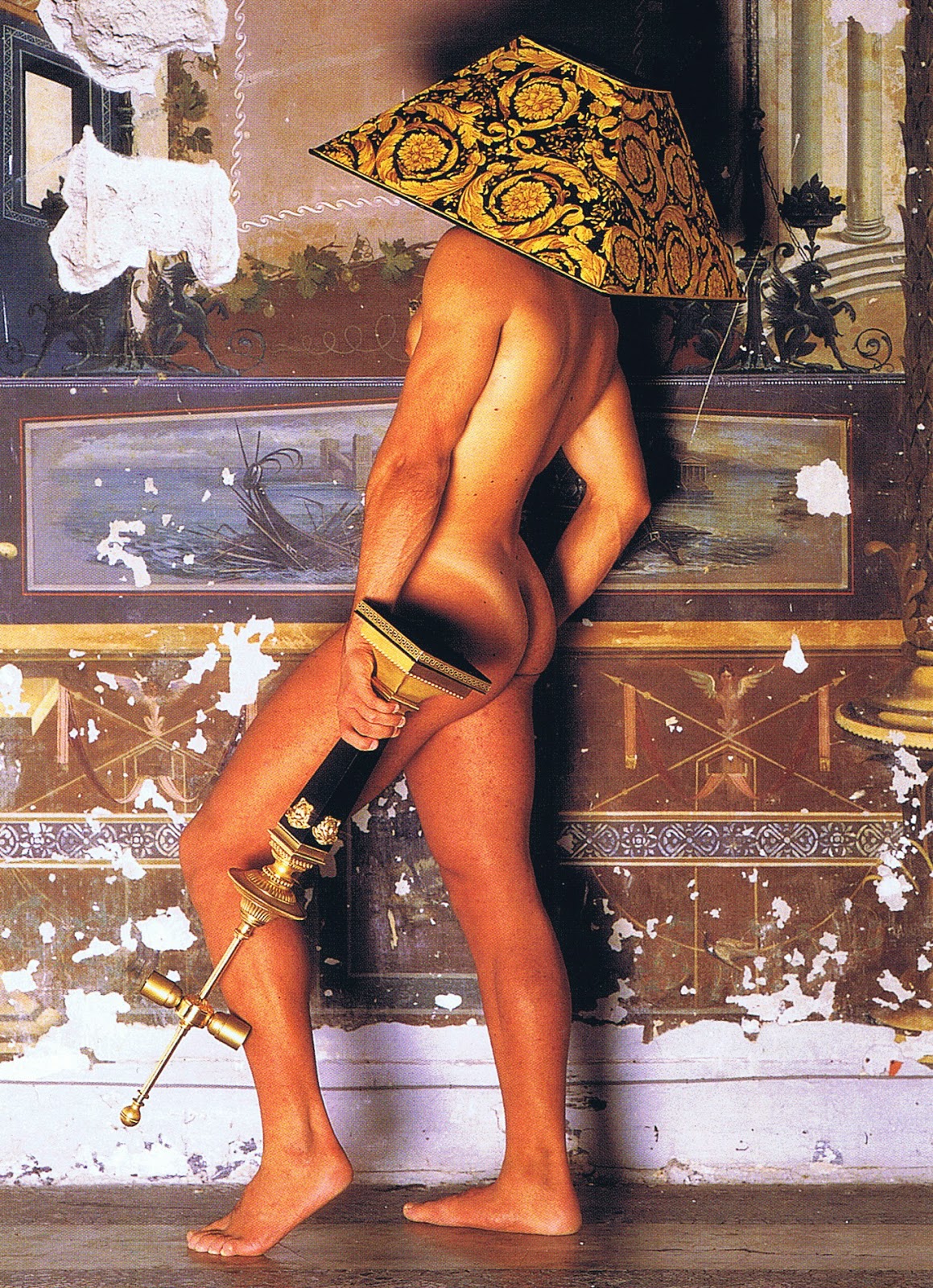
Actually, it was not. Built in 1930, Casa Casuarina, as the home was known, was inspired by Christopher Columbus’s son Diego’s residence in the Dominican Republic. In the courtyard of the 20,000-square-foot villa were busts of Columbus, Pocahontas, Mussolini and Confucius (all of which Versace kept). After Versace bought the property in 1992, he spent a million dollars restoring it. An army of artists and artisans filled the place with murals, mosaics and baroque furniture. Versace published a typically bizarre coffee-table book about his many bonkers properties in 1996, and in it you can find photos of the family frolicking poolside at Casa Casuarina alongside busy interiors and shots of naked men ironing. My favorite page shows a close-up of a burger, fries and a milkshake served on gilded Versace china, atop an ornate gold table. America! If you can’t track down a copy, this Google Image search should give you an idea. Look, here’s a bare-assed dude with a lampshade over his head! See you next week!

Recapping the First Episode of ‘American Crime Story: The Assassination of Gianni Versace’

The Assassination of Gianni Versace Premiere Recap: Miami Vice

Editor’s Rating: ★★★☆☆

In an episode that is so steeped with terrazzo floors, bulbous gold watches, and even servants’ uniforms that are chicer than anything I could pull out of my closet, there is one image that I just can’t get out of my head: old men in tiny red bathing suits. Seriously, what the hell is up with that? There’s at least three of them in the premiere of The Assassination of Gianni Versace: American Crime Story. I think it might be a hint the next season of Ryan Murphy’s other shows. Stay tuned this fall for American Horror Story: Thongs.

Seriously, though, this first episode of Versace is absolutely gorgeous. Just think about all of the lush images that pop out of the screen like an IMAX version of a Vogue issue. There’s the elegant pool of the opera singer’s sequin dress as she belts on stage. There’s Gianni Versace (Edgar Ramírez), delicately sipping his espresso from a black gilded cup, shot from above so his breakfast table is just off center of the Medusa logo that he made famous. There’s the hollow chime of crystal champagne flutes clinking together on the set at the opera. There’s Gianni’s sister Donatella (Penélope Cruz), with that famous platinum hair and doorknocker of a nose standing at the top of a little portico. And let us not forget that perfect peach emoji of an ass as Andrew Cunanan (Darren Criss) strides into his roommate’s husband’s closet to steal a suit.

Oh, there’s just so much beauty! So many surfaces! It’s fitting for a story about a man who made his fortune creating beauty and cultivating the world around him in his own image. And the cinematography has that round golden glow one can only find from the light in Miami. But when we’re looking under all of those surfaces, it’s unclear if there is anything there yet.

It is an interesting choice to start the series with Versace’s murder, as we watch that day unravel much as it did in 1997 with the mourning of a fashion icon happening at the same time as a statewide manhunt for his killer. We only get one real flashback, to Cunanan and Versace’s first meeting in San Francisco when the designer was in town to design the costumes for the opera. Cunanan tracks Versace down to the VIP section of a gay club and slowly weasels his way into the designer’s orbit. Versace is totally disinterested at first, batting this cute twink away with the same forceful courtesy that he uses to deny an autograph seeker.

Cunanan is charming, however. He uses his skills as a liar and his knowledge of Versace to charm him with stories about his parents moving from Italy, weaseling his way not only into both a seat next to him (savagely dispatching his friend with the VIP pass to get him a drink), but also into a date with the designer. In these flashbacks, we also learn that Cunanan will lie about things large and small, like when he erroneously retells his story to his girlfriend and her husband, or his school friend.

The scene with his gay friend at school is the most revealing when the friend tells Andrew, “You tell gay people you’re gay and straight people you’re straight.” Rightfully, he’s confused about Cunanan and his ever-changing stories of himself, ones that crop up to serve whatever need arises at that minute. (That didn’t confuse me, though. I was just confused by how those glasses without temple bars managed to stay on his face without falling off.) Cunanan’s answer to his friend? “I tell people what they need to hear.” Yup, that seems to fit the profile.

That is just one of the moments in this episode that seem a little bit on the nose. The whole opening is a tad bit obvious, where Versace swans around his house in his pink robe while his killer walks into the surf wearing all of his clothing (a mark of a true mad man) screaming the whole time. Versace is sunning himself by his tiled pool while Cunanan is puking in a dirty public restroom with “Filthy Faggots” scrawled on the wall.

Then, of course, there is Gianni’s corpse with the bullet through his cheek, lying next to the dead dove that is similarly afflicted. Yes, people, we get it. What about when Andrew hears the news of Versace’s murder in the lobby of a fancy hotel and then watches a woman’s shocked reaction and mimics it perfectly? He doesn’t know emotion. He doesn’t know anything real.

But the most glaringly obvious symbolism is when Gianni’s partner Antonio D’Amico (Ricky Martin) tries to follow Donatella into a family meeting and she literally shuts the door in his face. Oh, I wonder what’s going to happen to him during the rest of the season?

Antonio definitely gets the worst scenes of the whole night, especially his grilling by Det. Scrimshaw (Will Chase), who you know is a jerk because he has a mustache. Scrimshaw’s casual homophobia and disregard for Antonio’s feelings after the loss of his partner and his callous disregard for a non-monogamous, non-heterosexual relationship is pretty disgusting. Just as The People v. O.J. Simpson asked us to reexamine the issues of race, gender, and celebrity surrounding that case, it seems like this season is going to ask us to reexamine how Versace, Cunanan, and D’Amico’s sexual orientation factored into this case. In no place was it more obvious than these unsettling scenes.

It’s also obvious in the way that Donatella treats Antonion, and how she’s fixated not just on preserving her brother’s saintly image but also the family business. She says she doesn’t want to talk to the board so soon after her brother has been gunned down in front of his house, but there she is, doing just that. She also shoots down taking the company public just days after her brother signed the papers to do just that. Donatella says she wants what her brother wanted, but it’s clear that she has a separate agenda all of her own as well.

From this first episode, ultimately, I’m curious to wonder how the series will unfold. Will we see things in 1997, as the cops and FBI continue to hunt for Cunanan, alongside flashbacks to how we got here? Or are we going to take a giant leap backwards and start with both Cunanan and Versace’s beginnings to show us what led the murder in the first place? The structure is still unclear, but it doesn’t seem like there is enough meat left for 10 episodes set just in 1997. Or is there? Will the reexamination of this case reval details that those of us who lived through it aren’t even aware of? Or is it just taking the facts and putting them in a dramatic light? We won’t find out until we delve beneath the surface, something that hasn’t quite happened yet. But, man, what a very gorgeous surface it is.

The Assassination of Gianni Versace Premiere Recap: Miami Vice

The Assassination of Gianni Versace: American Crime Story — Grade It!

Whether Darren Criss was shooting people in the face, puking in public bathrooms or casually rubbing his crotch while standing over a sleeping couple, he sure made Wednesday’s season premiere of American Crime Story feel like the darkest episode of Glee yet.

I’m half-joking, but considering this is Criss’ first series-regular TV role since Blaine Anderson warbled his final warble in 2015 (not to mention Criss’ first professional reunion with Glee boss Ryan Murphy), I trust you’ll overlook my inability to disassociate — at least in this first week.

Truth be told, Criss’ take on Andrew Cunanan — the sexually manipulative serial killer who murked fashion icon Gianni Versace in 1997 — is impressive, thoughtful and downright chilling, a far cry from the singing bottle of hair gel in a sweater vest he brought to life on the Fox comedy. Let’s discuss:

1990 | Wednesday’s premiere turned the clock back to the year Cunanan first encountered Versace (played by Edgar Ramírez) at a gay club in San Francisco. He was basically “that guy” at the party — the one who shows up uninvited, then proceeds to inject himself into strangers’ conversations — but his boyish charm and Harry Potter glasses worked their magic on Versace, earning him a date to the opera. I guess it helped that Cunanan presented a completely fictitious backstory, one that made him approximately 100 percent more Italian than he actually was.

Cunanan excitedly (and inaccurately) relayed this meeting to several of his friends the next day, a series of conversations that offered a glimpse into his twisted psyche. While speaking with a straight married couple, Elizabeth and Phil Cote (played by Annaleigh Ashford and Nico Evers-Swindell), he labeled Versace the F-word. But during a subsequent chat with a fellow gay, Cunanan had no problem referring to his and Versace’s opera meet-up as a date. “You tell gay people you’re gay and straight people you’re straight,” the friend protested. “I can’t keep up.”

1997 | Before diving into Versace’s history with Cunanan, the episode introduced us to the fashion icon in all his Miami Beach splendor. And despite his international fame, Versace was also painted as somewhat of a local celebrity — like a post-Christmas Carol Ebeneezer Scrooge, receiving hugs and hellos from all the Muppets people he encountered in town. And it was after one of these jaunty strolls that Versace was confronted by Cunanan, who shot him point-bank at the gate of his mansion. (The dead dove next to Versace felt a little on-the-nose, so I fact-checked — it really happened.)

Versace’s sister (played by Penelope Cruz) sauntered into the party about three-quarters of the way through the premiere, and while Donatella always commanded attention, most of her mourning breath was spent belittling her brother’s lover. When Antonio broke down in tears, her response was, “That’s not what I need from you right now.”

Speaking of Ricky Martin’s character, it was kind of shocking to hear how Donatella — and even the police — regarded his relationship with Versace. Donatella berated him for not protecting her brother, which she called his one job, and the police seemed far more interested in details about Versace’s sexual behavior than the details surrounding his untimely demise. 1997 doesn’t feel like it was that long ago… and yet it was.

The premiere concluded with Cunanan still at large, though the authorities — led by a mustachio’d Will Chase — were hot on his trail. (Also, yes, that was New Girl‘s Max Greenfield playing Ronnie, the guy found living at Cunanan’s last known address.)

Your thoughts on Crime Story‘s second season premiere? Grade the episode below, then drop a comment with your full review.

(A secret confession for those who have scrolled this far: Do you have any idea how difficult it was for me not to make a stupid joke about Darren Criss showing his butt in this episode? Believe me, I thought of ’em all, including “he put the ‘ass’ in ‘assassination.” But I refrained, for I am a professional… and that’s what Twitter is for.)

The Assassination of Gianni Versace: American Crime Story — Grade It!