‘The Assassination of Gianni Versace’ Season Finale: A Perfect Boy

Season 2, Episode 9: ‘Alone’

It turns out that “The Assassination of Gianni Versace,” this gorgeous mess of a television series, was neither about an assassination nor, really, about Versace, the fashion designer who was shot to death on the front steps of his Miami Beach mansion in 1997.

It would have been more accurately called “The Agony and the Ecstasy of Andrew Cunanan,” Versace’s killer, whose spectacular orgy of violence briefly dominated headlines around the world at the close of the American century.

Over the eight previous episodes, starting with Versace’s killing, the series drew us back in time, through Cunanan’s killings of four other people; his career as a drug addict and escort; his resentment of the fame and accomplishment of other gay men; his odd childhood; his troubled relationship with his doting but oppressive and mendacious father; and — in the closest thing to a “Rosebud” moment — an imagined encounter between Cunanan and Versace years before the murders.

The finale is a riveting hour of television, filled with anguish and revelation as Cunanan, played by Darren Criss, relives his crime spree through television and radio reports that fill the Miami Beach houseboat where he is hiding out — appropriately blown-up to larger-than-life proportions on a home theater projector, no less. But, like much of what preceded it, the episode is a muddle, never quite settling on a coherent thesis or a sustained argument.

That’s a pity, because the series writer — the novelist Tom Rob Smith, who also wrote the chilling British mini-series “London Spy” — has consistently given the characters flashes of brilliance and insight.

No moment manifests those qualities more than the brilliant monologue by Ronnie, a gay man whom Cunanan befriended as he was hiding out from the law during the two months before he killed Versace. Ronnie recognizes Versace’s significance. “We all imagined what it would be like to be so rich and so powerful that it doesn’t matter that you’re gay,” he says during a police interrogation.

But he is also angered about society’s homophobia. The authorities had been slow to alert the gay community and to solicit its help in the manhunt — until, as Ronnie notes, one of the victims was famous. “You’re so used to us lurking in the shadows and, you know, most of us, we oblige,” he says. “People like me, we just drift away. We get sick? Nobody cares.”

“But Andrew was vain,” he continues, as a flicker of something almost like pride, or at least defiance, lights his eyes. “He wanted you to know about his pain, he wanted you to hear, he wanted you to know about being born a lie. Andrew is not hiding. He’s trying to be seen.”

Maybe. But at that moment Cunanan is, in fact, hiding out on a house boat. If he had a message to communicate about his pain, he did not share it.

The series is loosely based on Maureen Orth’s gossipy book “Vulgar Favours,” but the dramatizations and embellishments are so extreme that the series appears more a flight of wishful fantasy than an act of journalistic reconstruction. Also extreme is the director Daniel Minahan’s insistence on making this finale a retrospective of horrors. Until now, the series was told in reverse chronological order. But the finale circles back to where it started, and it is bursting at the seams with tangential characters, visual cues and over-the-top emotions that leave a jumble of impressions instead of delivering a clear punch.

We pay a visit to Marilyn Miglin, a self-made cosmetics magnate who sells her wares on television and whose husband, Lee, a Chicago property developer, was the third of Cunanan’s five victims. She happens to be in Tampa, Fla., while the manhunt following Versace’s murder occurs. The local police urge her to return to Chicago for fear that Cunanan may be after her, but she refuses.

Her strength and resolve are admirable — and Judith Light turns in a magnificent performance — but we hardly learn anything that we didn’t know from Episode 3.

Similarly repetitive is a scene in which the father of David Madson, the Minneapolis architect whom Cunanan forced to flee home before he killed him, communicates his anguish on a TV interview. We knew from Episode 4 that the father and son were both pretty decent people.

The most strange and haunting moment of this finale comes when Cunanan, desperate and reduced to eating dog food, dials his father, Modesto, a disgraced former stockbroker who fled to his native Philippines after some shady financial deals. Andrew is sobbing, a man of 27 reduced to helplessness. “Dad, I’m in trouble,” he pleas. “I need help. I need you to come get me.” Modesto promises Andrew that he’ll drop everything and race to Miami to rescue him. “I will find you and I will hug you and I will hold you in my arms,” he says.

Of course he doesn’t. He’s a hustler.

The next morning, it’s clear to Andrew that Modesto isn’t coming. In fact, he hasn’t even tried to leave the Philippines. “My son is not and has never been a homosexual,” he tells television reporters. He adds: “He was a perfect boy, the most special child I ever saw. The idea that he could be a killer makes me angry.”

Modesto tells the reporters that Andrew called him a night ago. Asked what they discussed, he replies: “The movie rights to his life story. I’m acting as the broker calling Hollywood from here in Manila. Andrew was very particular about the title.”

The movie, he says, will be called “A Name to Be Remembered.”

It’s disturbing and nauseating, of course. But we already knew from Episode 8 that Modesto was a pretty despicable guy.

Then there’s a jarring shift to Milan, where Versace is honored with a ceremony akin to a state funeral. We are reminded — as we learned in Episode 2 — that his sister and de facto heir, Donatella, and his partner, Antonio D’Amico, have a frosty relationship. Antonio wants to move to one of Gianni’s properties, on Lake Como; Donatella says it’s up to the company’s board to decide. (Later, we are shown, Antonio is driven to such despair that he attempts suicide.)

Watching the live broadcast of the funeral, Cunanan kneels before the television and makes a sign of the cross: a shockingly sacrilegious moment, but hardly of great emotional power since Cunanan’s Catholicism hasn’t really been a theme at all. A scene with Cunanan’s friend Lizzie, whom we have barely heard from, is similarly lacking, as she begs him on television to turn himself in. Lizzie — a straight, older friend who asked Andrew to be the godfather to her children — has intrigued me throughout the series, but the underinvestment in her character makes her appeal seem wooden.

The one time when Cunanan’s eyes suggest remorse comes when he sees his fragile mother being hounded by reporters outside her home.

Otherwise, Cunanan’s victims flicker on the screen like Macbeth’s ghosts, and finally he is visited by one — himself, as a child of around 11. And then we have the “Rosebud” moment: a scene in which we return to a San Francisco opera house where, it is imagined, Versace and Cunanan met during a 1990 production of “Capriccio” that Versace designed.

Cunanan, at that point 21, tries to kiss Versace, but the designer turns away.

“It’s not because don’t find you attractive,” Versace says. “I invited you here because you are a very interesting young man. I want you to be inspired by this, to be nourished by tonight. If we kissed, you may doubt it.”

Versace, in this telling, had some useful advice for Cunanan: Success isn’t about convincing people that you’re special. Success is about hard work. It is sad that Cunanan didn’t learn this from his deadbeat father, but it takes us nowhere in explaining the blood thirst that followed.

Homophobia, mixed-race identity, sexual abuse, the lust for fame, the worship of celebrity — each of these themes is brought forward and then discarded.

Like many a true-crime drama, this second season of “American Crime Story” was more interested in the journey than the destination. I get it. But in the end, like Cunanan himself, the show was a beautiful, glittery, violent, extravagant mess.

‘The Assassination of Gianni Versace’ Season Finale: A Perfect Boy
‘The Assassination of Gianni Versace’ finale recap: A bug in a jar

We gave it a B+

It’s finally back to the beginning, the titular assassination. Remember Andrew Cunanan in a red baseball cap? Remember Gianni Versace bleeding out on his stairs, flanked by doves?

The second time, the assassination is shot almost like a music video: quickly paced, and in tempo. It’s more like a dance than a murder. The same is true of Cunanan’s breaking and entering of a Miami houseboat, where he pops champagne for himself and begins watching news coverage (focused on him, of course) on bigger and bigger screens until it’s finally projected onto the wall. It’s all almost choreographed — a perfect encapsulation of Ryan Murphy’s overly stylized style. A man on television remarks how he saw Versace’s head blown off just as the cap pops off the champagne. Cunanan descends into giggling hysterics. “Oh my god,” Cunanan says to himself when he hears his name on the news. He swings a massive silk scarf around his neck like a movie star, and lounges on a balcony chair. He looks like he’s pretending to be famous.

Lee Miglan’s wife, Marilyn, is informed that Versace was also killed by the suspect in her husband’s murder. “When will this end?” she says. “How many more are going to die?” Barely restraining her fury, she makes the most pointed case of the show: The police had months to find Cunanan, and they didn’t.

Ronnie makes the same point when he’s brought in for questioning. “Hiding? He wasn’t hiding. He was partying. The other cops: They weren’t searching so hard, were they? Why is that? Because he killed a bunch of nobody gays?” Ronnie finally gives the show’s thesis: “Andrew is not hiding. He’s trying to be seen.”

And now that the victim is famous, the police hunt has tightened. Cunanan can’t get out of the city with checkpoints set up to catch him. And so he flings his car keys into the ocean and screams — he’s famous, finally, but he’s also completely important. He is the bug trapped under a glass.

Cunanan sneaks onto a boat and eats stolen tortillas, barricading himself in the bedroom when a woman hears him onboard, and running away when he hears her tell someone to call the cops. He watches them arrive from his houseboat hiding spot, where he also watches Lizzie on TV talking about him, imploring him to end the standoff and give himself in. “The Andrew Cunanan I know is not a violent person. I know that the most important thing in the world is what others think of you.”

Cunanan’s mother watches television from under a blanket and lets the police in through a latched door. “Have you killed my son?” she says, voice soft as a ghost.

Starving, living on nothing but cable news and garbage, Cunanan succumbs to eating dog food. “Dad, I’m in trouble,” he cries on the phone to his father. His dad promises to fly in and come and get him.

“Twenty-four hours,” his dad says. “I will find you, and I will hug you, and I will hold you in my arms, and it will all be okay.” He promises again to come, and tells him to pack some clothes and be ready to leave as soon as he arrives.

And then Cunanan sees his father on television, talking about Cunanan’s innocence, telling them that they talked on the phone — to discuss movie rights to his life. Cunanan shoots the screen. He is fully alone.

Meanwhile, Antonio learns that the homes on Lake Cuomo where Versace told him he could stay are actually owned by the company, not Gianni. Donatella tells him he can take some time to stay there after the funeral. “And after that?” he asks. She tells him that it’s time for them to start a new life.

Eyes wide, Cunanan watches Princess Diana and Elton John parade into Versace’s lavish funeral. He sings along in falsetto with the church choir, eyes to heaven. He shaves his head, kneeling before the mirror.

Eventually, the police surround the houseboat and completely cut Cunanan off. Cunanan grabs his gun and hides in his bedroom, quietly sitting next to the childhood version of himself, and then, alone again. The police cut the power and deploy smoke bombs. They force their way in.

Cunanan takes off his glasses, cocks his gun, and shoots himself in the mouth after looking at himself in the mirror one last time.

Finally, we see the end of his interaction onstage with Versace — a polite rejection, a fundamental difference of understanding on the nature of art. Cunanan’s act, his charm, didn’t work on Versace. “Another night,” Versace says. “Another stage.”

Gianni’s remains are at a Lake Cuomo altar, gilded, surrounded by candles. Cunanan gets an anonymous block in an endless mausoleum. The final shot speeds away, his final resting place disappearing into anonymity.

The show was ambitious, beautiful, and impossible to look away from. Its conversations on the nature of fame and ego and homosexuality in the early 90’s were far more interesting in Cunanan’s story than in Versace’s — the latter’s plotlines were far thinner. But Andrew Cunanan is one of television’s most terrifying and memorable villains, a fully unique character equal parts tragic and despicable.

‘The Assassination of Gianni Versace’ finale recap: A bug in a jar

‘Assassination Of Gianni Versace’ Is The Best Ryan Murphy Show You Didn’t Watch

The second season of “American Crime Story” arrived with the near-impossible burden of topping 2016′s immaculate O.J. Simpson retelling. Simpson’s scandal was familiar to almost anyone who watched the show, but the saga of Gianni Versace, the designer murdered at the gates of his Miami mansion in July 1997, had faded from our cultural discourse, perhaps because the fashion scene doesn’t attract the significance granted to something as macho as football.

So when “Crime Story” graduated from Simpson to Versace, it felt like the perfect fodder for Ryan Murphy, master of sophisticated schlock. Murphy could again explore a nuanced tragedy, but this time he had less preconceived mythology to address.

Does “The Assassination of Gianni Versace” indeed top “The People v. O.J. Simpson”? Not quite, but that doesn’t matter. In both seasons, Murphy and his company of writers pushed past exploitable headlines to tackle race, sexuality, class and the media.

“Versace” came to an end on Wednesday, and we count ourselves ― reporters Matthew Jacobs and Cole Delbyck ― as massive fans. Instead of revolving around the titular couturier, this was really the story of Andrew Cunanan (played by Darren Criss), the spree killer who executed at least five men ― four of whom were gay, including Versace ― before committing suicide. The cross-stitched narrative turned out to be a smart tactic, even for those of us who expected a show with Versace in the title to fixate more on the Versace empire. Gianni and his sister, Donatella, were background players in a seedy pageant that resulted in an FBI manhunt and a stirring case of internalized homophobia writ large.

Time to discuss!

Matthew Jacobs: All right, Cole, let’s delve into the nine episodes of “The Assassination of Gianni Versace,” a show that not enough people watched, probably because it was very dark and very gay. But those should be selling points, and now that the season is over, I think it’s among Ryan Murphy’s best, most complicated works. Even in its disjointed moments, “Versace” felt haunted by demons literal (Andrew Cunanan) and figurative (class envy, crippling homophobia). Every bit built toward the finale’s unapologetic bleakness ― nothing left but a mausoleum and its entombed tragedy. What’d you make of the whole thing?

Cole Delbyck: Having watched Ryan Murphy productions in good times (early seasons of “American Horror Story,” anything Mary Cherry, “Feud,” that “Rumor Has It”/“Someone Like You” mashup on “Glee”) and bad (“AHS: Cult,” the “Glee” puppet episode, Julia Roberts not fitting into her “Eat Pray Love” jeans), I feel confident saying that “The Assassination of Gianni Versace” is the crown jewel of his career.

The show featured classic elements of his storytelling, e.g. truly batshit moments like that duct-tape asphyxiation sex scene. But it also managed to comment on all too relevant issues facing the gay community today, filtered through the lens of the very troubled and often shirtless Andrew Cunanan. Experiencing the killer’s mental breakdown in reverse was a true exercise in empathy that left us with a portrait of a man who just wanted to be remembered. Now, of course, Murphy has granted his greatest wish, which also feels somewhat troubling.

Matt: The show’s troubling mien that you mention is a fierce and valid observation (as is Darren Criss’ bare chest). Murphy has long adopted a two-steps-forward, one-step-back quality to the progressive television he makes. He gives actresses of a certain age dynamic roles and tells unabashedly queer stories, then he has Emma Roberts call a character “white mammy” and liken her to a “house slave” in the “Scream Queens” pilot. Ryan Murphy is complicated!

In this case, though, I found the whole affair a bit ― what’s the word? ― cathartic. In the age of “Carol” and “Call Me by Your Name” and “Love, Simon,” there’s a poignancy in witnessing a gay man, living in the shadow of the AIDS crisis, wrecked by society’s chauvinism. I’m not sure “antihero” is an apt label, but the series was wise enough not to villainize him too much.

Cole: Greenlighting the “Love, Simon” and “Assassination of Gianni Versace” crossover in 3, 2, 1.

Murphy is for sure a problematic fave who’s had his fair share of cringeworthy moments. “Versace,” however, felt squarely within his wheelhouse. That’s why I’m a little nervous about the next “American Crime Story” installment, about Hurricane Katrina, because he’s at his best when deconstructing the various facets of masculinity and how it can either ensnare or liberate his characters.

Here, Andrew Cunanan became a sponge for the worst society has to offer, soaking up lessons of power, abuse and deceit at an early age from his father, played by Jon Jon Briones, who had some of my favorite scenes in the series. While Criss’ performance deserves all the acclaim and the Emmy Award he will eventually be nominated for, I even more so appreciated the smaller performances from Judith Light, Cody Fern, Finn Wittrock and Mike Farrell. Here is where “The Assassination of Gianni Versace” soared when dealing with figures we don’t know so well, in contrast to the Versace family moments, which were well-acted but clunky.

Matt: Judith Light! MVP. The sympathy that character feels for her husband, whose affair with Andrew resulted in his death, gave the show its most powerful moments. Her refusal to let the police talk her into hiding from Andrew in the finale ― “How many more are going to die?” she demands ― signals a woman who understands how troubled her partner’s existence must have been. As for the Versaces, well, yep. That’s what I was getting at earlier with regard to the series’ disjointedness.

As Donatella (Penélope Cruz) rose to her brother’s perch, the show drifted away from its twin stories of ambition and self-discovery; at some point, the politics of a lucrative fashion house diverge from those of a sociopathic twentysomething. But in another way, the parallel became all too glaring. Gianni Versace (Édgar Ramírez), who rejected Andrew’s kiss and pleas for mentorship, represented everything Andrew couldn’t obtain. Fame, wealth and love helped Gianni to embrace his sexuality. But Andrew failed to secure any of those, and it drilled such a hole in his heart that he picked up a gun and didn’t put it down again until he himself was dead.

Cole: The finale, better than any other episode, brought the show’s disparate strands together in a mostly satisfying way. Instead of ending with Andrew’s self-inflicting gunshot wound, the show lingered for another 10 minutes to examine how all of his victims otherwise would be impacted by his death. Aside from the Versace portion of the story, the other plot they completely dropped was how the investigation into these murders was hindered by homophobia in the police department. Like, raise your hand if you completely forgot that Dascha Polanco and Will Chase were even on this show. Total waste.

But Max Greenfield, who played an HIV-positive junkie who befriends Andrew, has this long-overdue hero’s speech in the interrogation room after Versace is shot that makes it all worth it. “You were disgusted by him long before he became disgusting,” he sneers at the cops after they press him for information about his friend. It reminded me how this show has gifted us with so many compelling insights into what it was like to be gay at that time, whether it be the experience of a drifter in Miami Beach, a closeted and elderly businessman, the world’s most famous fashion designer or a Marine struggling with his sexuality. We so rarely get to see such compassionate depictions of gay men on television.

Matt: Oh, precious Max Greenfield ― I don’t like seeing our strapping charmer so disheveled and sickly. But Greenfield got the defining line of the season, spoon-feeding us the overriding theme in typical Ryan Murphy fashion: “Andrew is not hiding; he’s trying to be seen,” he tells Polanco and Chase’s police officers after berating them for only accelerating the hunt now that Cunanan has murdered a celebrity. Everyday gay men don’t matter, just as they didn’t when the federal government ignored AIDS a few years prior. Glitz and glamour rule the day, so it’s no wonder Andrew sought renown.

But that’s also the concept that best served the show’s nonlinear narrative: Hope and despair came hand in hand. One door opened ― romance, tolerance, success, health ― and then another quickly closed, for both Gianni and Andrew. And that’s the real “crime” in this season of “American Crime Story.” Any chance Andrew had of escaping his dastardly father and unstable mother was stymied by a world that failed to teach him how to love himself.

Cole: Taking every gay fiber of my being not to quote RuPaul right now, but I will resist. Unlike Gianni, Andrew absolutely never learned those lessons, and therein lies the power of the effective, albeit obvious, final sequence. The designer is enshrined in eternal glory in his chicest mausoleum you’ve ever seen as his sister weeps over his remains, while Andrew is laid to rest among a seemingly never-ending hallway of no-name corpses before the camera cuts to black.

Matt: And what a stark cut it is, as if every ounce of hopefulness has dissipated along with Andrew’s life. He couldn’t overcome his demons, and he wasn’t clever enough to outwit law enforcement on the path toward a redemption that would never come anyway. How fitting that Andrew is last seen bloody and shirtless, sprawled out on a bed that should have been his haven. Even when the show’s theses become too heavy-handed to bear, there’s a knotty brilliance at its center ― one that’s depressingly acquainted with the stratification of gay tragedy.

‘Assassination Of Gianni Versace’ Is The Best Ryan Murphy Show You Didn’t Watch

‘The Assassination of Gianni Versace: American Crime Story’ Finale Recap: The End of Andrew Cunanan

The second season of American Crime Story ends where it began, with the titular assassination of Gianni Versace. After going back in time throughout Andrew’s life, the finale returns to Florida with Andrew on the run from the FBI, stuck watching his own life’s story play out on the news.

In many ways, this season can be split into three parts. There are the first two episodes and this finale, all about Versace in Florida and the manhunt for Andrew Cuanan. Then we had the third, fourth and fifth episodes, all about the start of the killing spree with Jeff Trail, David Madson and Lee Miglin. Then we had the past three episodes, all about Andrew’s psychology from his childhood to his rise and fall.

Andrew on the Run

After a seven-episode detour in time, from Chicago and Minneapolis to California and the Philippines, the finale takes us back to July 15, 1997 in Miami Beach, the day of the assassination of Gianni Versace. We see the murder again, then at night Andrew breaks into a houseboat and watches the news reports where he has been identified as the prime suspect. Andrew seems pleased with himself and laughs at the speculation that the murder was a hit ordered by the Italian mob.

The next morning he steals a car and tries to flee, but there are police checkpoints everywhere so he’s stuck on the houseboat, reduced to digging through the trash for scraps and even attempting to eat dog food.

Meanwhile, the FBI questions Ronnie (Max Greenfield), who gets snarky with the police about how they didn’t care about Andrew’s killing spree until he murdered a celebrity. He claims that society was disgusted by Andrew because he’s gay long before he started killing anyone and now Andrew isn’t hiding, he’s trying to be seen.

Andrew Cunanan, This Is Your Life

Most of the episode focuses on Andrew watching the news, offering a glimpse at his own life and what his story will be. He seems happy to have his name linked with Versace’s, but less pleased by the rest. His mom is being questioned by police and harassed by reporters. His best friend Lizzie begs Andrew to turn himself in because she knows how much he cares about what other people think of him.

A report about David Madson’s father defending his son as a victim seems to enrage Andrew, a reminder of the life he dreamed about having that ended in tragedy.

Andrew also sees Marilyn Miglin, marking the return of the best part of this series, Judith Light. She is in Tampa for an appearance on the home shopping channel, talking about her father dying when she was young and how that impacted her, forcing her to get a job and work hard. She talks about wanting to go back in time and tell her younger self how special she was. This seems to resonate with Andrew and he resents the fact that Marilyn is now successful but he isn’t.

Andrew has an emotional breakdown and calls his dad in the Philippines. Pete is profiting from the interviews he’s doing because his son is in the news. Andrew cries and begs his dad for help. Pete asks where he is and promises that he’ll fly right over to help him.

The next night Andrew sees his dad on the news, saying that his son is not gay. He adds that they talk regularly and Andrew is too smart to get caught by the cops, saying that he’s talking to Hollywood about selling the movie rights to Andrew’s life story. Andrew is furious that is dad is selling him out like this and he shoots the TV.

Gianni’s Funeral

The show jumps to Italy a week after the murder. Antonio and Donatella are preparing for Gianni’s funeral. He wants to spend his days at one of Gianni’s Italian homes to stay close to him, but Donetlla informs him that the homes are all owned by the company, effectively leaving him with nothing. He also gets snubbed by the priest at the service.

The only purpose is to highlight the difference between the two major figures in the series. While Gianni’s funeral is ornate in an Italian cathedral, with Princess Diana and Elton John in attendance, Andrew is stuck watching it on a houseboat while eating dog food and seeing cockroaches crawl along the floor.

I also wonder if this is a little Easter Egg for the second season of Ryan Murphy’s Feud, which will center on Diana and Charles, because Gianni’s funeral takes place a little over one month before her death. It would be kind of cool if FX connected the two shows and included Diana attending Gianni’s funeral in Feud season 2.

The End of Andrew Cunanan

Eventually, the owner of the houseboat shows up and sees that it’s been broken into. He enters with a gun, but Andrew fires a warning shot. The man runs away and calls the police, who swam the scene. Andrew sees the whole thing play out on the news, knowing that he’s surrounded. The police try to contact him, but he refuses. The police storm the houseboat. Andrew sits on a bed, puts his gun into his mouth and pulls the trigger.

In a beautiful piece of symmetry, the show immediately cuts back to Andrew’s meeting with Gianni at the opera. You may remember this scene from the premiere, when the show abruptly cut away from it to the moment when Andrew shot Versace. This time it picks up right where the scene left off last time.

Andrew talks about fearing that no one will think he’s special. Gianni tells him that it’s not about persuading people, he should just go out and do it. Andrew desperately wants to work with him because Versace is the only man who believes that Andrew is special. Andrew tries to kiss him, but gets rejected. Gianni just wants him to be inspired.

The Aftermath

Following Andrew’s suicide, Marilyn is informed and she’s glad it’s done. She also reveals that she’s received letters about the charitable things her husband did that he never told her about.

In Italy, Donatella tells Antonio that the morning Gianni died he called her to talk about a runway show she was doing. She was annoyed that he was micromanaging her so when he called back 30 minutes later, she ignored the call. The show ends with Donatella visiting her brother’s tomb, cut with Andrew’s meager tomb as well as Antonio making a failed suicide attempt.

It’s all a little rushed, perhaps because Penelope Crruz and Ricky Martin were underused and their characters were underdeveloped throughout the series. The finale tries to make it seem like Versace was an important part of this story, even though he was largely absent from most of it.

In the end, the show offers a brief disclaimer, saying that while the series was inspired by a true story, “Some events are combined or imagined for dramatic and interpretive purposes.” In other words, some of it was kind of true, but they made up some stuff. That feels like the kind of warning that should have appeared at the beginning of the series, not after it’s all over.

‘The Assassination of Gianni Versace: American Crime Story’ Finale Recap: The End of Andrew Cunanan

The Assassination of Gianni Versace episode 4 recap: the drama returns to Andrew Cunanan’s first killings

BBC crime drama The Assassination of Gianni Versace took a particularly tragic turn in episode four, returning to the very beginning of murderer Andrew Cunanan’s killing spree.

After watching him murder his final three victims – Versace, Lee Miglin and cemetery worker William Reese – in cold blood in the previous three episodes, episode four sees Cunanan undergo an emotional journey as he builds towards the murder of his former lover David Madson.

It’s the first time we see Cunanan seemingly emotionally attached to anyone, and provides some insight into his motives and the downward spiral that leads to the murder of the fashion designer.

Who is Jeffrey Trail?

We get very little insight into the character of Cunanan’s first murder victim; presumably that is coming in the next episode, with the series retroactively exploring Cunanan’s murders.

But, for the record, Jeff Trail, a former naval officer, was a friend of the murderer’s from his days in San Diego. According to a New York Times report from July 1997, Cunanan told friends shortly before leaving for Minnesota that he was flying to Minnesota to “settle some business” with an old friend.

The report goes on to suggest that the two had been romantically linked, but this was denied by Trail’s family.

Cunanan’s motives are clearer than ever

For the first time in the series, the murders Cunanan commits appear to have a clear motive. The episode opens with Versace’s assassin pummelling his first victim – his friend Jeffrey Trail – to death with a hammer in front of David Madson, who is frozen in fear.

A brief conversation between Trail and Madson suggests that Cunanan, who was in love with Madson, had found out that they had been sleeping together, and that Cunanan had killed him out of jealousy – thinking that somehow he and Madson would be able to build a life together with Trail out of the way.

As the episode unfolds, however, Cunanan begins to realise that his ex is never going to love him back, and that Madson is likely to run away at the first opportunity. He appears to realise this as he sits watching real-life musician Aimee Mann perform a cover of the Cars’ 80s anthem ‘Drive’.

Elsewhere in the series, there had been suggestions that his killings were a result of his craving notoriety (the day after he kills Versace, he picks up a copy of every newspaper to read the reports), but the murders that kicked off his spree appear more emotionally motivated.

Why didn’t David Madson escape?

The episode is particularly excruciating because we know exactly where it’s going. David Madson fails to escape Cunanan despite several opportunities on their road trip.

It is worth noting that this is one of the areas where the writers have had to embellish the most, as very little is known about what transpired in those days in late April and early May in Minnesota after Andrew Cunanan arrived to visit Madson and Trail.

“We know there was this murder, and then we know they were in a car together, and we know that David begged for his life at the end,” American Crime Story executive producer Brad Simpson told Vanity Fair, “but we had to fill in what might have happened during that time.”

A report by Newsweek in July 1997 stated, “Madson’s role remains hard to figure out. He apparently made no effort to leave; neighbours saw the two men walking Madson’s dog the day after Trail’s murder.”

The drama itself suggests that he was motivated purely by fear.

The killer’s misdirection

The show’s writers have been detailing repeated errors by the police, many of which may have resulted from stereotyping and a lack of understanding of gay life. In episode four, Andrew Cunanan throws the police off his scent by placing sex toys and gay porn magazines out on Madson’s bed before they flee, leading the police to assume that some sort of sex act had gone wrong.

The police later tell Madson’s parents ominously, “I can tell you with certainty, there’s a great deal you don’t know about your son”.

This continues the drama’s exploration into gay politics of the era, following the allusions to the AIDS crisis, and the police’s aggressive questioning Versace’s lover Antonio D’Amico (Ricky Martin) about his sex life on the day of the murder.

Where are Donatella and Gianni Versace?

For the second episode in a row, two of the series’ most prominent figures, as played by Penelope Cruz and Edgar Ramirez respectively, are nowhere to be seen, as the show continues to delve deeper into the life of the fashion designer’s killer.

Have we seen the last of the show’s glamorous duo? As has become increasingly clear, the show isn’t really about Versace. Oscar-winning Cruz and beautiful Miami beach scenes have give way to something far more cold and brutal…

The Assassination of Gianni Versace episode 4 recap: the drama returns to Andrew Cunanan’s first killings

What Donald Trump and Versace’s Killer Have in Common

“The answer for every question about him really, no matter what the question is, is ‘dominance,’ the need to dominate,” said Gwenda Blair—the author of the not-exactly-briefly named The Trumps: Three Generations of Builders and a Presidential Candidatein a 2016 interview with Yahoo News about the tiny-handed presidential candidate and his big, presidential aspirations. “Everything is focused on that, that’s his whole MO, and it all goes back to his dad, and to getting out of the outer boroughs.” Harry Hurt III, another Trump biographer, agrees: “It all goes back to his father. Since he was a child, he’s been vying for his father’s attention and everything else in his disturbed existence is rooted in the crazy need to prove he can outdo his father.”

Hurt’s biography of Donald Trump has the title Lost Tycoon. It might as easily be called A Life In Dollars—something said by Andrew Cunanan’s stockbroker father, Modesto, in an interview at Merrill Lynch in this week’s episode. The monologue that he delivers is so speechifying and dramatic that it sounds less anecdotal than like propaganda. “I have lived a life in dollars,” he assures them. “I was born in the Philippines, in a house that any of you gentlemen could buy with the money in your wallets…. I bought my first home [in America for] $12,000. A few months later, I moved to an $80,000 home. Now is that biography, or business? Because I will tell your investors that’s what I plan to do with their money. I will cross oceans with it. I will take it to new lands. I’m talking about growth they can’t imagine.”

Like some presidents, it turns out that Modesto also happens to be something of a con man: one who flies the stars-and-stripes flag in his yard, and calls America “the greatest country in the world.” (The name “Modesto” is another of those real-life ironies this story’s riddled with; it is the perhaps the opposite of nominative determinism.) Aiming to transform himself into a more American American, he tricks a very, very aged woman out of her life’s savings. “Yes, I stole,” he tells his son after he’s fingered by the FBI for selling phony stocks, and has to flee back to Manilla. “But only what I needed to be an American. You can’t go to America and start from nothing—that’s the lie.”

This lie is flexible. To start from nothing can be possible, assuming that you have the something of familial love as a foundation. When the mother of the young Gianni Versace notices his interest in her dressmaking in this week’s opening scene, we brace for conflict; happily, none is forthcoming. This is Reggio Calabria, Italy, in the 1950s—and although the boy is called a pervert by his teacher, and a pansy by a schoolmate, she remains as tender as the mother in a fairytale. Denied her childhood dream of growing up to be a doctor, she does not believe that parents should police their children’s aspirations in accordance with a thing as tedious, or nebulous, as classic heterosexual gender roles.

“I see you watch me work,” she tells him, softly. “There’s no need to hide.” “Success,” she adds, encouraging her son to make his first dress from a pattern scribbled down covertly in a language class, “only comes with hard work: many hours, many weeks, and many years. And it’s never easy. But that’s alright, that’s why it’s special.” Contrast this with the advice Modesto Cunanan gives to his son, whom he refers to as “Prince Andrew,” an odd affectation that feels somehow creepy rather than paternal: “Every morning when you wake up, and every night when you go to sleep, I want you to remember something: that you’re special. And when you’re special, success will follow.”

If the current president were not the current president, it would be easier to believe that Gianni’s mother was correct, and that Modesto was in error. Thinking that success is special only when you work for it seems more right, or more ethical, than thinking that some persons are de facto special and deserving of whatever they desire. But “more ethical” does not mean, necessarily, more true.

Now that we’re almost through with American Crime Story: The Assassination of Gianni Versace, what appear to be the series’ themes? That there is no authentic shortcut to success; that genius cannot be approximated; that our early family lives sow seeds that will eventually grow into something inescapable, for good or bad: a thing that bears fruit, or a choking weed.

From early childhood, Hurt says in his Trump biography, Fred Trump would tell his son: “‘You are a killer…You are a king…You are a killer…You are a king…’ Donald believers he can’t be one without the other. As his father has pointed out over and over again, most people are weaklings. Only the strong survive. You have to be a killer if you want to be a king.” Following Modesto to Manila not long after graduating high school, Andew Cunanan expects to find an answer as to why his father gamed the system, sold the family’s assets, and then cut and ran. Instead, he finds the thing that he most fears: a coward, penniless and living like a ghost—no go-getter, no hero, but a deadbeat bum. “I can’t be you,” says Andrew. “If you’re a lie, then I’m a lie.”

“You’re not upset that I stole; you’re upset that I stopped,” Modesto snarls back. “Now you have to work. You’re a sissy kid, with a sissy mind.” He spits on Andrew, and the son—begotten by the father, but not yet his double—grabs a knife, but is incapable of striking with it. Both men watch each other with the tense uncertainty that only comes from two male animals not knowing who is predator, and who is prey. The moment is near Biblical in tone.

“Do it!” screams Modesto. “Be a man, for once!”

“I’ll never be like you,” Andrew Cunanan says, before he leaves. But you can’t go back as if your parents don’t exist, and start from nothing—thats the lie.

What Donald Trump and Versace’s Killer Have in Common

‘American Crime Story: Versace’ recap: ‘Creator/Destroyer’ – TheCelebrityCafe.com

Modesto sucks.

Growing up is never easy — especially when you have a father like Modesto Cunanan (Jon Jon Briones). That’s what we learned the in the eight and penultimate episode of American Crime Story: Versace, entitled “Creator/Destroyer,” as we journey back into Andrew and Gianni’s childhood.

Gianni’s is, not surprisingly, finished before the opening credits even role, as we’ve learned by now that the focus of this season is on Andrew. His backstory is mostly meant to contrast Andrew’s — Gianni always wanted to be a dress-designer and, despite his teacher calling him a ‘pansy’ in front of the whole school, he was supported by his mother, Franca (Francesca Fanti).

To be fair, Andrew’s father Modesto truly wanted the best for Andrew, at one point in time. Modesto also only wanted the very best, both for himself and his family. He moved his family into an incredibly expensive home (probably not the best move), banking on the fact that he was going to be hired as a stock broker by Merrill Lynch and that Andrew would get accepted into an exclusive private school.

And, once again to be fair, both of those things end up happening. While Andrew’s siblings are left on the sideline (Andrew is clearly the favorite and Modesto doesn’t bother giving any of them the time of day), Andrew makes it in and Modesto gets hired. Andrew is even gifted the master bedroom and then given a car, well before he can drive. Things, for the time being, are looking up.

Until they aren’t, of course, as Modesto’s true nature begins to reveal himself. He accuses his wife of not having enough faith in him, portraying an abusive relationship between the two of them. There’s also a slight hint that Modesto may have also been sexually abusive to Andrew, although we’re left to ponder just how far exactly this goes.

Fast forward to Andrew’s high-school years and things have gotten worse. Modesto no longer holds his job at Merrill Lynch, but now in a pretty small and cramped cubicle, trying to scam elderly people out of money (someone better call Saul Goodman!)

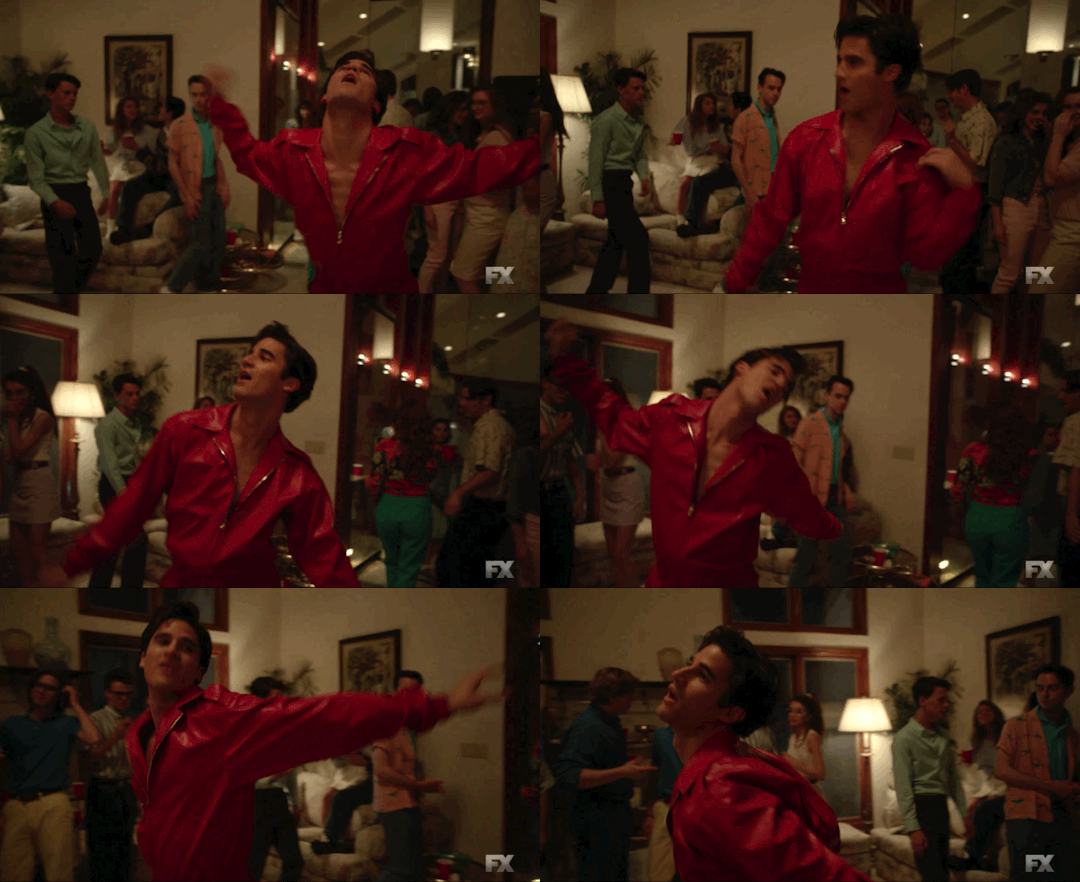
Andrew is trying to make the best of the situation, going around to parties in ridiculous red one-suits and all that, once again proving he’s never exactly been one to fit in.

That’s when the FBI shows up. Modesto has conned enough people out of their money for it to have been a crime. While Modesto escapes the office, runs home to grab his extra cash and still has time left to escape in the car his favorite son, Andrew and his mother are left to deal with the authorities.

Guess what: they don’t (surprise, surprise) get to keep the house.

Frustrated and confused, Andrew decides he’ll go find wherever his father ran off to and try to get some questions answer. That place just so happens to be Manila, so suddenly Andrew is on a plane that’s headed to the Philippines.

He doesn’t exactly find the reunion he was hoping for. While Modesto is happy to see him at first, the conversation quickly turns sour when he feels Andrew has been ungrateful for all he’s done. “You’re not upset that I stole; you’re upset that I stopped,” Modesto tells him before spitting in his face.

Returning home defeated, Andrew and his mother are forced to move out and find jobs. We see Andrew apply for at the pharmacy we then see him working at in the previous episode, which is when he’s asked by the owner about what his father does.

This is when we see Andrew get that ever so familiar grin on his face, as he conjures up a fable.  He says that his father owns a pineapple business, making millions upon millions of dollars.

And we all know that the lies only escalate from there.

There’s only one episode of American Crime Story: Versace left, airing Wednesday night on FX!

‘American Crime Story: Versace’ recap: ‘Creator/Destroyer’ – TheCelebrityCafe.com

American Crime Story: The Assassination of Gianni Versace S02E08: Creator/Destroyer

A stylish episode that fills in the last gaps in Andrew’s story, hopefully.

The Assassination of Gianni Versace has been a detailed character study of the assassin and his victims. Andrew Cunanan has been so thoroughly explored over the past seven episodes, with an episode each for four out of his five victims, that I’m starting to wonder whether there is anything left that we need to explore. Despite being a huge fan of this season’s backwards structure, last weeks Ascent left me craving that the structure would be broken, and the manhunt begun. Then Creator/Destroyer comes along and reaffirms my faith and confidence in this show’s direction. As much as we already know about Andrew there is always that lingering presence of his father, who has been conspicuous by his absence up to this point. We have already seen that Andrew’s family has a history of mental illness (most families do, which rarely leads to murder despite what pop culture would have us believe) due to his mother’s fragile mental condition. She is possessive, but not abusive, so where has Andrew learned this behaviour?

Enter Modesto Cunanan, Andrew’s father from the Philippines who has amassed a great fortune according to his son. Considering the fact that we have had almost an entire season to get used to spotting Andrew’s lies, it’s obvious that his image of his father, used in an almost PR-like way by Andrew, is far from his true identity. Creator/Destroyer draws parallels between Gianni Versace and the man who killed him once again in an effort to rubber stamp its themes. Before we meet Modesto, we are given an introductory scene consisting of how Gianni, as a young boy, found his passion for design. His mother is a dressmaker, and Gianni is so fascinated by her work that he begins to sketch some designs himself. Despite his teacher calling him a pervert when she sees these drawings, and a fellow student call him a pansy, Gianni’s mother supports her son’s dream of becoming a designer. As she agrees to help him create a dress from these designs, she tells him that hard work and perseverance are the essential components of realising this dream. While he may have talent his Gianni’s mother instils a strong work ethic that he and Donatella showcase in later life.

While these scenes are essential in showing the contrast between Gianni and Andrew’s upbringing, they feel purely functional (as most of the Versace stuff has been this season) and don’t have the same skill and nuance that Andrew’s scenes have.

Still, they do serve a function, and through Gianni’s mother’s sound advice, we can see how Modesto Cunanan short-changed his son. Remember when Andrew told David that he was given the master bedroom when he was younger? Like David, I bet you thought that Andrew made that up. It’s true, Andrew, despite having two other siblings, was his parents favourite, especially his father. Andrew’s father taught him that success, despite how nebulous that term is, is the goal. It doesn’t matter what you do, as long as it gets you lots of money. This is obviously bad parenting, neglecting to teach your children the value of a dollar can blow up in your face many times down the line, but even Andrew’s ambitions (like writing a novel because he loves stories) are put through this financial filter.

How can a child learn about working hard when he gets the master bedroom, preferential treatment compared to his brother and sister, and a car before he is even old enough to drive. Creator/Destroyer smartly shows how destructive being the golden boy has been to Andrew’s sense of self. His father shows all of the characteristics of an abusive partner, to both Andrew’s mother and to Andrew himself. He baits his family with tales of bad news so he can find a reason to exert his power when he turns the tables. He separates Andrew from the rest of the family by telling him how special he is, and how much he loves Andrew more than the rest. This is emotional abuse that can crop up in romantic relationships. A person cuts their partner off from friends and family by telling lies and saying that they are the only one that their partner can count on. The script, and Matt Bomer’s tasteful direction hint at sexual abuse by playing up mood and a chilling performance Jon Jon Briones when he is alone with Andrew in Andrew’s room. While there is no proof of this abuse, it does make sense within the context of this show and goes a long way to explaining Andrew’s own intimacy problems.

It’s finally revealed that Andrew’s father is a fraud: an embezzler of money that must flee to his home country. Andrew’s vision of his father is so firmly in place that he believes that there is money stowed away. When he visits his father in the Philippines the truth finally comes out. Modesto is a weak man, that shatters his son’s image of him while also calling out the hypocrisy of his Andrew himself. Andrew was willing to believe that his father was a big shot as long as the money was coming in. This is ridiculous of course. It’s not Andrew’s fault at all, despite what his father has accused him of. What’s also telling is that, despite Andrew’s clear intent to hurt his father he, like many victims of abuse, chooses to hurt himself instead. Faced with a new reality, one in which his father has irreparably failed him, he decides to symbolically kill off this version and replace him with the big shot plantation owner that we are familiar with.

8/10 – A return to the quality we’ve come to expect from this show, with Jon Jon Briones the latest guest star to challenge Darren Criss for performance of the season.

American Crime Story: The Assassination of Gianni Versace S02E08: Creator/Destroyer

ACS: Versace Recap: Andrew’s And Gianni’s Childhoods Reveal Polar Opposite Lives In “Creator/Destroyer”

It’s hard to believe that we are one week away until the finale of The Assassination of Gianni Versace: American Crime Story. And while it’s been one hell of a ride with one hell of an acting tour de force from Darren Criss as Andrew Cunanan, I must say that there are times that I wish the episodes had shared equal focus on both the leads of the show. For a program to be named after the famed designer, he hasn’t appeared much in it.

Luckily in this episode, both the men were featured as we have gotten to the very end of the flashbacks as far as the events leading up to Gianni’s death go. In the Matt Bomer directed episode and featuring an amazing turn by Jon Jon Briones, we finally got to meet Cunanan’s father, and it is safe to say that the apple did not fall far from the tree as far as behaviors go.

Gather round and let’s discuss the episode aptly titled “Creator/Destroyer”.

Daddy Dearest:  Cunanan’s childhood, as it turned out, wasn’t as bad as one might have thought it to be, at first anyway. His dad worked for Merrill Lynch, talking his way into a highly coveted job with his professed work ethic and track record of upward mobility. Cunanan’s father also spoiled him terribly: the would-be killer got the master bedroom of the house and a car before he was even old enough to drive. His father constantly told him that he was better than anyone else, even though Andrew had siblings.

Life Of The Party: Cunanan’s luck doesn’t end at the house with his father either as he gets into a prestigious private school, where he’s voted “most likely to be remembered.” We also get to see how he meets Lizzie at a house party while spinning on the dance floor in a red, leather one-piece jumpsuit.  This version of Cunanan isn’t quite the liar just yet; just a charmer who dated older men.

Two Worlds: We get one glimpse of Gianni Versace’s childhood, mostly as a means to contrast Cunanan’s. When Versace is sketching, and called a “pansy” in school, his mother comforts him and promises to teach him. “You must do what you love, Gianni,” she says. As for Cunanan, he doesn’t get that kind of love and support, especially when   Cunanan tells his father he dreams of being a writer, his dad reminds him that writing isn’t an effective way to make money.

End Of A Fairytale: We then flash forward to see Modesto “Pete” Cunanan working not at Merrill Lynch, but in a cubicle, scamming the elderly out of their money. The FBI comes for him sooner than anyone might have expected as they pop up to his office, barely giving Modesto enough time to escape home, pry out some cash from underneath floorboards, and exit through a backdoor  before flying away to Manila and leaving his family with nothing. They lose the house but Cunanan still believes in his father so he packs his case and leaves his mother to go to Manila alone to find his father, where he confronts him for his crimes. “Weak, like your mother,” Modesto tells him when Cunanan makes it to the shack where he has been living right before spitting in his face.

A Liar Is Born: When Cunanan returns home and gets a job at the pharmacy where we saw him at the beginning of last week’s episode, he’s a defeated person. That sense of utter rock bottom doesn’t last long as  Cunanan tells his first lie, which gives him the idea that he can build his own future based on said lies. His yearbook quote was in French after all, and as it turned out, oddly prophetic: “After me, destruction.”

Quote of the night:

“You’re not upset that I stole; you’re upset that I stopped.” Modesto

ACS: Versace Recap: Andrew’s And Gianni’s Childhoods Reveal Polar Opposite Lives In “Creator/Destroyer”

‘The Assassination of Gianni Versace: American Crime Story’ Episode 8 Recap: Oh Father

Andrew Cunanan was cool.

Like, really cool.

image

Sincerely, legitimately awesome.

image

That’s the tragedy of “Creator/Destroyer,” the penultimate episode of this extraordinary season of television. By the time we see Andrew in his full glory as one of the wildest guys at his high school, we’ve also seen his father Modesto, who debuts in this episode, get his hooks deep into the kid. Andrew has seen his father harangue and assault his mother. He’s borne the weight of all his dad’s dreams, knowing this comes at the expense of his siblings, sensing on some level it’s not right to have this kind of pressure placed on him but, because the pressure is couched as praise, not knowing how to fight back. He’s been…well, the show is cagey on this, but saying he’s been molested by his father would not be out of bounds.

And even now, as an ebullient and confident teenager, he’s begun certain behavior patterns that will get him in trouble in the end: he has a sugar daddy, and he becomes fast friends with Lizzie, his future bestie, because she shows up at a high-school house party pretending to be a kid rather than the married adult she really is. (“I’m an impostor.” “All the best people are.”) He’s picking up little tidbits on how to deceive (including his go-to pseudonym, DeSilva, the name of the people who own the house where the party takes place) and why (because “when you feel special, success will follow” as his father teaches him).

But for a brief time, he’s just a cool, slightly weird, slightly obnoxious, slightly closeted teenager, and if you weren’t at least two of those things during your high school career I don’t wanna know you. He stands up to homophobes in a familiar way, by camping it up even further, going so far as to pose for his class photo with his shirt all the way unbuttoned to show off his (impressive!) torso. He’s prophetically chosen to be “Most Likely to Be Remembered,” and equally prophetically selects “Après moi, le déluge” as his yearbook quote. He rolls into the parking lot like a refugee from Less Than Zero (complete with that movie’s soundtrack staple, the Bangles’ cover of “Hazy Shade of Winter”; the film was his IRL fave) and shows up at the house party in an Eddie Murphy red-leather jumpsuit. (Finally it’s clear why so many of his music cues over the course of the ‘90s portion of the series were anachronistically ’80s: The ’80s were his time.) This Andrew could be loved. This Andrew could be saved.

In that sense, Andrew’s not so far away from our episode-opening glimpse of Gianni Versace as a kid, though that’s the least successful segment of the episode, if not the whole season. This has been a bugbear of mine all season long, but for real: Anytime native Italian-speakers start talking to one another when there’s no one else around, those conversations scenes reallyshould take place in Italian. It’s next to impossible to feel a connection to young Gianni and his mother when they’re talking in absurdly accented English like they’re doing a nostalgic spaghetti-sauce commercial. The old-country lighting and color palette doesn’t help either, nor does the dialogue that Mama Versace and Young Gianni are forced to spout — an uplifting, after-school-special lesson about not letting bullies and homophobes and sexists stop you from pursuing your dreams, the importance of hard work, yadda yadda yadda.

Knowing this show, the excess schmaltz here is probably deliberate, intended to drive home the contrast between Gianni’s genuinely supportive mother, who instills in him the belief that effort, talent, and success are all interconnceted, with Andrew’s faux-supportive parents, who treat him like a god when they’re not terrifying him with pressure and spousal abuse and who brainwash him into believing that success is handed out to innately special people like a party favor. I get that, I appreciate that. But in a time when shows from The Americans to Narcos can spend half an episode or more using another language — or when shows like Game of Thrones shoot scenes in languages that are completely imaginary! — going with the “when the moon hits your eye like a big pizza-pie” approach displays a baffling lack of confidence in the audience. (This is the only episode where Tom Rob Smith shares the writing credit with another person, Maggie Cohn, and I wonder if that’s got something to do with it.)

Fortunately the show is on firmer ground with Andrew’s father. As Modesto “Pete” Cunanan, Jon Jon Briones faces the daunting task of airdropping into the series in its penultimate episode, in a role with no more or less responsibility than revealing the foundational traumas that turned Andrew Cunanan who and what he is. He makes it work so well that it starts to feel like he’s been there all along. He inhabits the era perfectly, for one thing: With his impeccable coiffed hair, double-breasted suits, tight-fitting leisure ware, and grown-ass-man mustache, he looks like every uncle in your family’s old faded photo album. He has a fireplug physicality and a crisp vocal cadence that can project confidence and dynamism one moment, then weirdness and menace the next. Frequently he’s called upon to shift between modes almost within a single sentence, as when he chokeslams Andrew’s mother Mary Ann to the ground and then immediately starts celebrating the purchase of his son’s new car once again.

And like many Horatio Alger cases, his belief in pulling himself up by his own bootstraps (as his superiors at Merrill Lynch put it) comes with undue contempt for those he considers weak. He brings up his childhood poverty in the Philippines as a talking point; he brings up Mary Ann’s postpartum depression and hospitalization as a weapon. Unsurprisingly for such a figure, at no time does he seem capable of addressing or even acknowledging his own weaknesses, his own pain. For one thing, he’s clearly experienced anti-Asian racism; that’s the unmistakable subtext of his interview with Merrill, where he’s the only candidate who isn’t white, as well as his relentless drive to assimilate and Americanize. It’s hinted at in the way he refers to his family home as a place his would-be employers could purchase with the cash in their wallets; when we finally see it, it’s not a mansion to be sure, but it’s no hellhole either. It’s a house, but it happens to be a house in a place other than America, which makes it a hovel in his eyes. He passes this self-hatred on to his son, who when asked by a relative in Manila if this is his “first time home” can’t even bring himself to respond. Only by concocting the legend of his father the pineapple magnate (plantations “as far as the eye can see,” he tells his Filipino boss at the pharmacy, for whom he holds nothing but contempt) can Andrew reconcile his heritage with his and his father’s hunger for the American dream.

Moreover, while Modesto’s justification for why the feds are out to bust him for theft but not his bosses — “They’re all stealing. My crime was that I stole too small…If I had stolen $100 million, they would have promoted me” — is pretty much completely accurate, it doesn’t explain why he left his family holding the bag. Watch him when he returns to his cubicle after learning his fraud has been uncovered: He grips the desk, grimaces, puts his head down for about two seconds, and by the time he raises it again he’s decided to buy tickets to Manila and abandon his wife and children. Not even his wall full of photos of Andrew (the style of which should look familiar at this point given all of his son’s similar shrines to Gianni Versace, and what does that tell you about this relationship) prevents him from telling his travel agent to book that flight.

I think there’s a moment that portrays the damage Modesto does to his son more clearly and powerfully than the car incident, than the bit where he pretends not to have gotten the job at Merrily Lynch and then berates Mary Ann for believing him, than his escape and exile, than his homophobic confrontation with his son when Andrew (in a rare and genuinely impressive display of hard work and emotional uncertainty) tracks him down in Manila, or even during the bedside scene that very heavily implies child molestation (implied again when, in ostensible reference to becoming reaccustomed to the Manila heat, he purrs to Andrew that “You can pretend you belong somewhere else, but the body knows”). And Modesto’s not even on screen for it at first.

In a scene that’s achingly familiar to any former young overachiever waiting for confirmation that they’ve gotten the thing they’re supposed to want, Andrew grabs the days mail directly from the postal worker and flips envelopes to the floor until he finds one from Bishop’s School, the prestigious secondary school Modesto has made it his life’s mission to get Andrew into. The next time we and his mother Mary Ann see him, he’s in tears. “Why are you crying?” Mary Ann asks, her toothy grin shaping the words. “You got in!”

Andrew is crying the way you might cry when you hear a certain test result came back negative, or receive word that your kid is alright after a bus accident. The pressure of being Modesto Cunan’s special son — so special that his father literally gets down and kisses his feet upon hearing the news — was slowly crushing him. Now that he’s made it, he’s sobbing from the decompression. What misery it must have been for him a few years later, then, when he realized he’d fought all his life to live up to a fraud. “I’m the world’s greatest opportunist,” his father once told him. We’ll see about that, Dad. We’ll see about that.

‘The Assassination of Gianni Versace: American Crime Story’ Episode 8 Recap: Oh Father