It’s hard to believe that we are one week away until the finale of The Assassination of Gianni Versace: American Crime Story. And while it’s been one hell of a ride with one hell of an acting tour de force from Darren Criss as Andrew Cunanan, I must say that there are times that I wish the episodes had shared equal focus on both the leads of the show. For a program to be named after the famed designer, he hasn’t appeared much in it.
Luckily in this episode, both the men were featured as we have gotten to the very end of the flashbacks as far as the events leading up to Gianni’s death go. In the Matt Bomer directed episode and featuring an amazing turn by Jon Jon Briones, we finally got to meet Cunanan’s father, and it is safe to say that the apple did not fall far from the tree as far as behaviors go.
Gather round and let’s discuss the episode aptly titled “Creator/Destroyer”.
Daddy Dearest: Cunanan’s childhood, as it turned out, wasn’t as bad as one might have thought it to be, at first anyway. His dad worked for Merrill Lynch, talking his way into a highly coveted job with his professed work ethic and track record of upward mobility. Cunanan’s father also spoiled him terribly: the would-be killer got the master bedroom of the house and a car before he was even old enough to drive. His father constantly told him that he was better than anyone else, even though Andrew had siblings.
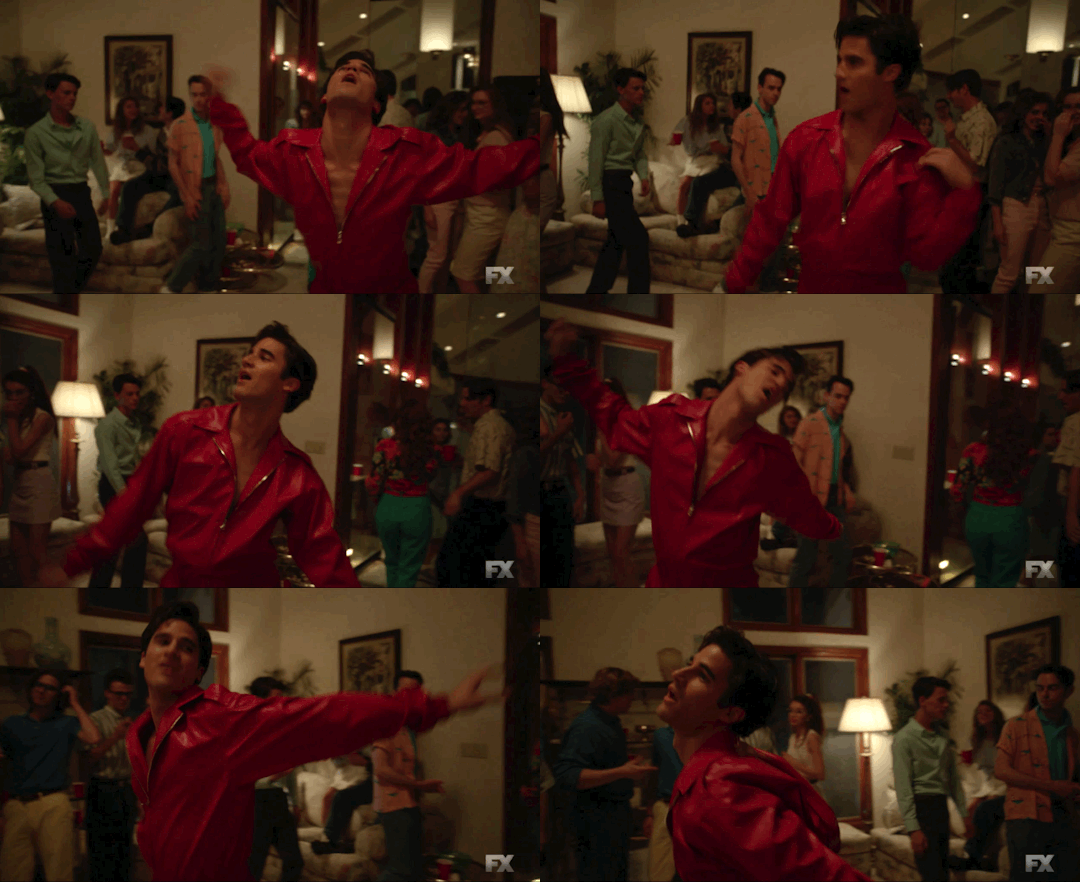
Life Of The Party: Cunanan’s luck doesn’t end at the house with his father either as he gets into a prestigious private school, where he’s voted “most likely to be remembered.” We also get to see how he meets Lizzie at a house party while spinning on the dance floor in a red, leather one-piece jumpsuit. This version of Cunanan isn’t quite the liar just yet; just a charmer who dated older men.
Two Worlds: We get one glimpse of Gianni Versace’s childhood, mostly as a means to contrast Cunanan’s. When Versace is sketching, and called a “pansy” in school, his mother comforts him and promises to teach him. “You must do what you love, Gianni,” she says. As for Cunanan, he doesn’t get that kind of love and support, especially when Cunanan tells his father he dreams of being a writer, his dad reminds him that writing isn’t an effective way to make money.
End Of A Fairytale: We then flash forward to see Modesto “Pete” Cunanan working not at Merrill Lynch, but in a cubicle, scamming the elderly out of their money. The FBI comes for him sooner than anyone might have expected as they pop up to his office, barely giving Modesto enough time to escape home, pry out some cash from underneath floorboards, and exit through a backdoor before flying away to Manila and leaving his family with nothing. They lose the house but Cunanan still believes in his father so he packs his case and leaves his mother to go to Manila alone to find his father, where he confronts him for his crimes. “Weak, like your mother,” Modesto tells him when Cunanan makes it to the shack where he has been living right before spitting in his face.
A Liar Is Born: When Cunanan returns home and gets a job at the pharmacy where we saw him at the beginning of last week’s episode, he’s a defeated person. That sense of utter rock bottom doesn’t last long as Cunanan tells his first lie, which gives him the idea that he can build his own future based on said lies. His yearbook quote was in French after all, and as it turned out, oddly prophetic: “After me, destruction.”
Quote of the night:
“You’re not upset that I stole; you’re upset that I stopped.” Modesto
Brett, Meredith, Brett and Alonso review the eighth episode of American Crime Stories second season about the assassination of Gianni Versace. | 15 March 2018
That’s the tragedy of “Creator/Destroyer,” the penultimate episode of this extraordinary season of television. By the time we see Andrew in his full glory as one of the wildest guys at his high school, we’ve also seen his father Modesto, who debuts in this episode, get his hooks deep into the kid. Andrew has seen his father harangue and assault his mother. He’s borne the weight of all his dad’s dreams, knowing this comes at the expense of his siblings, sensing on some level it’s not right to have this kind of pressure placed on him but, because the pressure is couched as praise, not knowing how to fight back. He’s been…well, the show is cagey on this, but saying he’s been molested by his father would not be out of bounds.
And even now, as an ebullient and confident teenager, he’s begun certain behavior patterns that will get him in trouble in the end: he has a sugar daddy, and he becomes fast friends with Lizzie, his future bestie, because she shows up at a high-school house party pretending to be a kid rather than the married adult she really is. (“I’m an impostor.” “All the best people are.”) He’s picking up little tidbits on how to deceive (including his go-to pseudonym, DeSilva, the name of the people who own the house where the party takes place) and why (because “when you feel special, success will follow” as his father teaches him).
But for a brief time, he’s just a cool, slightly weird, slightly obnoxious, slightly closeted teenager, and if you weren’t at least two of those things during your high school career I don’t wanna know you. He stands up to homophobes in a familiar way, by camping it up even further, going so far as to pose for his class photo with his shirt all the way unbuttoned to show off his (impressive!) torso. He’s prophetically chosen to be “Most Likely to Be Remembered,” and equally prophetically selects “Après moi, le déluge” as his yearbook quote. He rolls into the parking lot like a refugee from Less Than Zero (complete with that movie’s soundtrack staple, the Bangles’ cover of “Hazy Shade of Winter”; the film was his IRL fave) and shows up at the house party in an Eddie Murphy red-leather jumpsuit. (Finally it’s clear why so many of his music cues over the course of the ‘90s portion of the series were anachronistically ’80s: The ’80s were his time.) This Andrew could be loved. This Andrew could be saved.
In that sense, Andrew’s not so far away from our episode-opening glimpse of Gianni Versace as a kid, though that’s the least successful segment of the episode, if not the whole season. This has been a bugbear of mine all season long, but for real: Anytime native Italian-speakers start talking to one another when there’s no one else around, those conversations scenes reallyshould take place in Italian. It’s next to impossible to feel a connection to young Gianni and his mother when they’re talking in absurdly accented English like they’re doing a nostalgic spaghetti-sauce commercial. The old-country lighting and color palette doesn’t help either, nor does the dialogue that Mama Versace and Young Gianni are forced to spout — an uplifting, after-school-special lesson about not letting bullies and homophobes and sexists stop you from pursuing your dreams, the importance of hard work, yadda yadda yadda.
Knowing this show, the excess schmaltz here is probably deliberate, intended to drive home the contrast between Gianni’s genuinely supportive mother, who instills in him the belief that effort, talent, and success are all interconnceted, with Andrew’s faux-supportive parents, who treat him like a god when they’re not terrifying him with pressure and spousal abuse and who brainwash him into believing that success is handed out to innately special people like a party favor. I get that, I appreciate that. But in a time when shows from The Americans to Narcos can spend half an episode or more using another language — or when shows like Game of Thrones shoot scenes in languages that are completely imaginary! — going with the “when the moon hits your eye like a big pizza-pie” approach displays a baffling lack of confidence in the audience. (This is the only episode where Tom Rob Smith shares the writing credit with another person, Maggie Cohn, and I wonder if that’s got something to do with it.)
Fortunately the show is on firmer ground with Andrew’s father. As Modesto “Pete” Cunanan, Jon Jon Briones faces the daunting task of airdropping into the series in its penultimate episode, in a role with no more or less responsibility than revealing the foundational traumas that turned Andrew Cunanan who and what he is. He makes it work so well that it starts to feel like he’s been there all along. He inhabits the era perfectly, for one thing: With his impeccable coiffed hair, double-breasted suits, tight-fitting leisure ware, and grown-ass-man mustache, he looks like every uncle in your family’s old faded photo album. He has a fireplug physicality and a crisp vocal cadence that can project confidence and dynamism one moment, then weirdness and menace the next. Frequently he’s called upon to shift between modes almost within a single sentence, as when he chokeslams Andrew’s mother Mary Ann to the ground and then immediately starts celebrating the purchase of his son’s new car once again.
And like many Horatio Alger cases, his belief in pulling himself up by his own bootstraps (as his superiors at Merrill Lynch put it) comes with undue contempt for those he considers weak. He brings up his childhood poverty in the Philippines as a talking point; he brings up Mary Ann’s postpartum depression and hospitalization as a weapon. Unsurprisingly for such a figure, at no time does he seem capable of addressing or even acknowledging his own weaknesses, his own pain. For one thing, he’s clearly experienced anti-Asian racism; that’s the unmistakable subtext of his interview with Merrill, where he’s the only candidate who isn’t white, as well as his relentless drive to assimilate and Americanize. It’s hinted at in the way he refers to his family home as a place his would-be employers could purchase with the cash in their wallets; when we finally see it, it’s not a mansion to be sure, but it’s no hellhole either. It’s a house, but it happens to be a house in a place other than America, which makes it a hovel in his eyes. He passes this self-hatred on to his son, who when asked by a relative in Manila if this is his “first time home” can’t even bring himself to respond. Only by concocting the legend of his father the pineapple magnate (plantations “as far as the eye can see,” he tells his Filipino boss at the pharmacy, for whom he holds nothing but contempt) can Andrew reconcile his heritage with his and his father’s hunger for the American dream.
Moreover, while Modesto’s justification for why the feds are out to bust him for theft but not his bosses — “They’re all stealing. My crime was that I stole too small…If I had stolen $100 million, they would have promoted me” — is pretty much completely accurate, it doesn’t explain why he left his family holding the bag. Watch him when he returns to his cubicle after learning his fraud has been uncovered: He grips the desk, grimaces, puts his head down for about two seconds, and by the time he raises it again he’s decided to buy tickets to Manila and abandon his wife and children. Not even his wall full of photos of Andrew (the style of which should look familiar at this point given all of his son’s similar shrines to Gianni Versace, and what does that tell you about this relationship) prevents him from telling his travel agent to book that flight.
I think there’s a moment that portrays the damage Modesto does to his son more clearly and powerfully than the car incident, than the bit where he pretends not to have gotten the job at Merrily Lynch and then berates Mary Ann for believing him, than his escape and exile, than his homophobic confrontation with his son when Andrew (in a rare and genuinely impressive display of hard work and emotional uncertainty) tracks him down in Manila, or even during the bedside scene that very heavily implies child molestation (implied again when, in ostensible reference to becoming reaccustomed to the Manila heat, he purrs to Andrew that “You can pretend you belong somewhere else, but the body knows”). And Modesto’s not even on screen for it at first.
In a scene that’s achingly familiar to any former young overachiever waiting for confirmation that they’ve gotten the thing they’re supposed to want, Andrew grabs the days mail directly from the postal worker and flips envelopes to the floor until he finds one from Bishop’s School, the prestigious secondary school Modesto has made it his life’s mission to get Andrew into. The next time we and his mother Mary Ann see him, he’s in tears. “Why are you crying?” Mary Ann asks, her toothy grin shaping the words. “You got in!”
Andrew is crying the way you might cry when you hear a certain test result came back negative, or receive word that your kid is alright after a bus accident. The pressure of being Modesto Cunan’s special son — so special that his father literally gets down and kisses his feet upon hearing the news — was slowly crushing him. Now that he’s made it, he’s sobbing from the decompression. What misery it must have been for him a few years later, then, when he realized he’d fought all his life to live up to a fraud. “I’m the world’s greatest opportunist,” his father once told him. We’ll see about that, Dad. We’ll see about that.
The Assassination of Gianni Versace: American Crime Story is known more so for its coverage of Andrew Cunanan than the man himself, but it also should be known for its utter disregard to anything and everything Italian.
As someone who grew up in an Italian household, Versace is a pretty big deal (especially since my mother works in fashion). So to see a show completely ignore the fact that he’s Italian and then not even bother using actual Italian in a scene set in Italy is pretty outrageous.
But don’t worry, the show goes back to covering Andrew shortly afterward because I’m 99 percent sure the only reason this show is a thing is because Ryan Murphy wanted Darren Criss to play Cunanan and didn’t care about Versace at all.
Week after week, it seems like the assassination is almost an afterthought. Which, it isn’t exactly surprising because Ryan Murphy tends to miss the point of what people want to see anyway. Remember Glee?
This week we got more of the backstory of Andrew and his “struggle” growing up as a gay man; we even got a house party scene where he danced to Michael Jackson. But again, I have to stress, who cares? I know that I wanted this show because of Gianni Versace, not because Darren Criss was aiming to win a Golden Globe (that I don’t think he’ll even get a nomination for).
Ryan Murphy continues to let me down, and I feel like this is college all over again where I’m trying to defend Glee to people. Maybe Ryan Murphy shouldn’t sell us a show about Versace if the show itself isn’t about Versace.
The opening of the penultimate episode of The Assassination of Gianni Versace takes us further back in time than we’ve ever been in the series. It’s 1957, and a very young Gianni Versace is trying to learn his place in the world. He’s an outsider at school; picked on by teachers, ignored by fellow students. He sits in his mother’s dress-making shop and watches her work, a sense of awe and wonder on his face the entire time.
He wants to do what his mother does. And so he does.
While school discourages this desire in Versace, his mother embraces it. If her son wants to be a dress-maker, so be it. She wants to nurture this in the child, and give him the chance to grow.
Yet when she places a pencil in Versace’s hand and asks him to design something for her, he instantly gives up.
“I can’t,” he says. “It’s too hard.”
It’s supposed to be hard, his mother counters. “Success only comes with hard work,” she says. “And it takes many years. But that’s alright. That’s why it’s special.”
It’s clear why this scene is here: to sharply contrast Versace against his murderer Andrew Cunanan even more. Here is the message that no one bothered to instill in Andrew – that success takes time, and that you have to work for it.
1980
It would be inaccurate to say that one event, one specific thing, turned Andrew Cunanan into the sociopathic serial killer he became. That’s not how these things work. But while there was no specific trigger, it’s clear from “Creator/Destroyer” that Andrew’s upbringing certainly didn’t help matters. This week, we’re provided with more insight into Andrew’s life, and it’s not pleasant.
As a child, Andrew adores his father, Modesto “Pete” Cunanan (Jon Jon Briones, giving a phenomenal, disturbing performance). Modesto is an immigrant, and he seems obsessed with the concept of making the so-called “American dream” a reality. He moves his family across the country, and sweet-talks his way into a cushy job at Merrill Lynch.
It becomes very clear very quickly that Modesto is a cruel, even violent man. His wife lives in terror of him, and his other children steer clear. Andrew is the only child who receives any sort of warmth from the man, and as a result, he would do seemingly anything to make his father proud.
We watch as the young Andrew interviews to join a fancy school. When asked by the board why he wants to attend the school, Andrew replies, “Because it’s the best school in America.” When asked who told him that, Andrew says: “My father.”
The school board then asks Andrew a seemingly simple question: if he could have one wish, what would it be? Never one for simple answers, he rattles off a list of material things – a house overlooking the ocean, multiple Mercedes’. Here, the school board cuts him off, reminding him that these are multiple things, and what they want to know is what would be his one ultimate wish. Andrew thinks about it for a moment, then replies: “To be special.”
Here again is the sharp contrast between Andrew and Versace. Andrew doesn’t want to be good at anything; he doesn’t want to have talent. He just wants the adulation.
And for a while, he gets it, courtesy of his father. Like when Modesto buys a brand-new car for Andrew, even though Andrew isn’t even old enough to drive yet. Thanks to his father, Andrew comes to believe he truly is special. But this feeling won’t last forever.
1987
A lot can change in 7 years. After setting up Andrew’s “special” childhood, “Creator/Destroyer” jumps ahead 7 years, just as the bottom is about to fall out. Modesto is no longer working at Merrill Lynch. Instead, he’s set-up shop in a rinky-dink firm that operates out of a strip mall; the type of establishment that might have popped-up in The Wolf of Wall Street.
Andrew has grown into a cocky, fun-loving 18 year old. He has an older, married lover who buys him gifts and keeps him comfy – but Andrew wants more. He wants to show his lover off to his friends – something the older man wants no part of. “This is strictly on the side,” he tells Andrew. It’s not that Andrew genuinely cares about this older man; he just wants to show-off. That’s the nature of Andrew Cunanan. To brag; to cause a scene. To get attention.
The happiness that Andrew is feeling is about to crumble apart like a sand castle as the tide is coming in. Modesto is busted for fraud – he’s been selling non-existent stocks to clueless, elderly people. When the feds come calling, Modesto flees the country – leaving his family behind, and in serious financial trouble. Andrew’s mother is understandably worried, telling Andrew that the family has no money, and that Modesto secretly sold their house months ago. But Andrew doesn’t want to hear it. He shrugs his mother off, and insists that his father wouldn’t leave them in such trouble. He must have a plan. He must have money stashed somewhere. He must.
So Andrew charts a trip to Manila to find his fugitive father. Modesto is living with a relative, bunked out in a shadowy, sweaty shack in the middle of nowhere. He welcomes Andrew with open arms, but the reunion turns sour very quickly. Andrew asks Modesto about any hidden money the family might be able to use. Modesto insists there is money. A lot of it. “Millions,” he says.
“Where?” Andrew asks.
“Out of reach,” is Modesto’s lame answer.
Later that night, however, Andrew gets the truth: there is no money. Andrew is furious and disgusted with Modesto, but Modesto is, in turn, just as disgusted with Andrew.
“You can’t go to America and start from nothing,” Modesto says bitterly. “That’s the lie, so I stole.”
“If you’re a lie, than I’m a lie,” Andrew cries.
“You’re not upset that I stole, you’re upset that I stopped,” his father shoots back. “Now you have to work, for yourself.”
In a fit of rage, Andrew brandishes a knife at his father, but backs off, whimpering.
“You don’t have it in you,” Modesto says, his voice thick with disgust. If only he could see into the future…
That bleak, blood-soaked future is calling. But first, Andrew returns home, defeated, and takes a job at a pharmacy. When quizzed about his family by the pharmacy owner, Andrew does what will soon come very naturally to him: he lies. His father is a success story, he says. And if Andrew’s father is a success story, then so is Andrew.
Creator/Destroyer
After spinning its wheels in previous episodes, American Crime Story finally finds its footing again with “Creator/Destroyer.” Part of that is due to the direction of actor Matt Bomer. Bomer doesn’t just juggle multiple narratives with ease, he also sets up three distinct time periods and locations – the Italy of Versace’s youth, the California of Andrew’s, and shadowy, humid Manila where Modesto is hiding out. The result is a clear, concise three-act structure that other episodes of this season have been drastically missing.
The other key element of this week’s episode is the performance of Jon Jon Briones as Andrew’s father Modesto. Briones is incredible here, crafting a truly memorable, truly unsettling character. Because of Modesto’s sleazy, cruel nature, we find ourselves empathizing with Andrew ever-so-slightly. It’s hard to have any sympathy for Andrew, since we know what a destructive monster he eventually becomes. But seeing his childhood, and watching his interactions with Modesto, we can at least begin to understand some of Andrew’s behavior.
Now that we’ve gone as far back into Andrew’s life as we can possibly go, there’s only one place American Crime Story: The Assassination of Gianni Versace can go: back to the future. Back to the aftermath of Versace’s murder. The event that launched us on this violent, unsettling journey through the life of Andrew Cunanan. The end is near.
I was expecting a little more from the penultimate episode of The Assassination of Gianni Versace: American Crime Story. Instead, we continue our journey backward through the life of Andrew Cunanan. This time, we traced his early childhood and high school years. With only one episode left to go, I don’t think we’ll follow him back to the womb, and I, for one, am glad.
I’ve been lamenting this storytelling technique all season. With Cunanan, so few details are known that it feels disingenuous to portray the series as an exploration of why he did what he did. I don’t think I’m coming away with more of a sense of sympathy for Cunanan, nor do I want to.
The focus on Cunanan’s formative years also robbed us of spending time with Versace. All the decadence and luxury the promos promised feels a bit like a bait and switch. Remember the bungled manhunt for Cunanan that started in the premiere? I guess we’re only getting the bulk of that in the last episode.
It’s a strange choice considering how little happened in last night’s 90-minute episode. “Creator/Destroyer” was directed by Matt Bomer, who did a serviceable job of it, although it could have been condensed, for sure.
It was another mostly Versace-less installment, with just a quick glimpse of a young Versace being bullied at school, but showered with support and adoration at home. His sexuality and his passion for fashion were encouraged by his mother.
Andrew, on the other hand, didn’t enjoy the same level of acceptance or comfort. As a young boy, his father, Modesto, treated him like a prince. (He actually had the master bedroom, turns out.) He groomed him to be “special.” Modesto is all about projecting success to help blend in with white, suburban life. He’s thrilled when Andrew gets into a prestigious private school, so much so he buys young Andrew a car he’s not even old enough to drive.
Although he’s beloved at home, he faces a bit more trouble at school. Fitting in isn’t Andrew’s strongest suit. He’s got style and flair. Whether he’s bemoaning the staid yearbook photo setup or rocking a red leather jumpsuit to a house party, he’s very, very extra.
It draws a few side-eyes and name-calling from classmates, but even then Andrew did better with an older audience (including the married man he was seeing while he was a teen). At the aforementioned house party, he connects with Lizzie, the female friend we’ve seen him with later in California. Apparently, they met at this high school house party she crashed because she missed being young.
She calls it being an “impostor” which is a pretty heavy-handed way of characterizing her actions as a means of forcing a connection to Andrew’s later lies.
Modesto’s lies had much more impact. His pathological obsession with keeping up with the Joneses drove him to start swindling. After trying to get more cash out of a 90-year-old woman, the feds are on his tail. As they close in on him, he flees the office, grabs cash from under the floorboards of the house and flees the country.
Modesto’s spiral from Merrill Lynch broker to sleazy con artist destroyed the family and left them with nothing. Andrew can’t accept his father being a fraud, so he tracks him down in Manila. His father is shacking up in an actual shack. He’s still spinning lies about having millions of dollars hidden from the feds.
It’s one lie too many. Andrew traveled around the globe to find his father, and he’s not leaving without facing a hard truth. He confronts his father in a heated scene wherein Modesto calls him a “sissy” multiple times before spitting in his own son’s face.
This is the moment, American Crime Story seems to suggest, that Cunanan snapped. Upon his return to the States, facing homelessness and bankruptcy, he applies for the job at the pharmacy. He tells the boss his father is in Manila running pineapple plantations, a first step into the twisted world-building we’ve seen Andrew master over time.
Next week the story comes to an end with Gianni’s funeral and the climax of the manhunt for Cunanan.
The apple never seems to fall far from the tree, and now we finally have answers as to why Andrew Cunanan is such a lying, delusional, narcissistic sociopath: his dad basically groomed him to be that way.
Modesto Cunanan favors his son over his other children, brags about how successful he is even though he can barely hold a job and eventually flees the country with stolen money and most of his family’s savings. He tells Andrew he’s special, that his dreams will come true if he just imagines them and to appreciate the best things in life. These are not terrible things to teach your children, but Modesto lays it on so thick that Andrew begins to live in Modesto’s fantasy world. Once Modesto flees and Andrew’s vision of him is shattered, it doesn’t seem to shake Andrew out of his privileged fantasy. He just doubles down and picks up the trail of lies where his Dad left off.
This is all in stark contrast to Versace. The scenes between him and his Mother are incredibly brief, but his mom is supportive of him at a young age (instead of in denial about who he really is) and when Versace balks at challenging work, his mother urges him to continue. It would have been nice to see even more of Versace’s childhood, but as we’ve slowly discovered, this show isn’t really about Versace.
I’ve been wondering since this series started who Andrew really was and how he got to be so awful. As we set up for the final showdown next week – when Andrew’s time on the run will finally be over – I feel like I finally know who this man is. The backwards timeline took a long time to figure out, but now part of me wants to go back and watch it again. In hindsight, it would be so much easier to understand the progression of this spoiled little boy who turned into cold-hearted killer.
It makes us feel better to know how someone became capable of so much evil. The reasoning separates us from them, because we don’t dare dream that there’s only a thin line separating those who snap and those who don’t. It feels good to know Cunanan had a violent, delusional upbringing and there was total justification for what he did, right?
The truth is, there are a lot of crappy parents out there, but not every child grows up to go on a murder spree. Cunanan’s parents were definitely one of the secret ingredients that led to his downfall as a human being, but there had to be something else. That, I think, is the unknowable thing about Andrew Cunanan. He had friends, and at times he had money. But he still decided to do terrible things. We’ll never know the specific reasons for his horrible choices because we were only able to skim the surface of his story, but at least Cunanan is no longer a blank canvas. We know he was loved, he had his heart broken and he was somebody’s best friend. This show humanized a man who was previously just a headline to me. It does not make me feel sympathetic for him, though. If anything, it just adds to the list of tragedies surrounding him.
Next week, we jump back to the ending and follow the events immediately following Versace’s murder. We know there will be closure on Cunanan’s side, and hopefully the Versace and Donatella arc will feel just as satisfying.
Just about every episode of The Assassination of Gianni Versace has provided a different possible answer to the question of why? Did Andrew Cunanan murder five men because he was a sociopath, or because his heart was broken? Was he lashing out because he’d failed at life, or did he see his killing spree as a way of attaining immortality? (If so, unfortunately, he was correct.) Was he a victim of widespread homophobia, or the living embodiment of it? Should we blame his fragile, mentally ill mother or, as last night’s penultimate episode, “Creator/Destroyer,” suggests, his defrauder dad?
We’ve heard so much about Modesto “Pete” Cunanan in the season’s first seven episodes that his appearance this week qualifies as a reveal. Andrew mentions this mythical figure in the crucial, if also fantastical, scene from the pilot where he and Gianni have a heart-to-heart at the San Francisco Opera. By then, a few years after we leave him in “Creator/Destroyer,” he’s perfected his story about the pineapple plantations and the boyfriend and Imelda Marcos. Now we know that Andrew learned to lie so shamelessly from his father, whose entire life was a con.
Pete grew up in the village of Baliuag, in the Philippines. As we hear him mention in his Merrill Lynch interview, he began his career in the US Navy. In 1961, he met Andrew’s mom, MaryAnn. Although he was a short, squat man 11 years her senior, she fell for him immediately. As she recalls to Maureen Orth in Vulgar Favors, “He was dressed in a white tuxedo, and I thought he looked like a Filipino Errol Flynn.” By the time they married, the same year they met, MaryAnn was six months pregnant. The kids we see in the episode are all ostensibly the products of that union—although Pete, who was constantly paranoid that his wife was cheating on him, maintained that their blonde, blue-eyed elder daughter, Elena, wasn’t his.
From here, the show’s timeline gets messy. It’s true that the Cunanans bought their first home, in the working-class San Diego suburb National City, for around $12,000, or roughly $90k today. Andrew was born two years later, in 1969. But when he was four, they moved to a fancier house in middle-class Bonita. Paid for with an inheritance MaryAnn received after her father died, the new place would have cost more than $550,000 in 2018.
The mini-mansion they bought when Andrew was a teenager was a third, even more expensive, home—the one we see them move into at the beginning of “Creator/Destroyer,” except that Versace suggests that he was just a precocious ten- or 11-year-old at the time. (Shout out to Evelyn Waugh’s Brideshead Revisited, a classic novel of wealth, war, and homoeroticism that Andrew started obsessing over after he caught the equally beloved 1981 PBS miniseries.)
His dad did, in fact, give him the master bedroom and buy him a sports car before he was old enough to drive it. There’s a peculiar, uncharacteristically context-free passage in Vulgar Favors where Orth notes, “People have wondered whether Pete and Andrew could possibly have had an intimate relationship while Andrew was growing up,” then reports that, “Pete is not upset by the question. He coolly takes a drag on his cigarette, and says no.” And that’s the end of that.
In any case, it was MaryAnn’s idea to send Andrew to La Jolla’s exclusive Bishop’s School. Although he hid his sexuality from his family, at school he cultivated a gregarious, pretentious, preppy, and extremely effeminate persona inspired by the aristocratic, queer Brideshead character Sebastian Flyte. He dated older men who showered him with gifts—including one named Antoine, who supposedly paid for that insane red leather suit Andrew wears to the house party. (That Antoine was a married closet-case is pure speculation on the show’s part.) The details about his yearbook, in which classmates voted him “Most Likely to Be Remembered” and he captioned his senior photo “Après moi, le déluge” (“After me, the flood”), an ominous quote attributed to either King Louis XV or his mistress, Madame de Pompadour, are accurate.
Meanwhile, Pete had retired from the Navy in 1977, earned his bachelor’s degree and MBA, and entered a stockbroker training program at Merrill Lynch. He left two years later, going on to work at five other firms between 1981 and 1988. One former employer told Orth that Pete had stolen money from clients, including at least one nonagenarian like the elderly woman we see him talking to on the phone, at many of those companies. “There is no disclosable disciplinary action with the [National Association of Securities Dealers] on record,” Orth writes, “but Pete was let go more than once.” There was never any dramatic FBI chase, but Pete did secretly sell the Cunanan home and flee to the Philippines. MaryAnn spiraled, her kids dropped out of college, and Andrew spent five uncomfortable days in his dad’s homeland. As Versace suggests, he’d bought in to Pete’s lies about their prosperity as much as anyone else.
The connection to Gianni Versace’s childhood, in a rare dive into the designer’s history that actually works on the show, is obvious. Versace’s mother, Francesca, really did want to be a doctor before yielding to the sexism of the the family’s Southern Italian home city of Calabria and starting a prosperous dressmaking business instead. In her book House of Versace, Deborah Ball writes that Franca had opened her own shop by age 20. That Andrew’s beloved dad bought his son everything he wanted and encouraged him to see himself as special, while Gianni’s beloved mom preached hard work and taught him to sew, is too telling a contrast to ignore.
There were other important differences between Cunanan’s and Versace’s beginnings, of course. The Assassination of Gianni Versace has been taken to task for erasing Andrew’s biracial identity. Although she praises Ryan Murphy’s decision to cast Darren Criss, a half-Filipino Glee alum, in the starring role, Slate critic Inkoo Kang points out that, “A few character details here and there suggest Andrew’s racial self-hatred and the prevalence of anti-Asian racism within the gay community, but the relative sparseness of these implications is all the more noteworthy in contrast with the richly developed portrait of the decade’s homophobia.”
Last night’s episode goes a long way toward justifying the omission. Murphy and writer Tom Rob Smith aren’t blithely erasing Andrew’s Filipino identity so much as depicting the way he denied his Asian-American side because he was ashamed of his father. In an interview with Vulture, Smith said, “It’s interesting that [Andrew] excludes his own racial identity, which is why you don’t get to it until a later part of the episodes, because he lies about it.” Pete’s story, which highlights how he talked his way into the overwhelmingly white world of banking and implies that racism kept him from excelling there, is the story of the role Andrew’s nonwhite heritage played in his life. By the end of the episode, he’s rejected his dad, left the Philippines, and applied for a job with a Filipino drugstore owner whose modest success elicits only condescension from Andrew.
So! Next week is the series finale. No telling what can be expected. There isn’t much left to tell about Cunanan’s life before the murders, so maybe Versace will flash forward to the period immediately after them, when Andrew was on the run again and Donatella was struggling to carry on her brother’s company as the family mourned. Maybe, like the premiere, it will alternate between that story and the characters’ pasts. Either way, it should be an exciting final chapter of such an elegant, if misunderstood, season.
The episode is a little too long and delves further into Andrew’s past while only showing Gianni before the cold open.
Gianni and Andrew had very different childhoods.
“Creator/Destroyer” shows Gianni as being very close to his mother and being encouraged at a young age to do what he loves as his mother did. She tells Gianni that success only comes from hard work. It’s not easy but it’s worth it.
How funny that for Andrew, he is told the exact opposite. Andrew expects everything without hard work because he is “special.”
Andrew’s father, Modesto “Pete” Cunanan, is doting but in an over-the-top and threatening way. He is certainly an interesting character played amazingly well by Jon Jon Briones. We get a glimpse into perhaps why Andrew became the person he did.
For one, Andrew is completely spoiled by Modesto and even his siblings call him “Prince Andrew.” While they all suffer in a small, shared bedroom, Andrew gets the master suite to himself.
After Andrew gets accepted into an elite private school, Modesto buys young Andrew a car, which is utterly ridiculous. He’s about twelve.
Modesto often calls Maryanne, his wife, weak and abuses her verbally and physically. From previous episodes, Maryanne seems unstable, but from “Creator/Destroyer,” I definitely feel a little sorry for her.
Modesto also turns Andrew against her–or he at least shuts her out.
Modesto is a wheeler and dealer who spins lies and who wants the most from his American Dream. After beating out hundreds of Ivy-leaguers for a job at Merrill Lynch, we see Modesto isn’t quite as good as finding clients to invest as he once bragged.
He’s a liar and ultimately a con-man who leaves his family broke as he runs off to the Philippines.
Andrew is distraught when his father leaves but still believes that Modesto has money and that he’s just in hiding from the FBI. So, he goes to Manila to find him.
The confrontation between Modesto and Andrew is the highlight of the episode and showcases the acting talents of both Jon Jon Briones and Darren Criss. The whole scene between them is utterly mesmerizing and difficult to watch.
Modesto berates Andrew and says that he’s just like Maryanne—weak. He spits on Andrew and for a moment, as Andrew holds a knife in his hand, it seems plausible that Andrew could begin his spree of violence here.
Instead, Andrew presses the knife in his hand and cries.
Andrew returns to the US and nearly shrinks in embarrassment as neighbors watch them move out of their grand home. He’s broken.
Andrew reluctantly goes to his local pharmacy to apply for a job. The pharmacist is a Filipino man and presses Andrew about his father.
It is there where Andrew begins the big lie—he says that his father owns pineapple plantations:
Andrew: As far as the eye can see.
And this is the Andrew we know.
“Creator/Destroyer” shows us that Andrew had seen violence in his home and that he was taught that things should be given to him without actually putting the work in. It’s also alluded to that Andrew was sexually abused by his father.
We can see why Andrew is obsessed with portraying a certain image, but his childhood does not give absolve him for the brutal murders. Andrew could have taken the Gianni route by working hard to earn money, but instead chose the wrong path.
“Creator/Destroyer” is the penultimate episode of the series, so we should see Andrew’s demise on the last episode. Just like Modesto, he will be hunted down by the FBI.
Overall, “Creator/Destroyer” is an insightful episode with some great scenes (including Andrew owning the dance floor to “Whip It”) but it’s not the most compelling. I do appreciate though, that we see Andrew before he sets out on his path of lies.
1957, Calabria. Gianni Versace’s mother fits a dress to a client as, in a corner of the shop, little Gianni watches and works on a sketch of the dress. After the client leaves, Mama confronts Gianni: she sees him observing her, and “there is no need to hide.” She asks to see his notebook; seeing the drawings inside, she smiles fondly and tells him – in English, idiotically the language in which this and the other Italian scenes take place, leavened only with the occasional “ciao” and a handful of offensive Chef Boyardee pronunciations, which we will get to – that as a girl, she hoped to become a doctor. Her father told her that’s not a job for a woman, so she became a dressmaker, and promised herself she would never tell her children what job they should do. Gianni should do what he loves, what he feels in his heart. Not how I think parents talked to their kids about their future careers in the fifties, but okay. She goes on that it will take hard work, practice, educating himself about sewing and the fabrics…she’ll teach him if he wants her to. Gianni nods happily. | 15 March 2018

 ACS news

