The two intertwined plotlines on this week’s American Crime Story involve future serial killer Andrew Cunanan and future fashion designer Donatella Versace both coming into their own, in very different ways.
Andrew has yet to fully blossom into the master con-man we know he is. Instead, he’s working a dead-end job at a pharmacy. He’s miserable with his life, and while he likes to tell lies – he brags that he’s finishing up his PhD, which isn’t even close to true – he hasn’t quite caught on to the fact that he can talk his way into a comfortable life. Instead, he pines for it. And he returns home to his fragile, emotionally unstable mother and grows furious when he sees she’s purchased non-brand ice cream instead of Häagen-Dazs.
“Why do you have to get so upset?” his mother asks.
“Because I want the best!” Andrew yells.
Donatella, meanwhile, is trying to come with the terms that Versace could die from his ear cancer. She’s not ready for the company to be left in her hands; not ready to lose her brother so soon. It seems her instinct is to ignore things and hope it will all work out, but Versace clearly doesn’t agree. He’s all but accepted that he’s going to die, and he wants Donatella to prepare for his death, and to prepare for her future in the spotlight. The tragedy is, of course, that later Versace will beat the cancer, but die anyway.
For now, though, he’s alive, and he’s not in the best of moods. Dealing with his illness is affecting him emotionally, which leads him to fly off the handle and berate Donatella for having others sketch her dress designs instead of doing it herself.
“What do you want from me?” Donatella asks.
“I want everything,” Versace yells.
If They Could See Me Now
From these two setups springs the events of the episode. Donatella learns to find confidence in her dress designs, going so far as to model the dress herself at a gala. Andrew, in turn, learns to use his own unique brand of confidence to “sell himself.”
At one point, Andrew ends up at an escort service, but the cold woman who runs it doesn’t seem very impressed. When he says he’s Asian American, the escort service owner quickly replies: “Gay men don’t want Asians.” No matter what Andrew says, the escort service owner remains nonplussed. Undeterred, Andrew goes out on the hunt.
His journey takes him to a play, where he meets three older gay men: Norman, Lincoln and Gallow. We know from last week’s episode that Andrew will eventually end up with Norman, but first he strikes up a (paid) relationship with Lincoln. Andrew will basically be on-call to Lincoln for a weekly allowance.
This is, in theory, what Andrew wanted – disposable income for no real work. Yet Andrew doesn’t have the mindset to be a kept-man, and before long, he’s discovered David at a fancy restaurant. Andrew is clearly taken with this young, shy man, but we know from previous episodes that it’s merely an infatuation rather than actual romantic feelings, and we also know it will end tragically, with David shot dead in the tall grass by the side of a river.
For now, though, David is alive, and appears to be taken with Andrew. He opens up, and tells Andrew a story about unpopular girl he was friends with in high school. David told this girl that one day, he would be a successful architect and build a house they could live in together. Later, when he finally told her he was gay, she was so upset she never spoke to him again.
Andrew’s wooing of David backfires: when Lincoln learns Andrew is spending his weekly allowance on other men, he cuts Andrew off. Looking for new companionship, Lincoln cruises a gay bar and picks up a strange, twitchy young man named Kevin. Kevin insists that he’s not gay, that he merely goes to the gay bar so that men will buy him drinks. Yet he agrees to come home with Lincoln, which leads to a shocking act of violence. Seemingly unprovoked in any real way, Kevin brutally bludgeons Lincoln to death – just as Andrew is coming through the door.
After witnessing the murder, Andrew is shaken, yet he also tells Kevin, “You should run.” Perhaps here, the seed has been planted in Andrew’s mind. Here is the impetus of Andrew’s future murder-spree; the germ of the idea. It’s like an infestation suddenly in his brain, festering until the day he finally decided to murder Jeff Trail.
The other thing Andrew learns from this event: the murder of gay men isn’t a top priority for law enforcement. Later, talking with Norman, the two discuss how blase the cops are about investigating Lincoln’s murder. Here, too, perhaps is the realization that colors Andrew’s future actions. He can kill other gay men if need be, and possibly get away with it, simply because the police won’t really care.
His meal ticket dead, Andrew decides to charm Norman into the same deal he had with Lincoln. And here, we see the first signs of the Andrew we’ve come to know from the future. He turns on the charm, and repurposes David’s childhood story about the unpopular girl to win over Norman.
It works.
Soon, Andrew is leaving his frantic mother behind – after “accidentally” fracturing her shoulder blade in a tussle – and moving into a huge, seaside home with Norman.
At the big, new house Andrew and Norman are moving into, Andrew stands on the terrace overlooking the ocean and says, “If they could see me now.”
“Who?” Norman asks.
“Everyone.”
Donatella, meanwhile, has learned to embrace the spotlight. Wearing the dress she designed has increased attention in the Versace brand, and she gathers her staff around to tell them about Versace’s illness, and how she’ll be taking over the company in his absence. We can almost hear her think, “If they could see me now…”
Ascent
I hate to say this, especially since I’ve enjoyed so much of the season, but American Crime Story: The Assassination of Gianni Versace is spinning its wheels at this point. I continue to think the backwards-moving narrative was a mistake, and it’s cost the show some serious momentum.
Yes, it’s interesting to learn more about Andrew in reverse. And yes, the way the show has flipped the narrative from being about a murder to rather being about how the murder (or rather, murders) happened is clever. But the side-effect of this approach is a show slowly running out of steam.
This week’s episode gave Penélope Cruz a chance to step back into the spotlight, and Cruz does good work here, but Donatella, and even Versace himself, both seem almost out-of-place at this point. We’ve spent so much time with Andrew that when the Versace storyline pops up, it unbalances things a bit.
Darren Criss remains the show’s MVP, and the actor has a lot of fun this week discovering who Andrew is, or rather, who Andrew is turning into. I also really enjoy Michael Nouri‘s performance as the sophisticated, calm Norman, who clearly knows Andrew is trouble but is willing to take a chance on getting involved with him anyway.
Next week, we’ll go even further back in time and learn about Andrew’s destructive, emotionally manipulative father. These events won’t exonerate Andrew, but they will go a long way towards explaining who he is.
I wasn’t into “Ascent” the first time I watched it. Like the first two episodes of The Assassination of Gianni Versace, this one felt unfocused and overcrowded. The timeline was confusing: Am I crazy, or do we see Andrew Cunanan hanging out with Jeff Trail long before episode five has them meeting? There were too many characters, too many settings (San Diego, San Francisco, Milan, New York), too many moods. Writer Tom Rob Smith was trying to establish too many relationships too quickly. The juxtaposition of Cunanan’s life with Versace’s still felt forced.
On my second viewing, though, what had looked like a sloppy mess started to reveal its surprisingly purposeful structure.
The scenes in Versace’s studio, where an ailing Gianni attacks Donatella for her lack of ambition, then patiently collaborates on her first dress, then throws a tantrum when she asks him to tone down his designs to attract customers, are fairly simple. We watch her become a celebrity, as the garment they made together draws a crowd of photographers at Vogue’s 100th anniversary gala in 1993. (As you can see here, the real dress, with its sheer bodice, was even more risqué than it looked on the episode. And the Times article that compared “the Versace woman” to a dominatrix actually came out before the event.) In the end, when Gianni is sick again and Donatella takes the reins of the company, she’s not only confident, but loyal to her brother’s outré vision. This is the myth of how Gianni created Donatella in his own image.
Cunanan’s story is creation myth, too—and the fragmented way in which it’s told subtly elucidates the differences between him and his final victim. Versace is the same person all the time: moody, stubborn, arrogant, defensive, but also brilliant, hard-working, nurturing, and inspiring. As we see in “Ascent,” which finally provides some insight into what he was like before he became violently unhinged, Cunanan adopts a different persona for everyone he meets. “What are you?” asks the woman at the escort agency. This is a crass query about his race and ethnicity, but when applied to Cunanan’s personality and behavior, it’s also one of the show’s central questions.
For his mother, he’s an angel and a monster and her only hope in the world, the golden child who promises to take her “sky high, where they all look down on us” but fractures her shoulder when she tries to hold him to it. For Lincoln Aston (more on him later), an older man with voracious appetites, he’s a charismatic connector. For Norman Blachford, a quieter friend of Aston’s, he’s the dream of a person to call home again, after the death of his longtime partner. But Cunanan steals that idyllic vision from David Madson after their first night together.
We get to see Cunanan both lovestruck and as the beloved. He lets Aston and Blachford fight over him the night he snares them at the opera. They woo him with money, luxurious homes, and their adoration. Then he turns around and does the same with Madson when they meet—buying him a drink, inviting him to sit with his impressive friends, taking him back to a suite Aston paid for in the Mandarin Oriental. Even when he’s falling for someone, as he appears to be for Madson, Cunanan sees romance as transactional. If he can dazzle Madson with the smoke and mirrors of his lifestyle, maybe they can live happily ever after. As a result, we see Madson becoming entranced with the hotel room rather than the man who brought him there.
This depiction of their relationship tracks with the impression Maureen Orth gives in Vulgar Favors, the book upon which The Assassination of Gianni Versace is based: Madson was reportedly attracted by Cunanan’s lavish spending. He accepted expensive gifts from his future killer despite his confusion about where all that wealth came from and his ambivalence towards his long-distance boyfriend. Orth judges Madson a bit harshly for this; she’s frustratingly tough on Cunanan’s gay friends and lovers throughout the book, framing them as fame whores, drug addicts, perverts, and, at best, materialistic, superficial flakes. It’s worth wondering whether money would play such a central role in her story if the couples in question were heterosexual. Still, the way the show (which does substantially moderate Orth’s judgmental tone) draws important parallels between Cunanan’s simultaneous romances without smacking us in the face with them is really skillful.
Anyway, this isn’t a big episode for fact-checking—as I mentioned, the structure makes it hard to tell exactly how long a period it’s supposed to cover, but its representation of the characters and their relationships with Cunanan is solid. There is one character who deserves to be explored in greater depth, though…
Lincoln Aston
Aston’s death, in the same episode where he’s introduced, might have come as a shock to anyone who thought the murder portion of this program had ended weeks ago. But it’s a true—well, mostly true—story, down to the name of the killer, Kevin Bond. And there’s more to it.
As Orth reports, Cunanan met Aston sometime after Cunanan left San Francisco and returned to his mother’s house in 1991. The heir to an oil fortune, Aston had once been married and was now enjoying a second youth as a gay man in his 60s. Like Madson, he was an architect. While he patronized the arts and hosted classy soirées for an elite circle of older men, Aston also had ties to a wilder group who threw parties with “pool boys” and escorts. He and other men in his clique were often spotted out with Cunanan in San Diego’s gay neighborhood, Hillcrest, though Orth heard conflicting reports as to whether Cunanan was blatantly exchanging sex for money.
One of Orth’s sources claims Aston was trying to free himself from Cunanan’s clutches around the time he was murdered, on May 19, 1995. Although the scene where Aston calls Cunanan out on his San Francisco tryst is fiction—Cunanan actually met Madson for the first time about six months after Aston’s death—mutual acquaintances did confirm to Orth that Aston had caught onto his young companion’s lies before the end of their relationship.
So, what was going on in that bizarre scene where Cunanan quietly lets himself into Aston’s house, watches Kevin Bond kill Aston, and then advises the killer to run? Could Cunanan possibly have had anything to do with that crime?
Apparently not. Orth writes that, “Because Andrew bragged to people that he had been with Lincoln the night of his death and had found the body, many in Hillcrest still believe that he had something to do with his murder.” But when San Diego police reopened the case, after Cunanan had become a fugitive, they couldn’t find any evidence to connect him to it.
Thankfully, the story doesn’t have quite as bleak an ending as Blachford and Cunanan’s conversation towards the end of the episode suggests. Although they predict that gay panic will be sufficient to get the confessed killer off the hook, after pleading guilty to the crime, Bond was convicted of second-degree murder and received a sentence of 15 years to life.
Also? In case you didn’t catch it in the episode, when Cunanan convinced Blachford to relocate from Phoenix to San Diego, the hilltop mansion Blachford bought was Aston’s former home.
After several mostly Versace-less weeks of The Assassination of Gianni Versace: American Crime Story, we finally revisited the fashion haus in last night’s episode, titled “Ascent.” However, it wasn’t about the titular Gianni. Last night gave us a glimpse at his iconic sister, Donatella.
It’s a long-awaited showcase for actress Penelope Cruz, and it’s an interesting time to follow her character. We see her struggling to assume more responsibility of the Versace empire back in Milan, 1992. This not the oft-parodied Italian party monster we’re used to. Instead, this is Donatella struggling to step into her brother’s luxury loafers at the leader of Versace while his health is on the decline.
Donatella lacks the confidence (if not maybe the vision) to lead the company in the shadow of her brother. His staggering genius is something that’s hung over everyone around him in this series, including his sister, his lover and, of course, his eventual killer. Donatella sheepishly tries to share designs, but can’t quite assert herself.
Gianni’s answer is tough love. He’s shouting at her to be more than an assistant, to find her place in the company. He knows he is not well, and he seems desperate to comfortably situate her as his successor. He offers to design a dress with her.
It’s her idea to create “a dress as a weapon,” something Gianni manifests as a leather-accented black dress, complete with belts and harnesses. It’s something Adam Rippon would have loved to wear. He insists she wears it to the Vogue 100th Anniversary Gala, and it is a complete smash. The paparazzi eat it up, encouraging Gianni to step away to Donatella could (literally and figuratively) take center stage.
The dress is a hit, and it lights up Donatella’s confidence. The bold design earns heaps of attention (not all of it good, but you know what they say about no such as bad publicity … ).
Unfortunately, all of that attention hasn’t translated to sales. Women want to see the dress, but it’s not something they could wear in their everyday life. Donatella suggests Gianni make a simpler version — a ready-to-wear, if you will — but he hates the idea. In a fit of frustration, he takes scissors to the dress, hacking off some of the harsher elements.
It’s only mostly about the dress. As his fit reaches its crescendo, he realizes he’s gone deaf. He’s scared, and his health is failing.
Meanwhile, Andrew Cunanan is preparing for his own ascent. (Truly, these shows don’t make you work too hard to unpack metaphor … ) Given the series’ backward storytelling technique, a lot of what we witness in Andrew’s story feels like a bit of a rehash. Many of these contextual details have been doled out over the course of previous episodes to fuel the reverse chronology engine. The scenes were still compelling, thanks to the dependably excellent performances, but hardly anything felt particularly revelatory.
We see his humble beginnings working at a local pharmacy where he’s telling handsome young men that he’s working on his PhD. We see him slam a tub of store-brand ice cream on the ground, because his mother bought it instead of Haagen-Dazs. We see him hit the gay bar with Jeffrey Trail, only to find himself alone at the end of the night, because he fears rejection. (Been there, gurl.)
Despite the fantastical tales he spins and all his wealth of knowledge, he can’t fake the fact he’s broke, as one older gentleman reminds him at closing time. He heads home drunk, reassuring his worried mother that they are moving on up, and he’s taking her with him.
His plan is to begin his escort career. He goes to an agency where, despite his intelligence and allegedly large junk, he’s told clients don’t want Asians. Frustrated, he vows to sell himself.
Andrew stalks the local the press for arts and philanthropy patrons. He meets a target at the La Jolla Playhouse, smoothly deploying all his research on the mark, Norman Blachford (whom we met as the host of Andrew’s party). He impresses Norman and his friends, earning an invite to join them for dinner. He regales them with tales we’ve grown accustomed to hearing Andrew spin.
It’s not Norman that wins the prize to stay with Andrew that night; it’s his friend Lincoln. Cunanan becomes Lincoln’s kept man, living off an expense account and taking trips to San Francisco. That’s where we see him meet David and play out their wild, over-the-top stay at the Mandarin Oriental.
Lincoln is not thrilled that Andrew lavished all this attention on David in SF while on Lincoln’s dime. He ends it. Lincoln hits the gay bar to pick up some new trade, choosing to take home a jittery “straight guy” he found in a bar. The man ends up murdering Lincoln for getting a little too close (which actually happened). Andrew witnesses the killing (which likely didn’t actually happen), but the man runs off, eventually turning himself in and using the “gay panic” defense.
At Lincoln’s funeral, Andrew makes the connection with Norman. They share a too-real discussion about how no one cares when they’re murdered, how no one cares they’re dying in the AIDS epidemic. It’s heartbreaking, but it’s their truth; maybe the most true thing Andrew has said.
He convinces Norman to relocate full-time from Phoenix to start a life with him. First, he needs to tell his mother he’s leaving, giving her the explanation that he’s leaving with Versace to work at opera houses around the globe. She’s so excited for him, but also so excited for herself. He promised he would take her with him on his ascent, but now bringing her along would risk exposing all of his lies.
Andrew flips out, shoving his mother, leading to a fractured shoulder blade. In the hospital, his mother refuses to turn him in, telling the doctors what a good boy he is.
The episode ends with Andrew and Norman walking through their gorgeous new home. Andrew steps onto the balcony and remarks, “If they could see me now.” When Norman asks to whom Andrew is referring, he tells him, “Everybody.”
“We must be talked about, or we are nothing.” —Donatella Versace, to the Versace staff
“For me, being told ‘no’ is like being told I don’t exist. It’s like I disappeared or something.” —Andrew Cunanan, to Jeff Trail
“Is this normal? Is this normal enough?” —Gianni Versace to his sister Donatella, on creating a less unique version ready-to-wear version of the haute couture dress they designed together for her
“It’s just a name they made up to sound special.” —Andrew Cunanan to his mother Mary Anne, on Häagen-Dazs ice cream
“It needs confidence.” “It gives confidence.” —Donatella and Gianni, on the dress
“So you can hold your own at a dinner table conversation.” “I am the dinner table conversation.” —an escort agency owner and Andrew Cunanan, on Andrew Cunanan
“I want the world to see you in a way that you have never been seen before.” —Gianni to Donatella
“Oh, if they could see me now.” “Who?” “Everyone.” —Andrew Cunanan to Norman Blachford
“This dress is not my legacy. You are.” —Gianni to Donatella
“He’s a good boy. He’s always been a good boy.” —Mary Anne on Andrew Cunanan
“Ascent,” the seventh episode of ACS Versace, is the one where my admiration for what writer Tom Rob Smith has accomplished with his scripts and structure for the series shifted into something approaching awe. Returning to the Versaces’ world of high fashion for the first time since Episode 2 (their appearance in Episode 5 centered on Gianni’s coming out, not their work as designers), it creates a series of parallels between the the artist and the man who would murder him that are all the more striking for how different they are in intention and affect.
When Donatella tells her employees “We must be talked about, or we are nothing,” it’s a demand that they raise their collective artistic bar, creating things that are bold and new. When Andrew tells his friend and future victim Jeff that rejection makes him feel like he doesn’t exist, it’s a cry for help that neither Jeff nor Andrew recognize as such — a sign that if who he is isn’t working, he’ll simply steal ideas from others to create a man who gets told “yes” instead of “no.”
And that’s exactly what he spends the episode doing. When his Filipino heritage costs him a job with an escort agent who cloaks anti-Asian racism in capitalist realism — she says her clients don’t want “Asians With Attitude,” then mocks his promise to work harder than all her other escorts with “this isn’t a sweatshop, sweetheart” — he rechristens himself Andrew DeSilva, Portugese-Italian-American. When he hears a beautiful story about promising to build a loved one in pain a house where they can be safe from his new flame David Madson, he claims the story for his own and repeats it almost verbatim to Norman Blachford, his latest rich older conquest. Donatella and Gianni busted their asses to shift the fashion paradigm; Andrew works just as hard to shift into whatever paradigm other men have already created for him.
“Andrew DeSilva,” meanwhile, echoes the Häagen-Dazs incident, in which Andrew throws the off-brand ice cream his mother bought for them to the floor rather than eat an inferior product, even though he knows every last detail of how the name “Häagen-Dazs” is a fugazi selected by the company’s Polish-Jewish immigrant founder to sound vaguely Danish (it doesn’t, but you can convince people it does), both in tribute to Denmark’s actions in protecting Jews during World War II and to sound like a high-end dairy product to American consumers.
His angry shout of “I WANT THE BEST!” when he destroys the cheaper ice cream (which his mother, heartbreakingly, eats off the floor without batting an eyelash) shows that he feels as strong about this as Gianni does about the integrity of his showstopping design when Donatella suggests making a simpler version to increase sales to women who are less bold about being “the center of attention.” “Well then this is not a dress for them!” he yells, in part because he’s angry, and in part because his illness has begun to affect his hearing to the point of near-deafness. (When he breaks down and cries after realizing he suddenly can no longer hear his sister and his partner Antonio talking to him, it’s a magisterially upsetting performance from Édgar Ramírez…as is Darren Criss‘s performance when Andrew breaks down after his mother covers for him when he shoves her into a wall and breaks her shoulder blade.)
Both men are obsessed with having the best, and suspicious of normies. But Gianni is intent on creating greatness himself; he resents the faking of greatness to please the masses. Andrew, by contrast, will happily accept fake greatness if that’s what it takes to separate him from the hoi polloi.
Here we reach the nature of their statements about how others see them and their loved ones. Andrew weasels his way into the life of millionaire Norman Blachford, encouraging him to move to San Diego, purchase a preposterous house, and let Andrew live in and decorate it with him. When he stands on the balcony he didn’t buy, he believes it’s his ticket to the place where, as he told his mom, “They all look up at us, and we look down on them.” The triumph and the resentment are inextricably linked. That’s a world apart from Gianni, who genuinely doesn’t care how other people feel about him. He simply wants to express himself and celebrate everything he finds wonderful about his sister — her talent, her intelligence, her drive, her looks, her power — so that others can celebrate it too.
Gianni isn’t kidding when he tells Donatella she is his legacy. She’s his muse, his business partner, his co-creator, and (as we see in an adorable anecdote about holding her on his shoulders so she could watch a performance) his kid sister. If, as it seemed at the time, he might succumb to his illness, this brilliant and beloved woman will take their shared name and make it her own, carrying his company into the future by transforming it into her company. To quote another great show about a killer, family is everything.
Andrew thinks so, too. He brings up his father in conversation constantly, but tells a different story every time. He dotes on his mother, when he’s not leaving her behind or berating her ice-cream purchases or shoving her across the room. In a very real way he’s his mother’s son: He has all of her desperate need to be needed, but unlike her he has the cunning and charisma to do something about it. And given how different things might have gone had she reported the true origin of the injury she sustained at his hands, she winds up being just as crucial to the Cunanan legacy as Donatella is to Versace’s.
There’s one more thing to say about this remarkable piece of work, once again directed with stately elegance by Gwyneth Horder-Payton; one last parallel to point out. This one doesn’t involve the Versaces. It involves Lincoln Aston, the real estate and oil mogul Andrew hooks up with the night he first tracked down and made a move on his intended target, Norman. (Norman had a business trip to make the next night, and Andrew decided to make the best of it.) It also involves a drifter Lincoln picks up at a gay bar and brings home, who then does this to him:
Andrew witnesses the attack, and the killer witnesses him, but neither wind up saying anything about their encounter to the police after the killer flees and turns himself in. There’s a potentially obvious reason for that: the encounter most likely never happened, and it’s an invention of the show that rhymes the macabre coincidence of Aston’s murder by a stranger with the similar bludgeoning death Andrew inflicted on Jeff Trail years later.
But ACS Versace only invents when all the parts are right there in front of them. We spend the entire episode using the resonating frequencies of Andrew and the Versaces to illustrate how Andrew would do anything to be noticed, admired, loved, remembered, special; how fury kicks in when he isn’t; how he’ll lie, cheat, and steal ideas and identities to ensure his success. Why wouldn’t his career as a murderer require a little outside inspiration, just like everything else he does? Which brings us to the final parallel, a callback to an event that hasn’t even happened yet. The ambition, the ego, the anger, the chameleonic ability this episode portrays — they’re what transforms this…
American Crime Storycame back from a week off and caught me off guard. I was starting to think the show’s reverse storytelling style meant I knew everything that was coming, but the horrific murder of Lincoln by someone other than Andrew Cunanan (Darren Criss) shook me. Seeing Cunanan become an accidental witness to the killing felt like watching an intense telenovela and I couldn’t look away. I am a little worried that for Cunanan this was the sick, twisted version of “You can’t be what you can’t see.” I worry he felt almost excited and inspired by the violence.
The bludgeoning was terrible but it did allow for one of the best lines of this episode. Norman (Michael Nouri) is so likeable and is even more so when he said, “We fall sick, it’s our fault. We’re murdered, it’s our fault.” The second best line had to be the woman who runs the escort service saying, “I can’t sell a clever Filipino, even one with a big dick.” All the other good lines belonged to Donatella Versace (Penelope Cruz). “I believe for a woman a dress is a weapon to get what she wants” is good enough to hang on a college dorm wall. And when she told her bro, “You want me to wear the dress and talk about female empowerment and then keep my mouth shut when we’re in the studio,” I was with her in a big way. If they’re pandering to this Brooklyn Feminist, I don’t care because I am eating it up.
This was the first time we get to see Gianni Versace (Edgar Ramírez) go full diva, and we get to see his sister be soft. In fairness, the man thinks he’s dying, but he is also the harshest we’ve seen him. It almost felt like his anger was bringing his partner Antonio D’Amico (Ricky Martin) and Donatella together for once. I also think the Versace matriarch deserves credit for how much she held it the heck together, and I appreciate that she wore a badass biker bitch outfit to deliver a truly sweet and vulnerable pep talk to her team. Also, if you love Gianni’s creative meltdown with the scissors, you should really see Phantom Thread.
I guess I should also talk about Cunanan, who starts this episode looking like San Diego Pharmacy Ken or a more handsome version of the creepazoid in 24 Hour Photo. His grooming and dressing are so meticulous, it almost makes him feel untrustworthy. Speaking of untrustworthy, wasting ice cream is easily the most serial killer thing we’ve seen Cunanan do so far. That and answering the question, “Are you drunk?” with “(I’m) drunk on dreams.” Gross. Call 9-1-1.
The relationship between Cunanan and his mother chills me to no end. Who lets their kid throw a fit over ice cream like that? And I say “kid,” when Andrew is a full grown man. I mean, he’s 23, but my mom would have laughed in my face if I had pulled that stunt. I also thought it was bizarre for her to wait up for him the way she did. They simultaneously seem very close and very dysfunctional. I think the scientific term for them is yucky. Cunanan call his mother his “dream woman.” Call me old fashioned, but I don’t love men treating their moms like wives and vice versa.
The rest of the episode felt like the same Cunanan snake oil show. We’re once again forced to reckon with the irony that if the killer had just put the work he puts into being with older men and charming people into something else, he could have done anything, but I sometimes doubt if he really is that smart or he’s just one of those guys who memorized a lot of Wikipedia entries about Häagen-Dazs and operas.
It was nice to see how David Madson (Cody Fern) fell (briefly) for Cunanan’s charms in San Francisco. It is kind of rude that it’s this Patty character’s birthday and Cunanan just brought a boy over, but maybe the friend group was super used to him dominating conversations anyway. I feel like we’re meant to understand that Cunanan’s proclaimed love and ultimate obsession with Madson is partly due to the fact that he’s the only man his own age who he had ever gotten anywhere with. He started to represent a life outside of hooking, but the only problem is that it truly was all an illusion, they wouldn’t always have the luster of the Mandarin Oriental and the fancy steakhouse dinners. Cunanan thinks money is a personality, and it simply is not.
I wouldn’t call “Ascent” missable, exactly. It has a handful of significant moments, and the usual pro performances. But it feels a bit flabby, by numbers, many of the facts already in evidence, and the attempt to re-foreground the Versaces lands more cheesily than I’d like.
I wouldn’t call “Ascent” missable, exactly. It has a handful of significant moments, and the usual pro performances. But it feels a bit flabby, by numbers, many of the facts already in evidence, and the attempt to re-foreground the Versaces lands more cheesily than I’d like. Let me know what you thought in the forums.
Milan, 1992. Donatella Versace is struggling to sketch a design, obliged to explain where her drawing can’t that, “for a woman, a dress is a weapon, to get what she wants.” Off that idea, another member of the atelier adds an element to his sketch. Donatella pointedly crumples her version and throws it away, then gathers up everyone else’s drafts and brings them to the conference room for Gianni to look at. Enter Gianni and Antonio, the former looking exhausted and unwell, and a couple of senior designers mutter to each other that he’s obviously sick, not that anyone’s saying with what or even admitting it. Donatella peers out at them, concerned, then turns her attention back to her brother, who wants to know which of the sketches are hers. None, she says, adding defensively that her idea is there, of dress as weapon. Gianni shoots Antonio a look, closes the conference-room doors, and demands to know what Donatella is: a designer? a collector of other people’s work? He shoves the sketches onto the floor as Donatella’s eyes fill with tears; she shrugs that he can call her whatever he wants, but he asks what she calls herself. She says she assists him, as best she can. “You have the opportunity to be great – and you choose to assist,” he confirms sarcastically. Antonio cocks his head watchfully as Donatella reminds Gianni that “none of us chose” the situation. She won’t talk to him when he’s “like this,” but Gianni bellows over Antonio’s suggestion that maybe he should rest; this is how he talks! If Donatella doesn’t like it, fine, they can never talk again!
That’s too close to the actual problem – that what he is sick with is a death sentence, and they won’t talk again, whether or not that’s a choice – and Donatella’s openly in tears now as she wails she knows he’s angry, and so is she, but it’s not her fault. He’s sick, he says more quietly. They have to face it, because he can’t hide it. Looking very young and utterly bereft, she asks what he wants from her. “Everything.” He has it! She gives him “all”! It’s not enough, he murmurs. She flaps her arms and leaves the conference room, and he yells after her, “Go – go assist!” She holds the conference-room doors closed outside as Gianni rants about her bringing coffee and some flowers, then leans against it, eyes red and darting in panic.
Inside, Antonio’s like, uh-uh, not cool. “She’s not ready,” Gianni grumbles. Antonio tells him to go apologize. “I don’t have time to be kind,” Gianni whispers. “You don’t have time to be cruel,” Antonio corrects him.
Later. Gianni comes upon Donatella in the darkened atelier, drawing. He leans his chin on a nearby dress form until she meets his eye. “I can’t sketch,” she frowns. He can’t either. “You’re just saying that,” she says, but he insists it’s true, she can ask any designer there. “It’s not the quality of the sketch; it’s the quality of the idea.” She’s scared; pretending to be bold isn’t enough. He wants her to grow, not become something else. Grow into what, him?, she asks. He pulls up a chair and tells her they’re going to work on a dress together, just the two of them, as if it’s the last dress he’ll ever make. She tells him not to talk like that, but he says firmly, though more kindly than before, that he has to – that “soon” all of this will rest on her. She climbs into his lap for a hug and whispers that the company is him. She has to make it hers, then, he says forcefully; she has to own it. He’s right, though not for the reasons either of them thinks. She heaves a breath and asks what he wants to “achieve” with their dress. The dress isn’t his legacy, Gianni says. She is. She smiles diffidently.
After the title card, we’re at a drugstore in San Diego, where a retail-smocked Andrew Cunanan is restocking a shelf with pocket packs of Kleenex and clock-watching. Later, he stops leafing through a Versace ad spread in Vogue to try to big-shot a cute customer in a UC San Diego sweatshirt by saying he’s “actually” finishing up his dissertation there. “Just a few more shifts” at the drugstore, Cunanan adds, as the store owner comes up to the counter to give Cunanan a “rly?” look. The customer’s flatter-than-the-prairie “great” is a work of under-five art; well done, young man. The owner grabs the Vogue and grunts at Cunanan, “Not on my time.” Cunanan and his perfectly ironical “Andrew: Here to help you.” name tag
stare into the middle distance.
Mr. Mercado cuts Cunanan a check as Cunanan, standing Starman-ishly at Mercado’s desk, asks if it bothers him that the customers only know him as “that helpful man.” Mercado doesn’t know quite what that means, or care, as he asks, “Does it bother you?” Of course it does; Cunanan’s also bothered by the check itself, but Mercado shrugs that Cunanan’s not going to get paid for hours he didn’t work, since he’s always late. Cunanan arranges his face into a boo-boo-kitty shape and burbles that he was thinking about his mom, not himself. Mercado looks down, then over at a wall map that includes the Philippines, before asking if Cunanan Sr. is still sending money. No, Cunanan says. “He’s gone.” Cunanan needs a plan, Mercado tells him, and reading magazines doesn’t qualify. “I didn’t get all this by being idle,” he adds, leaning back in his chair proudly. Cunanan looks pointedly around the utterly average office, murmurs, “Yes, Mr. Mercado,” and trudges out, his arms not moving at his sides.
At home, Cunanan comes into the apartment, squeezes past his mother without so much as a hello, takes a gallon of store-brand cookies-and-cream ice cream out of the freezer, and turns the label towards her accusingly. She’s like, it’s half the price for twice the amount as the Häagen-Dazs, and goes into the dining room to set the table. Cunanan’s face crumples, and he lifts the container high over his head and smashes it to the ground. Mary Ann flinches, and asks why he has to get so upset. He wants the best, Cunanan blares. Who says “that German stuff” is the best anyway, Mary Ann says in a trembling voice, then enters the Martyr Mom Hall Of Fame by scooping herself some ice cream straight from the melting heap on the floor. She rolls her eyes and enjoys her snack as Cunanan gives her a snotty graf on the history of the Häagen-Dazs name, although his read makes it sound more like arriviste branding bullshit than it actually is. The fact that he’s projecting his own aspirations onto a premium frozen treat, but at the same time not really seeing that that means its value as “the best” is an illusion, not to mention one he’s just punctured with his need to know everything, is Cunanan in a nutshell. Mary Ann doesn’t get it, though, crooning that he’s “so smart.” He steps around the mess he’s made without even a gesture towards cleaning it up, hands her a crumpled bill, and brats, “Next time? Buy Häagen-Dazs.” “Okay, Andrew,” she says, watching him go with a mixture of fear and admiration.
In his room, Cunanan gets ready to go out accompanied by the opening bars of Madonna’s “Deeper & Deeper.” You know, my esteemed Mark And Sarah Talk About Songs co-host Mark Blankenship and I like to joke that “MASTAS is #everywhere,” but this isn’t really what we had in mind? At Flicks, Cunanan pulls his (old ‘70s American) car into the valet station; inside, he’s discussing the night’s pick-up game plan with Jeff Trail. Jeff’s in the mood for someone “new,” but Cunanan’s not confident about his prospects. Jeff points out that he never makes a move; Cunanan says distractedly that “being told no is like being told I don’t exist.” Not sure a narcissist of this type would have that on-the-nose an insight about himself, but Jeff kindly reassures him that he’s “a catch.” Cunanan sighs that it’s easy for two other guys, down the bar, because they have the “look everybody wants,” but Jeff and Cunanan end up talking to them. Well, Jeff talks to them, about his service…and Cunanan performs, cringily, making sure to steer the conversation to his father working at Merrill Lynch and to lard it with rehearsed factoids. Jeff pipes up that “Andrew knows everything – he’s amazing like that,” but when the one guy whose father really does work there says he’ll tell his dad to look out for Cunanan Sr., it’s Jeff he throws the come-hither look to, not Cunanan.
Jeff and the other guy leave together when the lights come on at Flicks, and Cunanan is left alone with a bill he can’t pay, dissembling that he’ll “settle it next time.” The bartender’s okay with it, but the older gent still sitting at the end of the bar has a come-to-Jesus observation for Cunanan, sliding over and saying that most young guys in Flicks don’t even see him, but Cunanan always does. Cunanan looks a bit fearful as the guy goes on that “you can lie about a lot of things in life.” He scribbles what looks like his name and number on a bar napkin and finishes, “But there’s either money in your wallet – or there isn’t.”
At home, Mary Ann is waiting up for Cunanan, in the dark, smoking. Hours and hours he’s been out – where does he go? Is he drunk? Cunanan leans on the doorjamb near the dinette set; there’s something threatening about his posture as he sardonically sort of repeats her questions back to her instead of answering them, but to the last one, he responds, “Drunk on dreams.” Dreams of what? Getting the hell out of there, he says evenly. Mary Ann pouts: “What about me?” “Little mama, don’t you know?” he croons, leaning down to her, and for a moment she looks afraid, before he says that she’s his “dream woman,” and of course she’s coming with him! She’s pathetically grateful, and allows him to rock her, asking where they’re going. “Up,” he says, sky-high, where “they all look up at us, and we look down on them.” He rests his chin on her head and schemes.
The first part of his non-magazine-reading, upward-bound plan: trying to get signed to an escort agency. He’s immediately on bad footing when the booker, played by Molly Price with a flinty rhinestone flair that makes me want to see a whole episode just about this character, eyes his double-breasted suit and is like, you look like you’re going to church – do you know what this place is? Cunanan projects his usual confidence that he can bend the situation to the way he thinks it should be, versus having to observe the same realities as the rest of us; Rhinestone’s like, we’ll see, and takes a Polaroid, then asks his age and what he is – Latinx, Italian, what? He goes into a whole family tree that Rhinestone cuts off with a quickness: she doesn’t want his “story,” just his stats. This is the kind of reductive assessment Cunanan dreads, built as his whole shtick is on grand pronouncements meant to distract from the lack of there there, but he gambles on calling himself “Asian-American.” Wrong answer; Rhinestone notes straight clients ask for Asian women, but gay clients don’t ask for Asian men, so he tries to backtrack to calling himself Portuguese – would that work? No. If someone asks for a Latinx guy, she can’t send an Asian, and her Latinx guys “are studs.” She gestures at the Polaroid board, then asks Cunanan for his “greatest attributes.” He says he’s clever, witty, fun…he’s cut off again. “My clients aren’t looking for a wife,” she snorts, adding she really meant how well he’s hung. Cunanan regards her with loathing, then covers to chuckle that he’s well-endowed. Uh, it’s an escort agency; she’s going to need proof, boss. Sure enough, she grunts, “Show me.” It’s probably wrong to enjoy his humiliation as much as I do, but Rhinestone’s utter lack of use for Cunanan is giving me my life today.
Cunanan clearly wants to take her life, but whips it out.
She looks at it expressionlessly, then tells him to put it away and roll up his sleeves, asking if he’s a drug user. “No, never,” he says. She checks his teeth, horse-trader-style, and nods to the bookshelf: “Pick any book. Talk about it.” He fishes out the Versaces’ South Beach book; asked why that one, he shrugs that it’s the only one he hasn’t read. Rhinestone has her doubts, but he cuts her off this time, daring her to ask him a question, any question. So he can hold his own in dinner-table conversation, she says, unimpressed. “I am the dinner-table conversation,” he snots. Is he good with older men? The best, Cunanan predictably replies, oversharing that he took a man in his thirties to his prom and that he’s much better with older guys than guys his own age: “It’s a gift.” Well, he’s only one letter off. “Hm,” she says, and goes back behind her desk to tee him up: he has a lot going for him, but her clients don’t ask for Asians, and they for sure don’t ask for Asians “with attitude.” Cunanan protests that he can work harder than any of the guys on the Polaroid board, but Rhinestone snorts that “this isn’t a sweatshop, sweetheart” – nobody cares about hard work. “This is about being what people want.” Ouch. Cunanan says he can do this. Not for her, he can’t: “I can’t sell a clever Filipino – even one with a big dick.” Then he’ll sell himself, Cunanan says grandly, and walks out, slamming the door.
On that same theme, Gianni settles a dress on Donatella, then gets an idea as he’s fastening the belt around her waist, and puts his own belt around her neck. Looking thoughtful, he sketches something and shows it to her. She loves it, and exclaims again over his unique gift and she’ll never be able to do what he does, blah blah blah, and I’m sorry to sound dismissive of Donatella’s legitimate anxieties about the future, admixed with pre-grief over the loss of her beloved brother/mentor, because it’s not like Penelope Cruz isn’t acting the hell out of it, but while the decision to work the timeline in reverse is for the most part extremely effective and affecting, this is ground the writing’s trodden already in the episode, not to mention earlier in the season and with a lighter step. Exhibit A: the scene continuing with Donatella saying the dress is perfect for Naomi, Gianni saying it’s perfect for Donatella, she says no, he reiterates that it’s a joint effort and she has to own her creation, “I would look absurd,” “you would look like a star"…the creation myth of Donatella’s self-assurance isn’t uninteresting to me, at all. This translation simply doesn’t work for me.
Nor does the subsequent scene, which takes place at the Vogue 100th Anniversary Gala and is very predictable. Gianni and Donatella prepare to mount the stairs outside, both looking nervous, and he comforts her with a memory from their childhood – her sitting on his shoulders to see a concert, which he then saw through her eyes – and she hesitantly draws down her wrap and a paparazzo is like, holy shit, and then she’s surrounded, and a star is born. See above; don’t really buy it. Could totally have happened this way, but I don’t get the sense that Donatella ever particularly lacked in poise, and the comparison between the Versace family’s version of supportive togetherness and the Cunanans’ is duly noted, as is Gianni stepping aside to leave her alone in the circle of flashbulbs. (And, for not the first time in the series, Donatella’s period-inaccurate platform pumps.) Cruz looks fab, though.
In his room, Cunanan goes over the newspaper with a highlighter, noting charity events at which he might find and latch onto wealthy older men. He selects a staging of a Marivaux play, and circles Norman Blachford’s picture (which appears in a row with David "Red” Gallo’s and Lincoln Aston’s).
At the theater, Norman orders a red wine. Cunanan deploys target lock and orders a red wine of his own, making sure to bump against Norman and make meaningful eye contact – and leave a meaningful over-tip. Norman watches him go, intrigued but seeming to see what he is; Cunanan floats up the stairs with a smirk. Sure enough, Norman approaches him to wonder what brings a young man to an eighteenth-century play on his own. Cunanan name-drops a hard-to-pronounce repertory production, which has the desired effect, then introduces himself as “Andrew DeSilva,” adding, “It’s Portuguese. On my father’s side.” Yeeees, that’s how patronymics generally work; the customary spot-on detail in the writing that shows Cunanan giving himself away just a little bit. He doesn’t always realize it, but after going on that the original production of the play was considered a failure thanks to “inappropriate” gender roles, he does see that Norman smells a try-hard, and chuckles that he sometimes sounds like he’s “in a lecture hall” – it’s why he’s more popular with older people. Norman is giving him a “settle down, kid, you got the job” look when he’s joined by his friends Red and Lincoln, as seen in the paper. Lincoln exclaims that he can’t leave Norman alone for a second before he finds the handsomest guy in the place, and introduces himself. “I’m Gallo, if anyone cares,” Red gripes. Lincoln invites Cunanan to dinner after the show. Cunanan would be happy to, “if you don’t mind.” Lincoln is maybe a little weirded out by this – he did invite Cunanan, after all; why would he “mind”? – but the blood rushing to his nethers allows him only to say he doesn’t mind at all.
At Lincoln’s, Cunanan asks who Lincoln’s interior designer is. “My wallet,” Lincoln snorts; Norman’s “the one with taste.” Red pipes in that Lincoln always leaves an extra spot at dinner for “some young man – he’s superstitious like that.” Lincoln says not to mind Red, who’s like, right, “I’m bitter and unloved,” before snarking on Cunanan’s rented tux. Cunanan seats himself and mutters to Norman, “He’s hilarious.” Asked what brings him to La Jolla, Cunanan pretends he doesn’t want to bore them with the details, then does: he’s “in hiding,” from the end of his marriage, which he claims was to Lizzie Coté. He sings her praises while showing her picture around; the older men frown inscrutably at it as Cunanan goes on that he couldn’t live a lie anymore, so he bolted. “You’re very young to be married,” Red observes. Cunanan locks eyes with him and nods very slightly, bullshit game recognizing sharp-sense-of-smell game, but Norman interrupts with a toast to outcasts finding new friends and families. “To outcasts no more!” Cunanan eagerly agrees. Red is clearly only on board for the “no more” part.
My kingdom for a Red commentary track on The Bachelor. After dinner, Lincoln asks if Cunanan can stay. Cunanan asks what everyone “else” is doing. Norman grumbles that he has to leave for Phoenix early the next morning. “Phoenix!”, Cunanan exclaims, and you can practically hear the gears grinding before he tells Lincoln that yes, he can stay.
In the foyer, Norman hurls his napkin onto a sideboard and tells Lincoln that Cunanan’s “a very interesting young man,” but not Lincoln’s type at all. “You’re a sore loser,” Lincoln shrugs. Red pats Norman on the shoulder while shooting Lincoln a “good luck” look.
Lincoln returns to the living room and gets straight to it: “Hundred dollars a night.” Cunanan counteroffers: a weekly allowance, an expense account, and he’ll be available to Lincoln at any time. “I like variety,” Lincoln warns him. Cunanan claims he knows “everyone” in San Diego, and can make Lincoln’s condo the center of the city’s gay social life. Lincoln looks at Cunanan’s lips and says that sounds like fun. “Let’s discuss your wants, and my terms,” Cunanan says.
At the atelier, Donatella is getting a hero’s welcome and a flute of champagne for…successfully wearing a dress that in my opinion did not look that outré even for the time – Madonna’s Gaultier cone bra was well before this – much less for Donatella, who is consistently shown in animal prints, black leather, and gobs of heavy gold jewelry. I get what they’re trying to do here and I get that they want to give Cruz something to play; I don’t buy it, really, so I’m-a skim over most of the rest of this section of the story. Donatella serves up some gloppy writing to make the point that, good reviews or bad, “they’re talking about us.”
Chatter don’t pay the bills, though, as Gianni is getting a global sales report – which he makes a point of asking the operations lady to speak up to deliver – whose bottom line is that people talk about the dress, but nobody buys it. Operations Lady notes that there’s a global downturn in play as well, and when Gianni is baffled that nobody wants the dress that made his “sister a star,” OL is like, I don’t make the numbers, I just report them, and they’re bad. Donatella wonders if maybe it’s a good look for red carpet, but they need a simpler version for customers. “One design, two dresses?” Gianni asks, in a completely non-credible “you got your chocolate in my peanut butter” tone, like, come on, guys. The Versaces did not invent the idea of runway-to-retail or couture loss leaders that get butts into the pret seats, and I have trouble believing Gianni would have been this fragile about changing his design. But no, this is where the scene is going, as Gianni sarcastically says fine, grabs a pair of scissors, and asks what Donatella wants him to remove from the dress they made, together. She’s like, oh, so female empowerment is fine when I’m wearing the dress, but in the atelier I don’t get a vote – do you want to sell clothes or not? He wah-wahs about fashion designs having a heart and soul, she blah-blahs about not every woman wanting to be the center of attention, Gianni ends up cutting the breastplate of straps away from the look and bellowing, “Is that normal enough?” He slumps into a chair, panting. Donatella looks frightened and asks what’s going on; maybe he’s too tired. Gianni looks even more frightened and tells her he can’t hear her – he can’t hear anything. Donatella tells Antonio to call a doctor as Gianni begins to sob.
At a posh San Francisco hotel restaurant, Cunanan is telling his friends he’s a “consultant” to Lincoln, who in his telling is a Texas oil gazillionaire. Everyone toasts to Andrew, or really to his nads in calling himself a consultant; the man of the hour is eager to analyze what everyone else in the restaurant thinks of them, “making all this noise and spending all this money” – who do they think Andrew and his friends are? They probably think you ought to quiet down and act like you been there before, but I’ve been ordering people off my lawn since before this scene is set, so what do I know. Spotting David Madson at the bar, Cunanan spins a story about him, that he likely couldn’t stand being alone in his hotel room, “so here he is, amongst people…hoping someone will see him.” That story is really about Cunanan, because everything is, in the end.
He has a martini sent over to David, who’s kind of a bumpkin about it as he peers over his shoulder to see Cunanan, Eli, and the rest looking at him. “He wants to know if you’ll join him,” the bartender murmurs, in a tone implying that she’s both used to and impatient with grand lonely gestures of the sort. David cautiously approaches Cunanan’s table and smiles that nobody’s ever sent him a drink before. Echoing the earlier scene with Aston, Cunanan asks if David will join them, and David says, “If you don’t mind. I mean…sure.” He squeezes in at the end of the booth as Cunanan makes the introductions…
…and, later, is properly awed by Cunanan’s huge suite with commanding view upstairs. As David’s looking around, Cunanan briskly blows off an incoming call on a phone the size of John McClane’s walkie-talkie. David spots the two pairs of slippers he mentioned in the diner scene in Episode 4, and asks disbelievingly, “They give you these?” “His and hers,” Cunanan says. David picks up a pair: “Can I?” He can, and puts them on, but Cunanan is nodding toward the window to make sure David appreciates the view (and Cunanan’s role in providing it). David is again properly impressed, wandering towards it making “wow” noises, and you can fairly hear Cunanan becoming engorged at his own power.
He follows David to the window and leans in to murmur, “How are the slippers?” David answers by kissing him. After a collage of the two peeling each other’s clothes off and showering tenderly together – no hint of the conflicts over bondage/top-bottom preference alleged to have existed between them by Maureen Orth – they’re both in bathrobes, and David is telling Cunanan a story about a schoolmate of his, Leah, who was bullied; one day he found her crying in the bathroom, so he grabbed her hands and told her that one day he’d be “the world’s most successful architect” (which doesn’t really seem like the kind of career a high-school kid has in mind, specifically, for himself, but let’s just go with it), and he’d build her “this big, beautiful house,” and they’d live in it together and no one would be mean to her “ever, ever again.” He even drew Leah a picture, he says, chuckling at himself, and goes to get some hotel stationery and a pen. His childlike enthusiasm to draw the house for Cunanan is so sweet as he narrates his sketch: the house, a two-car garage, a yard… Cunanan watches him fondly, attaching not really to David but to the traditional, outward-facing vision of prosperity and contentment he’s describing. David repeats what he told Leah, that as long as they lived there, they’d be happy. He meets Cunanan’s gaze…
…but doesn’t see what we do with the benefit of hindsight, that Cunanan is already too deeply invested in what he sees as the promise of this drawing, “promise” as in “implied vow,” not “potential.” David sighs that, when he finally told Leah he was gay, “she was so upset” – she felt betrayed, like the drawing “was a marriage contract?” She never spoke to David again. “Anyway,” David says as Cunanan makes Brandon Walsh concern brows some more, “I hope she found her house.”
They’re side by side in bed now, and Cunanan whispers that he knew he had a good room, with a good view, but it didn’t give him any pleasure “until you walked into it.” A sleepy David has no reason to distinguish between the sincere version of this compliment and the reality that Cunanan can’t experience anything without an audience, and whispers back that it’s an amazing room. Cunanan rolls onto his side and snuggles into David’s shoulder, an oogy callback to his cuddling with David’s eye-shot corpse.
Back in San Diego, Cunanan answers his phone to find Lincoln wondering where he’s been. Cunanan lies easily that he was in San Francisco looking for “new antiques” – Lincoln agreed! Lincoln didn’t agree to midnight bottles of champagne, and asks if Cunanan has a secret lover; Cunanan, eyes screwed closed, tries to convince Lincoln he wasn’t with anyone, but Lincoln’s like, it’s an itemized bill, rookie, “I can see every dollar you spent.” Cunanan bets that a breezy reminder that he has “a taste for the finer things – you know that!” will charm Lincoln. Survey says? ERRRNNNHH. “Not anymore,” Lincoln says, and hangs up on him.
But Lincoln’s not going to get to enjoy this gotcha moment for very long, as he’s at Flicks, picking up the “drifter” convicted of killing him. Much is made of the guy, Kevin Bond, claiming to be straight but spending a lot of time in gay bars under those circs, and Bond flinchily shrugs to Lincoln that “men buy me drinks.” He does end up at Lincoln’s, drinking brown liquor and looking fearful, and Lincoln assures him that he’s not going to try anything if Bond doesn’t want him to, it’s not his style. Lincoln’s joking about liking Bond’s “monosyllabic John Wayne routine” but thinking “zero-syllabic” is a bit much when Cunanan lets himself into the condo and pads down the stairs to the main living area; he slows down to listen when he hears Lincoln talking, saying Bond can keep the fifty bucks, he’ll call Bond a cab. Bond says nothing, so Lincoln makes a “fine, don’t finish your drink” crack and moves to take Bond’s glass, brushing his fingers against Bond’s as he does so. Bond is triggered immediately, grabs a sculpture off a side table, and whangs Lincoln across the face with it, knocking him to the floor. Lincoln tries to crawl away but Bond pulls him back and obliterates his face with the sculpture, a visual I didn’t need, as Cunanan backs away in horror at the end of the hall, but bonks into a closet door, catching Bond’s attention. Bond stalks towards him and finds Cunanan with his hands in the air, hold-up style. “He, he tried to kiss me,” Bond whines. “I know,” Cunanan says, aiming for “soothing,” and adds, “You should run.” Bond does. Cunanan looks stricken. (Despite various headlines implying that people doubt Kevin Bond’s involvement, and the fact that the manner of Lincoln Aston’s murder is consistent with others Cunanan committed, it doesn’t seem to me like we can link his death to Cunanan, except to say that if Lincoln hadn’t felt obliged to dump Cunanan, he might not then have gone to Flicks looking for a replacement, et cetera.)
Cunanan finds Norman at the theater, in the front row of the balcony, brooding. He sits on the aisle stairs as Norman says he’s making a donation to have a plaque with Lincoln’s name on it put on one of the seats. Cunanan says Lincoln would have liked it “very much,” but Norman isn’t sure, laughing that he thinks Lincoln would have called him “a sentimental old fool.” Cunanan doesn’t respond to this; he has news about “the killer,” namely that he’s in custody – and in fact called from Utah to confess. (This may contribute in large part to the theory that Bond was a fall guy, because it doesn’t sound probable, but it does happen, op. cit. Edmund Kemper.) What do the police say? Cunanan eye-rolls that Bond’s story is that Lincoln tried to kiss him; “Kevin snapped and lost control.” Norman eye-rolls back that no doubt the cops considered that explanation acceptable, and Cunanan nods that they say Bond “lacked the self-discipline” to leave the house when he got uncomfortable. “This surprises you?”, Norman grouches, although Cunanan doesn’t seem surprised to me. Norman’s lived through this his whole life: “We fall sick, it’s our fault; we’re murdered – it’s our fault.” Cunanan adds, “You can rob us, you can beat us – you can kill us and get away with it.” He purses his lips in an approximation of disgust at this state of affairs, though of course he’s thrilled, consciously or not, because it will let him get by with shit a less marginalized population might have reported him for.
The kindred-spirit act works on Norman, though, because we cut to a walk on the beach and Norman explaining that he can’t just move; he’s lived in Phoenix a long time. Cunanan swans that that’s Norman’s old life – Norman should let Cunanan make a home for him in La Jolla. A new house…they could be happy. Norman mulls this, and asks Cunanan to tell him “honestly” if he thinks he could really live with Norman. Cunanan says yes. Norman wants to think about it. Cunanan needs to close the deal now, though, so after some mulling of his own, he recycles David’s story about Leah. He changes her name to Mary – hmm – and ups the drama so that “Mary” tried to kill herself. The part where “Mary” rejects him when he can’t deliver on the romantic aspect of this fairy tale is left out; Cunanan goes straight to arguing that he can make that home, that feeling of safety and togetherness for Norman. On that mic drop, he walks off down the beach. Norman watches him go for a moment, Michael Nouri’s semi-opaque squint doing a great and economical job of communicating that he would like to believe Cunanan, or anyone, who spins such a future, but is mostly landing on respect for the effort.
Wearing the same outfit he had on for the beach walk, Cunanan packs a suitcase while Mary Ann thrills that Cunanan is hitting the road with “Signore Versace.” Cunanan reminds her – or, really, himself – of whatever horseshit version of their “friendship” he based this also-fictional job on, that they met in San Francisco and have dinner once a year. Cunanan happily lists various great international cities, “anywhere there’s an opera house,” and Mary Ann says she always wanted to go to Paris. “Well, I’ll send you a postcard,” Cunanan says. Ooh; rookie mistake. It does seem to me as though his lizard brain would fire the “promise you’ll send for her soon, using vague ‘specifics’” synapse, if only because that version makes him look more important, but the purpose of the scene is to check the “Cunanan becomes physically abusive” box, so Mary Ann has to remind him that he said she would be coming with him. “…Mom,” he snorts, but she’s like, well but I have to, I can’t make rent on this place if you’re not here. He says he’ll send money. “But you promised,” she says quietly. He says relatively patiently that he can’t take her along, and Mary Ann starts to lose it, grabbing clothes out of his bureau and gabbling that she “won’t be any trouble” – she’ll make his bed, she’ll cook for him, he doesn’t even have to acknowledge her as his mother. He’s over it with her now, and snots that he doesn’t need those things done for him; he’ll be staying in hotels. Mary Ann’s like, well, then I’ll do anything else you want, you name it, “just…don’t leave me here alone, not all alone.” He tries to take his rolled-up socks out of her hands as she continues rambling about his asking Gianni, they’re both Italian, he’s a family man, he’ll understand – she can talk to him! If he says no, she’ll accept it, but “you need to let me try – let me try!” She punctuates that screech with a lunge at the suitcase. Cunanan roars, “No! Stop it!” and shoves her sideways into the door frame, which she hits with a crunch, sliding to the ground. Cunanan is taken aback.
At the doctor’s office, Mary Ann sits at the end of the exam table, bolt upright, pocketbook in her lap. The gooseneck lamp beside the table is on, but pointed behind Mary Ann, illuminating nothing, while the silent Cunanans are arranged in a very Tony-and-Livia way.
The doctor comes in, frowns at them both, and informs them that Mary Ann has a fractured shoulder blade. “It’s a very serious injury,” she adds, and asks what happened. Cunanan creates a pantload waiting to see what Mary Ann is going to say, but of course she rouses herself from her depression fugue to use the covering-for-him script, saying that it was an accident. Cunanan found her, called the ambulance…he’s a good boy. “He’s always been a good boy.” Cunanan breaks down, from what should be guilt but is merely simple relief.
Donatella marches into the atelier, wearing a huge-shouldered leather peplum jacket and sunglasses, and gathers the murmuring designers and seamstresses around. Gianni is sick, as they all know; he has “a rare form of ear cancer,” and has decided to go to Miami to rest. She’s on day-to-day operations for the time being, “while he is recovering.” Her eyes fill. “My brother is stubborn, don’t forget that,” she says – he’s stubborn about life. He loves all of them, he loves this place, and he will be back. She’s humbled and honored to take over temporarily, she says, wiping her eyes, then says their last runway show was their most attention-getting to date. “We must be talked about, or we are nothing!” With Gianni away, they have to be bold, daring, show that this house will survive, “no matter what.” When everyone’s gone back to work, she surveys the atelier, then sits down at the desk and plays idly with a pencil…then realizes she has the power to sketch, I guess? Again: enh. The writing could do and has done better by Donatella and this relationship.
Cunanan’s sitting pretty, though; it’s move-in day at Norman’s condo, and he’s primly bossy with the movers, then reassures Norman that he’ll make the currently empty condo beautiful and homey. They move to the terrace. Cunanan puts on his sunglasses. “If they could see me now!”, he smugs, taking in the view.
Once upon a time, Donatella Versace wore a lot less makeup and dressed like a frump and tried to “assist” her brother, who took her to task for not being… him. “I don’t have time to be kind,” Versace (Edgar Ramirez) says to Antonio (Ricky Martin) in tonight’s episode of The Assassination of Gianni Versace, “Ascent.”
“You don’t have time to be cruel,” Antonio replies. Donatella (Penelope Cruz) probably never realizes that the man she resents the hell out of was the catalyst for Gianni to help prepare her for his impending death by mentoring her.
Meanwhile, in San Diego, Andrew Cunanan (Darren Criss) is working at a local pharmacy, where the elderly Filipino manager tells him not to read Vogue “on his time.” Andrew’s getting restless. And angry. And experimenting with lying his pants off to a random customer, who seems singularly uninterested in how Andrew only works at the pharmacy because he’s wrapping up his PhD. At home, he violently berates his mother (Joanna Adler) for buying bargain-brand ice cream and then tells her he’s going to take care of her, get her out of the crappy condo and into someplace bigger, better, more important. After another long night of helping still-active Naval officer Jeff Trail (Finn Wittrock) get laid, Andrew gets an idea and goes to a shoddy-looking escort service. “I can’t sell a witty Filipino,” the charm-school graduate at the desk says. “Even one with a big dick.”
“Then I’ll sell myself,” Andrew replies.
In Milan, Gianni and Donatella share a totally non-incest-y—yet highly erotically charged— moment in the atelier. It’s something hard to capture, and this scene does a beautiful job of it: the distinctly sexual charge between a creator and a muse. I’ve never been a fan of Penelope Cruz, and I admit the real-life Donatella Versace gives me the willies, so for me to be riveted by a close-up of her, as Gianni slowly removes his belt and (in a curious echo of the hallucinated fitting scene in the previous episode) tightens it around Donatella’s neck like a dog collar, tells me something is going really right here. You can see rising pulses, galvanic skin response; her vulnerability, her fear, her insecurity, her love for her brother, a kind of blended submissiveness and power that seem to be filling her from simply wearing the mockup of the dress they can now both see in their heads. You can see him tightening his grip on that piece of leather as if it were life itself, a dying man who doesn’t want his vision to die with him, grasping at the still-unexpressed potential in her. He wants her to wear it. She says, “I’d look absurd.” They attend a Vogue gala in New York, and when Donatella unveils the dress, she instantly becomes the most fascinating woman in the room. You can still see it in her eyes, that she knows this isn’t really her creation, that it isn’t her real self—but you can see a shift beginning to happen. Whatever her mixed feelings, she’s finding her place in her brother’s world.
Back in southern California, Andrew Cunanan prepares to… sell himself, to a quartet of wealthy older gay men, at least one of whom is an AIDS widower. Andrew is good at selling himself. Two of the three men even seem to buy his elaborate story of having tried to make it work with a young wife but fleeing the marriage because he couldn’t live a lie any more. (The third, the acerbic David Gallo, makes it crystal clear he doesn’t buy any of it.) The other two men, Lincoln and Norman, find themselves vying for Andrew’s attention. Lincoln wins. Andrew trades his “availability” for an expense account.
Donatella returns to Milan flush with success, and the mixed reviews the eye-popping dress is receiving are all good news to her—Versace has never received this much attention from the press. But while people are gossiping about the dress, they’re not buying it. Economic downturn, desire for practicality. Donatella makes one of her first confident, pragmatic, and expansive suggestions—that some Versace designs have a runway version and a scaled-down, prêt-à-porter version for the everyday consumer. It’s a reasonable and wise idea, so Gianni’s response—a complete tantrum during which he rips pieces off the celebrated co-creation—cuts pretty deep, and only worsens when it becomes clear he is suddenly going deaf.
In San Francisco, with friends in a boutique hotel restaurant, Andrew explains he has become a “consultant” for an oil millionaire. Then he asks the group, “What do you think people in this restaurant see when they look at us, making all this noise, spending all this money. Who do you think they think we are?” But before the creepiness of that question has time to sink in, Andrew has noticed David Madson (Cody Fern) sitting alone at the bar.
In Andrew’s opulent suite upstairs, David’s almost ridiculously taken with the view, the potted orchids, the complimentary bedroom slippers. He’s nervous. Not as nervous as he should be, unfortunately. They hook up, and later David tells Andrew about a childhood friend who was bullied, how he’d promised to build her a house they’d live in together where no one could be mean to her again. “When I told her I was gay, she was so upset,” he says wistfully. “I guess she felt betrayed.”
Except it turns out that Lincoln’s a bit possessive and Andrew’s itemized bill makes it clear he was entertaining another man. He cuts Andrew off, picks up another young man at a bar, and brings him home. The guy says he’s straight, but he does seem to like money, and they end up at Lincoln’s house. The guy’s on edge, and Lincoln says he’s calling him a cab. Andrew walks in unnoticed. Lincoln takes the strange man’s drink. The guy snaps, and bludgeons Lincoln to death with a piece of sculpture. Then he realizes Andrew is there. “He tried to kiss me!” the man says in a daze.
“I know,” Andrew says, hands up. “You should run.”
At the theater where they first met, Norman invites Andrew to meet him and show him a memorial plaque he’s had made for Lincoln. Andrew explains that the killer has been caught, that he confessed to “snapping” and “losing control” when Lincoln made an advance. “And I suppose the police found that defense… understandable,” Norman says bitterly. Andrew talks Norman into moving to La Jolla from Phoenix. He tells a touching story about a childhood friend who was bullied and how Andrew had promised her that one day he’d be rich and successful and buy a beautiful house where they could both live. “I could do that for you,” he says.
Andrew’s mother simply can’t believe that her son’s leaving to tour the world assisting Gianni Versace in opera costume design. But then it sinks in that he doesn’t intend to take her, and she panics. She begs for an audience with Versace—he’s Italian, too; he understands family. She gets more and more worked up, and Andrew finally yells, “Stop it!” and shoves her into a wall. The urgent care doctor informs her she’s fractured her shoulder blade and asks what happened.
“It was an accident,” Mrs. Cunanan says tonelessly. “My son found me and called the ambulance. He’s always been a good boy.”
Andrew doubles over in tears.
In Milan, Donatella (now in her hallmark black leather and indoor sunglasses) explains that Gianni has a rare ear cancer and has decided to leave the company in her hands while he recovers in Miami. She reminds everyone how stubborn her brother is, that he will be back.
“We need to be talked about,” Donatella says. “If we are not being talked about, we don’t exist.”
Meanwhile, Andrew is moving Norman in to the glass-walled seaside mansion in La Jolla. “Ah,” he says, “if they could see me now.”
“Who?” Norman asks.
“Everyone.”
A creator falls (temporarily, for now). A destroyer rises (temporarily, for now).
While on the surface this would seem to be Donatella’s narrative, she’s really rather incidental to the story. This episode is about the drive to rise above one’s circumstances, but it’s also about the fundamental difference between a narcissist and a maker. Both might seek, be drawn to, find celebrity, money, access, privilege, attention. One of them does it by giving the world something. The other has nothing to give and resents the notion that he should. The myth of Narcissus is a poorly understood one; people tend to think Narcissus was in love with himself. Read the texts carefully and you’ll understand that his problem was of a fundamentally different nature—he didn’t have a self to love. The reflection in the pond that besotted and tormented him, the unattainable perfect Other, was his own face, and he didn’t realize it, and that failure of recognition drowned him. It drowns most of them, ultimately. It’s just a matter of how many people they destroy along the way.
The Assassination of Gianni Versace is in its second episode and Darren Criss as the fantasist serial killer Andrew Cunanan is mesmerically convincing. The scenes in which he drove towards Florida singing euphorically to Laura Branigan’s Gloria (pretty much proof of madness), then, having been hired for sex by a businessman, manically disco-danced around the room in gerbil-smuggler undies as his client thrashed on the bed suffocating because his head was wrapped in parcel tape were so good that I rewound to watch them again.
The programme opened in 1994 and clearly implied that Versace was HIV positive, a claim that the family angrily dispute. The froideur of Donatella (Penélope Cruz) for Versace’s partner, Antonio (Ricky Martin), whom she blamed for their promiscuous lifestyle, dripped with the contempt of someone who suspects opportunism. I must say I’m not really getting the sexual chemistry between Versace and Antonio. The latter’s grief-stricken facial expression often reminds me of a constipated pine marten. But Criss alone, sulky yet calculating, is reason enough to keep watching.
Two people are struggling with very different problems: Andrew Cunanan, working at a pharmacy, has delusions of grandeur; and Donatella Versace is crumbling under the creative pressure of having to fill her big brother’s shoes as his illness progresses. The common theme is a fear that one’s talent doesn’t match up to one’s ambitions.
Donatella has Gianni in her corner: Even as her sketch becomes instantly sidelined in a meeting with designers (either out of its ineptitude or her own insecurity), when she retreats to her brother, he fights for her. He knows she wants more and that she will have to become more in order to keep the brand afloat after he’s gone. “This dress is not my legacy,” he says to her, when the two begin collaborating on a piece. “You are.”
The closest Cunanan comes to fashion is flipping through Vogue at the counter where he works, before it’s snatched away by his boss. We get an early glimpse at how easily young Cunanan lies (“I’m actually finishing my PhD at UCSD,” he preens to a customer) and a glimpse inside his psychology when he faces his limited identity. “Being told no is like being told I don’t exist.” That line should be tattooed on his forehead — Cunanan wants power and relevance. He wants every door open for him. He wants to exist.
Flirting at a bar, he doesn’t do as well with the younger, hotter gay crowd as Jeffrey does, and it’s an older man who sidles up next to him at the bar. “Either there’s money in your wallet, or there isn’t,” the man says. Money is harder to lie about than a PhD, Andrew realizes. We don’t know (although we can guess) what happens with the man, but when Cunanan returns home, his mom is worried about why he’s been out so late.
Cunanan’s mother is the unexplored tragic figure in this show so far, so painfully pathetic and willing to indulge all of her son’s narcissism for the fantasy that he might achieve the better life he dreams of. When Cunanan slams a quart of ice cream on the floor because his mother bought the cheaper brand, not Haagan-Dazs, she scoops a bowl up and praises his intelligence. She is Cunanan’s perfect, willing audience.
We get the first glimpse of Cunanan’s Filipino heritage when he arrives at an escort agency in a suit that looks like “he’s going to church.” The woman there inspects him like a show pony, but gay men, as it turns out, unlike straight men, do not want Asian Americans, “even with a big dick.” Cunanan can lie, he can pretend to be Portuguese, but the woman says she can’t sell him. And so Cunanan will sell himself.
Meanwhile, Gianni is dressing Donatella, almost erotically, in the dress they designed, a dress that will finally allow her to take center stage. And when it’s finally revealed, on the red carpet of the 1996 Met Gala, it does: the black, bondage-collared dress means all eyes are on her, the star for the first time, posing with dozens of cameras surrounding her.
Cunanan said he was hardworking in the escort agency, and he proves that he was (for once) telling the truth. Like Norman alluded to in a previous episode, Cunanan researched him like a mark, showing up at a French play in La Jolla because he knew he’d be there. When Norman meets Cunanan, he’s a young, charming theater lover with a Portuguese last name. So what if he ends up staying overnight with one of Norman’s friends? He achieved what he wanted: a stipend and an expense account.
The money is good enough that Cunanan can go back to his friends like a king, treating them all to dinner and drinks and then acting every part of the philanthropic millionaire to a young David, alone at the bar. This is the night they met: David was charmed by a Cunanan at the height of his newfound power, both experiencing money for the first time, one of them better at acting unimpressed.
A heartbreaking scene shows Cunanan back at his mother’s place, packing to leave, pretending that he’s going with Gianni Versace to tour the world’s opera houses. His mother pleads to come with him until Cunanan shoves her into a wall. The doctor reports that her shoulder blade was fractured. She tells the doctor it was an accident.
Donatella and Gianni’s victory over their dress and red carpet walk is short lived; the dress is too outrageous for women to wear off a runway, and the look hasn’t sold. Donatella sheepishly suggests a second dress, and Gianni is furious. He snips off the harness. “Is it normal enough?” he snaps. But their fight ends with mysterious, panicked hearing loss. Gianni has ear cancer. He has to leave Versace to recover in Miami, and Donatella has to take over the day-to-day operations of the company, ready or not.
Cunanan’s sugar daddy Lincoln is paying his hotel expenses, which means he sees the midnight bottles of champagne Cunanan bought on David. Lincoln breaks up with him, but when Cunanan comes to his home to protest in person, he sees he already brought someone else home — a boy from the gay bar who claimed to be straight. When Lincoln reaches to reclaim the drink from the man’s hand, the man lunges and beats Lincoln to death with a nearby statue. The killer sees Cunanan. “He tried to kiss me!” the guy sputters. “I know,” Cunanan answers comfortably. The man runs. And Cunanan learns something: People kill gay men, and no one cares. The police caught him, but if that old man was trying to kiss him, who blames him?
He reunites with Norman, honoring Lincoln’s memory. Using a story David told him about wanting to build a home for his bullied friend in high school, Cunanan promises Norman he will build him a beautiful home where they can live together and be happy. (Cunanan’s version of the story is, predictably, more dramatic.)
The episode ends with Cunanan standing on the balcony of the new house he had Norman buy.
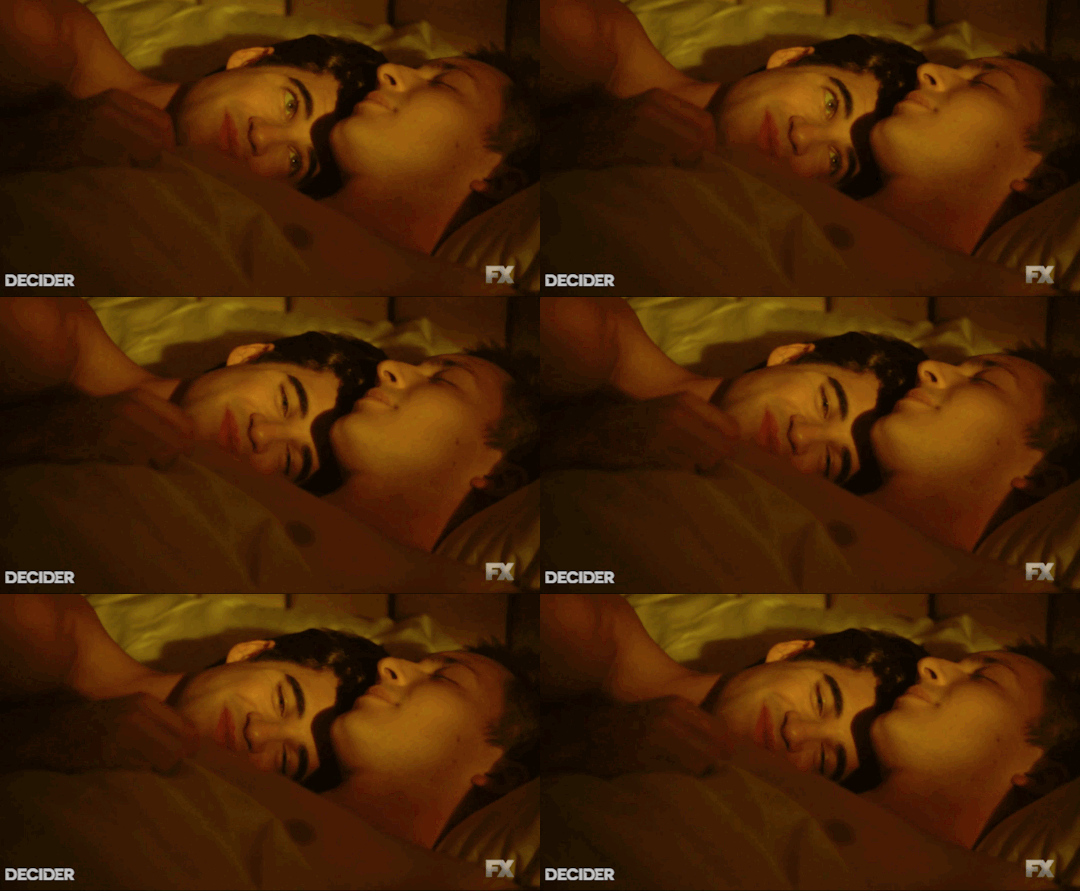
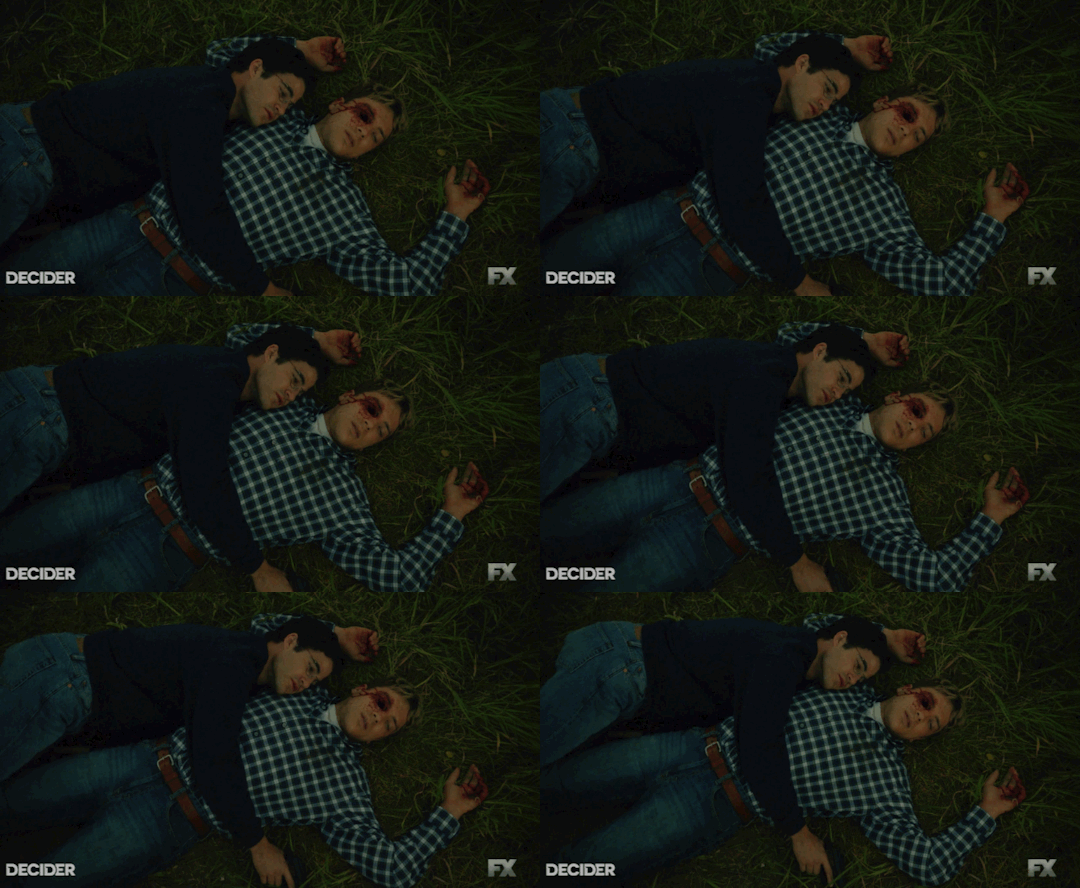


 ACS news