American Crime Story: The Assassination Of Gianni Versace
9pm, BBC Two
As this astonishing series nears its end, it gets even more brain scrambling. It’s the penultimate episode, and the backwards-running structure stretches back to its furthest points, to offer two parallel, contrasting portraits of childhood, in two different timeframes. In 1957, we glimpse the young Gianni Versace, aged 10 or so, and encouraged by his dressmaker mother to follow his heart and learn about and designing clothes, despite the taunts of other kids and disapproval of his teachers. Flipping forward to 1980 comes a fuller and more unsettling picture of Andrew Cunanan around the same age – singled out for special treatment and pressurised to succeed by his father, Modesto, a stockbroker with big dreams, and given to making big exaggerations about himself. As Cunanan becomes a young man, however, the house of cards Modesto has built begins to collapse. Darren Criss’s performance as Cunanan is extraordinary again, while the casting of the child actor playing young Cunanan (Edouard Holdener) is spooky.
It’s also the title of a new Cinemax drama series, the second show this spring to follow a serial killer case reverse-chronologically. Had Cinemax been able to premiere Rellik timed to its initial launch on BBC One last fall, it would have looked like the tricky progenitor and Tom Rob Smith’s work on The Assassination of Gianni Versace: American Crime Story might have looked like an imitator, but instead American audiences are getting this one reverse-chronologically.
Actually, being able to watch Rellik and The Assassination of Gianni Versace: American Crime Story basically back-to-back is an illuminating look at the advantages and disadvantages of storytellers creating obstacles for themselves in constructing otherwise familiar genre stories. Rellik creators Harry and Jack Williams are no strangers to experimenting with formal complications after The Missing and Liar and they commit much more thoroughly and much more intriguingly to the Memento-like structure over the first five episodes of their six-episode drama. It’s novelist Smith, however, who found a way to make a gimmick structure pay off in terms of character development (even if he just made Andrew Cunnan into a half-Filipino Tom Ripley), while Rellik sells out its gimmick entirely with a finale that’s an exercise only in exposition and flimsy psychological motivation.
[…] What shows like Rellik and The Assassination of Gianni Versace: American Crime Story are doing is acknowledging the entrenchment of crime investigation structure developed over decades of TV procedurals. The extra step that Gianni Versace only sometimes took and that Rellik rarely takes is progressing beyond cleverness into narrative rewards. The title itself reflects a series with an “Aren’t we cute?” indulgence that doesn’t deepen after you’ve said, “Yeah, I get it.”
Cunanan, Koresh and Hearst. On the surface they have nothing in common, other than than being three notorious figures who had done wrong in one way or another (serial killer, polygamist with way too many guns, kidnap victim turned revolutionary bank robber), capturing the world’s attention. Over the past two months, they OVERLY captured MY attention, as their incredible and tragic stories unfolded in three separate, but (mostly) equally excellent TV series – The Assassination of Gianni Versace: American Crime Story, Waco, and The Radical Story of Patty Hearst.
I live for series like these, because things that happen in the real world are always more compelling than stories that are made up (that’s why I STILL prefer Rome over Game of Thrones). I come to these types of series to learn, and to ask why, but what I didn’t realize would happen upon exiting them is that I would find myself sympathizing with these devils. The levels of badness differ between Cunanan, Koresh and Hearst, but after spending all this time with them, I see them now more as humans with flaws (some more deeply flawed than others) than as the pariahs that the media and the passing of time have turned them into.
‘The Assassination of Gianni Versace: American Crime Story’
I am not much of an awards guy, but in my hopes of hopes, I want Darren Criss to win 17 Emmys for playing Andrew Cunanan. Cunanan lived a life of lies, but mainly because he always wanted to impress people, make friends and feel loved and wanted. Darren Criss conveys this so perfectly that I was impressed, and loved his character so much that I wanted to actually be his friend. When Criss as Cunanan was charming and happy, I was charmed and happy. When he was doing wrong, and going on the lam, I was disappointed (and disgusted) that he was doing these actions, and yet I was somehow secretly hoping for him to NOT get caught. What is wrong with me? How could I possibly find empathy for a guy who senselessly murdered at least five people?
ACS: Versace brilliantly tells the Cunanan’s story backwards – starting with Versace’s murder, and tracing his sordid life back to childhood. By the time we learn the truth about his father Modesto, and how he professionally swindled people and left his family with nothing, you can see where everything started to go wrong for Cunanan. He just wanted a better life for himself, but unfortunately, that better life always seemed to elude him, so he took it out on those who were able to do what he wasn’t able to – succeed. And still, I felt for Cunanan. His father disappointed him. It was hard for him to be gay in a time that wasn’t easy for anyone to be gay. He was different and just wanted to feel special. Criss crossed all these roads – the light and the dark, and it somehow filled me with glee (pun intended).
But how could I not root for the Catholic school misfit who shows up at a house party in an Eddie Murphy Delirious red leather jacket and awkwardly takes center stage in someone’s living room, acting a fool like John C. Reilly in Cyrus?? Even if this scene never happened in real life and was dreamed up by the writers, I still have to shout – ‘you go Andrew!’
If only you found happiness in life, and not sadness, and didn’t created way too much sadness for way too many others.
Clare: What a surprise, Darren Criss in The Assassination of Gianni Versace: American Crime Story wins hands down for me this week and I’m sure this isn’t the only highly prestigious accolade he will be taking home for his performance as Andrew Cunanan over the next year. While he was absolutely spectacular throughout the 9-week series, in this finale “Alone” he was outstanding. Spending the majority of the episode holed up alone in the houseboat, the episode really hinged on his ability to carry the story and he did it and more. This performance is going to stick with you for a while to come. While it doesn’t excuse at all the horrendously evil acts committed by Cunanan, Criss’ performance inspired sympathy but also frustration at such wasted potential and the enormous potential in others that he ruthlessly cut short. Prepare your acceptance speeches, Mr Criss. You’ll be needing them over the next few months.
Top Episode
Clare: The Assassination of Gianni Versace: American Crime Story has me enthralled from the get-go, but “Alone” left me with goosebumps and needing to collect myself after the credits rolled. What a powerful 90 minutes or so of television and a fantastic and fitting conclusion to the series. While Darren Criss was definitely the standout performer, everyone brought their A-game week after week and the finale was no different. From Ricky Martin’s Antonio’s pain to Jon Jon Briones’ Modesto’s playing of his son, to the stoicness of Penelope Cruz’s Donatella, the tragedy of the events and how they affected everyone was so clear.
Top Moment
Clare: As the Feds are closing in on Andrew Cunanan in The Assassination of Gianni Versace: American Crime Story, we get a scene of a resigned and scared adult Cunanan watching the reports of the Feds’ efforts to get him out of the houseboat joined by the younger version of himself (played by Edouard Holdener). The look shared by the child and adult Cunanan was so beautiful in its simplicity and tragedy. Here Andrew finally has the fame and recognition that he has been told has been his due all his life and that he has seeked, but it’s for all the wrong reasons and has lead to his death. This was so heartbreaking.
Top Quote
Clare:
“Andrew is not hiding, he’s trying to be seen” – The Assassination of Gianni Versace: American Crime Story
John – “American Crime Story: The Assassination of Gianni Versace”
Coming off of its major coup of a first season — which dramatized the trial of O.J Simpson — the second season of true-crime drama “American Crime Story” focuses on serial killer Andrew Cunanan and his most famous victim, Italian fashion designer Gianni Versace.
Darren Criss’ portrayal of Cunanan — who killed five people, mostly gay men, in a cross-country killing spree in 1997 — is a spot-on characterization of a man so enraptured with acquiring money and notoriety that he has become alienated from his own humanity.
Along the way, the show spends time focusing on issues that have predominantly affected the gay community through the eyes of the show’s characters. Issues include the former ban on openly LGBTQ soldiers, the American HIV pandemic and coming out of the closet in an often-hostile society.
New episodes of “American Crime Story: The Assassination of Gianni Versace” are on FX every Wednesday at 10 p.m., but the previous episodes of this season are available for $2.99 each on Amazon.com — and while you’re there, don’t forget to check out the phenomenal first season about O.J.
The sins of the father emerge in the powerful penultimate episode of “The Assassination of Gianni Versace: American Crime Story” (10 p.m., FX, TV-MA).
This emotionally draining series has unfolded one flashback at a time, with characters’ stories emerging in seemingly random order.
Tonight’s episode focuses on Modesto “Pete” Cunanan (Jon Jon Briones), the con man father of serial killer Andrew Cunanan (Darren Criss).
Pete projects a brash belief in the American dream, enlisting in the military so he can arrive as a new citizen from his native Philippines.
His peculiar notion of family values is to lavish all his attention and much of his fortune on Andrew, while his other children languish in a state of emotional starvation.
It’s clear Andrew gets his sense of entitlement (as well as his contempt for his mother) from his old man, who follows a downward trajectory as a financial adviser.
A parallel plot about young Gianni Versace’s choice to defy gender roles and follow his mother’s steps as a seamstress is pretty much overshadowed by the Cunanan backstory.
I was shocked when I read that members of the Versace family complained “American Crime Story” had defamed the designer’s legend.
American Crime Story: The People v. O.J. Simpson was an impossible act to follow. The Emmy-winning event series found a singular subject in the O.J. Simpson trial, in many ways the flash point of modern celebrity. The series also ran in the run-up to the 2016 election, when age-old American rifts from cultural misogyny to media sensationalism were once again under a harsh national spotlight. But like many of Ryan Murphy’s critically acclaimed shows, American Crime Story was announced as an anthology series—and with the successful first season of an anthology comes a promise the more traditional miniseries never has to make good on: a worthy follow-up.
After the planned second season—on Hurricane Katrina and its aftermath—hit some production snags, a very different story kicked off in January. American Crime Story: The Assassination of Gianni Versace had all the makings of a semi-sequel that would fit comfortably within the mood of O.J. (At the very least, the Italian fashion designer’s shocking death seemed to fit much more comfortably in Murphy’s wheelhouse than storm-stricken New Orleans.) Like O.J., Assassination focused on a high-profile case from the ’90s, recent enough to survive in the collective consciousness but long enough ago for a fictionalized account to add a new perspective. Like O.J., Assassination delved into the experience of an identity group marginalized by the American mainstream. And like O.J., Assassination saw Murphy hand over writing and the majority of directing duties to collaborators, allowing him to concentrate on his primary talents of casting and big-picture curating.
Yet the interpretation writer Tom Rob Smith delivered represents a stark departure from the bedrock principles of Murphy’s blockbuster appeal. Versace is straight-faced where Murphy’s house style is smirking, sorrowful where his oeuvre leans dramedic. Watching one disturbed individual’s vanity, entitlement, and megalomania claim life after life makes for an excruciating marathon of violence and pain, rarely leavened by the campy humor that runs throughout Murphy’s other work. For those who tuned in expecting even a typical Murphy production, not another career peak, Versace’s tone required a learning curve too steep for many to climb.
Predictably, the numbers have borne out the disparity between O.J.’s addictive spiral — and Glee’s ironic sniping, and American Horror Story’s diva-centric gore — and Versace’s mournful dirge. Versace debuted to 5.5 million viewers, fewer than half of O.J.’s extraordinary 12 million. That drop-off is partly explained by the more obscure nature of Versace’s subject; most casual onlookers, like Smith himself before he began his research, are probably unaware that Versace’s death was the culmination of a string of killings, not an isolated event. (And compared with O.J. Simpson, what isn’t obscure?) But Versace’s viewership has continued to trend downward as the season goes on, with the live audience sometimes dipping under 1 million.American Crime Story’s second installment has also lagged behind in the more nebulous, though still palpable, arena of cultural relevance. Initial critical reception was admiring, though not rapturous; in the following weeks, the conversation around the show has remained within the confines of fact-checking recaps.
Heading into the final stretch of both Versace and Murphy’s decade-plus residency at FX, it’s time to explicitly acknowledge the subtext of Versace’s relatively muted response. The Assassination of Gianni Versace is not the new The People v. O.J. Simpson; given its challenging form, lesser-known inspiration, and the sky-high expectations set by its predecessor, it’s unlikely it was ever going to be. Besides, Versace’s popular shortcomings are inextricable from its creative risks. By crafting a true-crime story to evade many of the genre’s ethical pitfalls, Murphy and Smith have delivered a season of television that stands apart from the recent wave of ripped-from-the-headlines adaptations—and largely unable to capitalize on it.
The first and most significant roadblock for viewers excited to learn more about The Assassination of Gianni Versace was that the season’s title turned out to be something of a misnomer. Assassination is as much about the other four victims of 27-year-old spree killer Andrew Cunanan (Darren Criss) as it is about Versace (Edgar Ramirez), whose shooting on the steps of his Miami Beach mansion occurs in Assassination’s first scene. The plot then winds, reverse-chronologically, through the violent unraveling of Cunanan’s life, with Versace sparingly deployed as contrast rather than subject. But Cunanan isn’t truly Assassination’s subject, either: a triptych of midseason chapters—“A Random Killing,” “House by the Lake,” and “Don’t Ask, Don’t Tell”—functioned more like stand-alone biopics of Cunanan’s less famous casualties than part of a larger narrative about the murderer himself.
Under Versace’s dreamlike, counterintuitive logic, the more screen time a character gets, the less the audience is allowed into their inner lives. In fewer than 50 minutes, Judith Light is able to shape grieving widow Marilyn Miglin into a self-made woman as vulnerable as she is ferocious; Smith’s script for her spotlight episode, Versace’s third, paints a complete portrait of Marilyn’s complicated, loving partnership with her closeted husband, Lee (Mike Farrell). The same holds for Jeff Trail (Finn Wittrock), whose contradictory identities—to the United States military, if not Jeff himself—as a soldier and a gay man are negotiated and renegotiated within a single hour. David Madson (Cody Fern) gets a spotlight that visibly works to ensure he’s not just remembered, but remembered as more than a footnote to Cunanan’s story, or even Versace’s. Each victim is quickly and convincingly developed into a complete person with hang-ups to work through and attributes to mourn.
Versace himself, meanwhile, is idealized to the point of abstraction. One of the first images Versace presents of its namesake is his corpse sprawled, Pietà -like, across the lap of his longtime partner, Antonio D’Amico. The religious parallels hardly stop there. Versace died, Smith posits, for the sins of a homophobic culture that was unable to fully accept an openly gay creative genius. The designer is a martyr, but martyrdom can be antithetical to full humanity.
No one on Versace comes across as more of an enigma, however, than the titular assassin. Such are the hazards of depicting a pathological liar, given to acts of fabulism so extreme they almost dare Cunanan’s audience to call his bluff. And dubious though it would have been, Cunanan never lived to tell his side of the story; eight days after Versace’s murder, the fugitive killed himself on a Miami houseboat, leaving his precise motivations and rationale a mystery.
Smith adds to these inherent challenges by intentionally obscuring Cunanan’s background—and along with it, any temptation to excuse Cunanan’s behavior or dilute his responsibility. A common criticism of true crime is how vulnerable its storytellers are to the seductive intrigue of the criminal. Villains are almost always more interesting than heroes, a truism that becomes fraught when the characters inhabiting those roles are based on actual people. Serial’s Sarah Koenig and The Jinx’s Andrew Jarecki both had an obvious and uncomfortable rapport with their subjects; I, Tonya all but erased the woman whose assault the movie supposedly litigated. The Assassination of Gianni Versace takes no such risk. Andrew, not Jeff Trail, is relegated to the margins. Andrew, not David Madson, is kept at arm’s length. Cunanan is no anti-hero; he’s borderline inhuman.
Unfortunately, breaking the link between main character and protagonist creates as many problems as it solves. Conceptually subversive as they might be, when consumed in real time, Versace’s structural choices make for a confounding and even alienating viewing experience with a vacuum at its center. There’s a reason so many shows give in to the temptation of valorizing their monsters: It’s hard to get an audience on board with spending hours on hours, week after week with a person who has no redeeming qualities, however fascinating their pathology or sympathetic their supporting cast.
Coming from a franchise, and a creator, that promises all the sex and violence of tabloid fare sans network censors, Versace is almost shockingly cerebral. The themes are heady and high-minded—the damage wrought by homophobia on and within the gay men community; how the closet can manifest as ignorance as well as oppression—with a meditative rollout to match. In the binge-watching era, such a protracted, patient rollout can prove fatal; I’m not sure I myself would have stuck with Versace long enough to reap its rewards if FX hadn’t made the majority of the season available to critics in advance.
Many true-crime stories start with a well-known event and purport to uncover some new angle. Versace is working with events much of its demographic isn’t aware happened in the first place, assuming the mantle of educating as well as storytelling. In bringing the Cunanan victims into focus at Cunanan’s own expense, Smith and Murphy have made a trade-off between moral clarity and entertainment value. I’ve found their gamble has paid off, even if the swap isn’t one every viewer has been willing to make. Taking on a sociopath’s point of view may put a series in a compromised position as an adaptation of true events. It may also be essential for a show to succeed as entertainment.
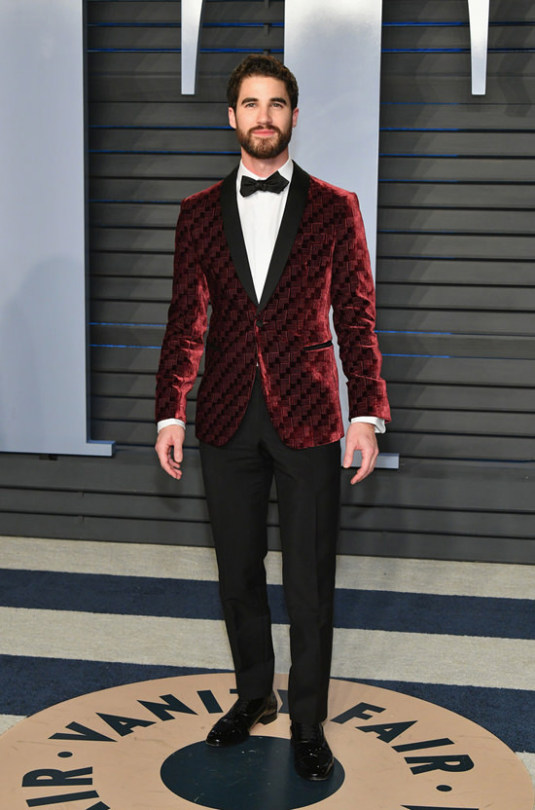
Absolutely never looked this good before. He’s impeccable. More importantly, he’s notably stylish in a quietly attention-seeking way. He’s really turned heads with his Andrew Cunanan portrayal on The Assassination of Gianni Versace, making it a savvy move to show up at glitzy industry party looking more stylish than most of the other men.
The titular character in The Assassination of Gianni Versace: American Crime Story is a mere footnote in a nine-episode saga that zeroes in on his killer, Andrew Cunanan who, in 1997, killed four other men across the country in a vicious spree. But the Ryan Murphy show does manage to rekindle our collective fantasy of the remarkable world of Italian designer Gianni Versace, perhaps the last of the greats in an era before fashion got too fast and too furious.
From the moment he (as played by Édgar Ramírez) steps out of bed in a pink Versace robe and glides across the immaculately tiled floors of Casa Casuarina, his Miami Beach home, it’s evident that this was someone who contributed an immense beauty to the world. It is a seemingly perfect re-introduction of his singular vision, one that reigned supreme in the 1980s and ’90s and has resurfaced like something of a couture ghost.
Aside from the well-deserved hype surrounding the FX series, the label’s current Spring 2018 collection marks the most celebrated it has been in a long time, perhaps since the death of its visionary. The collection, conceptualized as a tribute to her late brother on the 20th anniversary of his death, had Donatella, his successor, scouring the Versace archives for a “best of” compilation of the now-iconic designs that included Baroque, Vogue and Andy Warhol prints. The original supermodels – Naomi Campbell, Cindy Crawford, Claudia Schiffer, Helena Christensen, Carla Bruni – who were elevated to supermodel status on the same Versace runway three decades before walked the finale in matching Oroton gowns, made with an intricate metal mesh fabric Gianni devised in the early ‘80s. It was a joyful display of vintage fashion that didn’t in any way seem out of place on a 2018 runway, suggesting enough time may have finally passed for the brand to lose its clichéd nostalgia, and for younger Millennials and Generation Z to be introduced to Gianni’s work.
The timing is right, with Migos and Bruno Mars both name-checking the brand in their hit songs “Versace” and “Versace on the Floor,” respectively, and, of course, with Murphy bringing his name to primetime television. The star alignment for the brand could be considered coincidental, or it may mean that we’ve arrived at the precise point in the cyclical nature of fashion when the name Versace sounds like a symbol of power once again. Gucci received similar treatment last year, following in the footsteps of Tom Ford and Louis Vuitton.
This tribute to its founder comes at a potential crossroads for the house. It has long been rumoured by fashion trade journals, including Women’s Wear Daily and Business of Fashion, that Donatella has been eager to take the company public. In fact, we learn in The Assassination of Gianni Versace that her late brother had planned on doing so mere days before his death. We also learn that Donatella (played by Penelope Cruz) had clashing opinions with her brother on the artistic direction of the brand following his illness (the family has long claimed it was ear cancer, while the series makes a bold claim that he had been diagnosed with HIV, as alleged by author Maureen Orth in the series’ source material). Although she’s allegedly given her blessing to Cruz, Donatella has called the series a “work of fiction.”
The series depicts his final show as a true-to-life dueling ground for the siblings: Gianni’s designs were bright and joyful, while Donatella seemed to have fallen victim to heroin chic. “I want my models to look like they enjoy life,” says Ramirez’s Gianni. Donatella, on the other hand, explains that she wants the kind of attention that Alexander McQueen and John Galliano were getting at the time for their groundbreaking, often shocking work. She never got it.
Her first solo collection following his death was lacking Gianni’s signature joie de vivre, and received lukewarm reviews, as have most Versace collections of the past two decades. There were memorable moments, of course (the moment being the plunging tropical number Jennifer Lopez wore to the 2000 Grammy Awards), but overall, the brand has not enjoyed the kind of high praise or sales it did in Gianni’s glory days.
In 1996, just before his death, Versace sales topped $1 billion. A decade later, they were less than half that, suggesting the brand was on the path of gradual decline. But as of 2015, retail sales have been rapidly rising, partly thanks to a new retail strategy focusing on a greater number of brick and mortar stores, and a $290-million cash booster from private equity firm Blackstone Group that now controls a 20 per cent stake in the company. And if she does indeed go public, it may be a sign that Donatella is finally ready to let go of the heavy burden of being Gianni’s successor.
In fact, the trades have also reported that Donatella has been on a search for her own replacement, a fresh eye that can capture the vibrancy of the Gianni era in today’s zeitgeist. Former Givenchy creative director, and friend of Donatella’s, Riccardo Tisci is reportedly at the top of the list, according to British Vogue. Although, there have also been rumours swirling about the possible involvement of Off White’s Virgil Abloh or outgoing Louis Vuitton menswear designer Kim Jones. Whoever it is, they have their work cut out for them — and a looming legacy to live up to. As a tight family-run business, Versace is one of the last holdouts in an industry that is almost completely run by luxury conglomerates such as LVMH and the Gucci Group. And capitulating could mean a complete brand restructuring.
Although Versace has undeniable worldwide brand recognition, it lacks a signature product range that can act as consistent cash flow for luxury brands. For many fashion houses, handbags and cosmetics are bread and butter. In an era of ‘it’ bags, Versace has given us none, and, aside from a few fragrances, there are no existing beauty products. But maybe the real question is if anyone wants them. Many were ready to write off Gucci as a predictably safe Italian brand, coasting on its former glory. With creative director Alessandro Michele and his signature attitude at the helm, Gucci has finally come out of the shadow of its Tom Ford era. But Versace has a secret weapon — Gianni — and is finally ready to use it.
If the intrigue surrounding The Assassination of Gianni Versace is any indication, we are not yet done with the late visionary. Aside from a healthy dose of nostalgia, the early ‘90s Versace aesthetic fits perfectly in the current taste for remixed classics and logo-heavy luxury goods. As numbers and trends have proven, Versace’s spring collection is bound to fly off the racks suggesting, for the first time in a long time, it may prove to be more than its name.

 ACS news