I Love Serial Killer Stories And Worry What That Says About Me

This past weekend, I binge-watched Mindhunter, Netflix’ new, dramatized-but-based-on-true-events series about the origin of the FBI’s Behavioral Sciences Unit. It’s set in the 70s, when profiling serial killers was just beginning to be a thing and despite thinking the main character had about as much charisma as stale break (it’s ok, the show does, too), I could not get enough.

“One more episode,” was the refrain. “C’mon.” And then, of course, we’d watch another, with protagonist Holden Ford finding a way to create rapport with serial killer Edmund Kemper. Agent Tench, the cop-ass-cop of the duo, starting to see value in it. Dr. Carr—a professor and consultant on the project— finding ways to reign in these two and actually make their research viable and scientific and therefore useful in predicting violent behavior.

Eventually finishing up in spectacularly dramatic fashion, we were both shocked to realize that it was over. Season one: finished.

We immediately rolled into season two of American Crime Story: The Assassination of Gianni Versace. This is another dramatized but based-on-true-events story of a serial killer, the stylish, compulsive-lying Andrew Cunanan, who killed a whole bunch of people on a spree that included famed fashion designer Gianni Versace at his Miami Beach palace in 1997.

He preyed especially on gay men, using his good looks and erudite air to get men to trust him. Then, he robbed or killed them. Sometimes both.

Where Mindhunter is sometimes clinical, showing its characters meticulously interviewing serial killers in scenes that almost border the mundane, this show is passionate. It delves deeply into Cunanan’s victims’ lives, and cares deeply about their interior selves: struggles, passions, heartbreak.

I’m halfway through the season so far, but I already “know” Versace to some degree. I know Lee Miglan, a successful but closeted elderly man who, in one scene, tearfully prays at an alter, telling Jesus he “tried” not to be gay. I know David, a young man who dated Andrew and took him in, only to watch him brutally murder another friend, then hold him hostage and eventually kill him, too. I know about David’s relationship to his dad, an outdoorsman who wasn’t exactly pro-gay, but loved his son enough to accept him, despite his own leanings.

Both are valid approaches to the genre, as is the ridiculous, sexy Hannibal, which didn’t so much humanize a serial killer and cannibal, but made him so hot that it was impossible to resist his allure.

God, it all just makes me want to watch Hannibal again.

But all of this has got me thinking: why, exactly, is the serial killer genre so popular in our culture? Why is it so compelling to watch other human beings be broken down, terrified, brutally murdered? Why do we want to understand why that happens? What drives this morbid fascination with a particular psychological extreme?

I don’t really have any answers. If I had to wager a guess, I imagine that it’s fun on some level to play armchair detective, and comforting on a deeper level to have a safe (fictionalized) space to contend with the dark side of human nature.

I Love Serial Killer Stories And Worry What That Says About Me

What Did Versace’s Lifestyle Provoke In His Killer?

In 1999, just two years after Andrew Cunanan’s cross-country killing spree, a cartoon spot ran regularly in between the videos on MTV. The spot showed Ricky Martin walking down the street, and every woman fainting at his feet. This was the summer of “La Vida Loca,” when the public had agreed to enter into a collective sexual delusion, a la Wham, about the pretty and flamboyant Latin singer and his perfect leather pants—never mind that no straight man had ever made a hot relationship with a daring woman sound so dreadful or exhausting, or so apt to end in copious jail time. The cartoon’s punch line is that one girl doesn’t faint at all: she shrugs. We see a frightened Ricky Martin, soaked in sweat, sit up in bed and scream. The whole scenario was, for the “definitely-heterosexual” pop lothario, a bad dream.

Even aged eleven, I remember thinking something seemed a little off; which is perhaps the reason why the spot has stuck with me since then, and why, when Martin finally came out more than ten years later, happy and a father to two children, I remember also thinking that it seemed like the end of a real-life nightmare. It seemed like a realized dream. This, and not the adulation of the women of the world, was what the private Martin had desired all those years: to be himself, and to be loved for being himself, and to be given full permission to love anybody that he felt like loving. It is funny to be waxing serious and thoughtful, now, about a man who once released a single with the lyric “up in the Himalaya/you know I wanna lay la”—but this is a year of curious turns. If you had said to me six months ago that in this, The Year of Our Lord Disick 2018, I would find myself in tears at a scene from a TV drama starring Ricky Martin, I would not have bought it. Times, as well as being full of change, are strange. Thank God there is a little wonder left in all this chaos. I am, frankly, ready for the Martinaissance.

Despite Gianni’s status as the victim of the series’ title, he seems happier, more at peace, than any other character.

The scene in question is a recreation of Gianni’s interview with the gay magazine Advocate in 1995, and is the lynchpin of the episode—emotionally, and perhaps conceptually—despite being fairly brief. At this point, Gianni and Antonio have been together thirteen years (as famous and unfamous couplings go, this is no minor innings). Ricky Martin, as Antonio, is patient and devoted, and heartbroken by the fact that he’s usually mistaken for Gianni’s personal assistant. Gianni, clearly smitten with Antonio, is keen to right this wrong. He asks the journalist if they can do the interview together, a united front; and the look the two men give each other is a look of such excruciating tenderness that it can’t help but be informed by something real. “The ups and downs,” said Martin in an interview in January with US Weekly, “the frustrations, the uncertainty, the fear of losing your career because you’re gay is something that is there… I’m a gay man that lived in the closet for many years. To see the process of Gianni actually coming out and sitting down in front of a journalist to talk about his reality is something that moved me in many ways.”

It moved me, too. This week, it struck me that despite Gianni’s status as the victim of the series’ title, he seems happier, more at peace, than any other character; he is beloved by both his lover and his (terrier-like, but basically protective) sister, and does not appear to feel the least discomfort over who he is. Unlike Jeff Trail, whose shame at being forced to leave the military under Don’t Ask, Don’t Tell is revealed to have informed his feelings on his sexuality, or David Madson, who obsessed over his father being disappointed in him for the fact that he was gay, Gianni says the phrase “I am a gay man” with about the same inflection as he might say “I was born in Reggio Calabria,” or “I adore a Greek Key trim.”

Every episode so far of The Assassination of Gianni Versace has been more unpleasant, and moreover more violent, than the last. This week, an ugly exploration of individual, internalized and institutionalized homophobia, is grimmer still. “You live in isolation, surrounded by beauty and kindness,” Penelope Cruz’s perfectly extraordinary-looking Donatella tells Gianni. “You have forgotten how ugly the world can be.” When she worries that his coming out as gay might cost the brand endorsements, he says—wryly and delightfully—“we’ll still have Elton.” Andrew Cunanan’s first victims have been closeted or down-low: we have yet to see what Gianni’s open lifestyle, opulent and unashamed, provokes in him. One has to guess it might be envy. Seeing Gianni and Antonio, in love and in the public eye, one cannot help but almost feel a pang of loss on Cunanan’s behalf—they make a then-brave thing look easy.

What Did Versace’s Lifestyle Provoke In His Killer?

Versace’s Killer Was a Male Inversion of the Femme Fatale

Apparently not having overwhelmed myself enough already with the ugliness of Andrew Cunanan’s cross-country killing spree, this week I started reading Three Month Fever, Gary Indiana’s book about the case. “[A] synthesis between ‘the classic serial’ and ‘the classic spree’ killer,” writes Indiana in its preface, “Cunanan seemed less a threat to the general public than to familiar narrative genres and their claims to classicism.”

American Crime Story does not share the same disdain for a conventional crime narrative, nor for a classic serial killer trope. It does disdain conventional chronology, which helps explain why this week’s episode is dedicated to the Minneapolis-set murder that begat—or at the very least began—the spate of killings, even though it is the series’ fourth. Cunanan’s first victim was Jeff Trail, whose great misfortune stemmed from having slept with Cunanan’s intended long-term partner, and his sometime lover, David Madson. Madson, a young up-and-coming architect, bore witness to the crime, which happened in his gorgeous home: the episode begins with Andrew having lured Jeff to the front door. There are lingering, worrying shots of Madson’s photogenic dog.

Andrew Cunanan, a homme fatale, is both scorned and resentful of the straight world’s status quo.

The blows begin to rain the moment Jeff steps in. Ensuring we will never forget Cunanan’s first time, the sound design conspires to make us feel we’ve seen all twenty-seven hammer strikes. Blood Pollocks up the wall. It pools around the body like a wet, red joke: so bright and so extravagant in volume that it looks like Pop art, or a cartoon. Cunanan describes the killing as a loss of control, which would feel far truer if he did not say this in a voice so even-tempered and considered that nobody ever sounded more assured. If David calls the cops, he says, they will suspect him, too. The dog howls bloody murder. David ends up on the run with Andrew, looking even more like a conspirator than if he’d stayed.

A seducer, then a killer, Cunanan exists as a kind of male inversion of the hot-but-crazy femme fatale, whose unnerving affect tends to be mistaken for erotic freakiness instead of—well, just freakiness. Often, femme fatales are furious because they want to game the heterosexual system, which casts men as the deciders and the femmes, who ought to be obliging rather than fatale, as something men decide on. Sometimes, they are women scorned. Andrew Cunanan, a homme fatale, is both scorned and resentful of the straight world’s status quo. “They hate us, David,” he explains, fanning out gay porn as manufactured evidence. “They’ve always hated us. You’re a fag!”

“He has this feline intuition,” David says at one point said to Jeff, an observation notable for the fact that almost no one likens men to cats. Cunanan, aloof and neat and perfectly methodic, is a cat. (With this in mind, I had expected him to kill the dog. Thank God: he does not kill the dog.)

Jeff, meanwhile, is a cute, blonde, jockish boy with close-cropped hair and an appealing but unmemorable face, which means he’s nearly interchangeable with David. (Nothing stranger than white racists who insist that other races look homogenous, when most attractive Chrises and hot Laurens look—to me, at least—like variations on one milquetoast factory model.) Loving one’s own doppelganger might be the textbook definition of a narcissist, at least the way Narcissus happened to embody the idea; a sociopath like Cunanan might, under different circumstances, understand the impulse.

As it happens, Jeff and David’s interchangeability succeeds in throwing the police. They call the murder, first and with an air of casual disgust, “a gay thing.” They assume that David is the dead man, and a hookup’s gone far south. They’re half-right, in the sense that David Madson is a dead man walking from the minute he steps out with Andrew Cunanan—that while the latter sees their going on the lam as a lovers’ road trip, an excuse to sing along to Technotronic on the radio and fantasie about how Mexico will look at sunset, Madson sees a monster. One day later, Cunanan has killed him, too: strike one, and then strike two, of five eventual strikes.

Versace’s Killer Was a Male Inversion of the Femme Fatale

Episode Five of ‘The Assassination of Gianni Versace’ Is More Brutal Than Real Life

Every episode of The Assassination of Gianni Versace poses a different question about Andrew Cunanan’s unlikely murder spree: How did he survive long enough to kill Versace? Why did a rich and powerful man like Lee Miglin invite an unhinged rent boy into his home? Why didn’t David Madson, a successful architect whose friends and family loved him deeply, try harder to escape? The answer is always the same: Homophobia. This week, it explains how Jeffrey Trail—a kind, bright and beloved young Navy officer—came to be friends with a monster.

“Don’t Ask Don’t Tell” alternates between the weekend of Trail’s death in 1997 and two years earlier, likely because it was convenient to juxtapose his story with that of Versace’s Advocate interview. In truth, Maureen Orth writes in Vulgar Favors that Jeff met Cunanan and sat for an anonymous interview with 48 Hourssomewhere around 1992-93. “Whether people like it or not, there are gays in the military,” Trail told reporter Richard Schlesinger in the heartbreaking conversation. “They’re very top-notch performers. They know what they’re doing. You’re gonna weaken our national defense if you remove gays from the military. And you’ll never be able to do it 100 percent—it’s just whether or not you’re gonna continue to hunt us.” Schlesinger later recalled that Jeff “had absolutely nothing to gain by doing the interview. Yet he took the risk and spoke out. My colleagues and I left San Diego very impressed with Ensign Trail.”

Trail had grown up as the conservative oddball in a close, liberal Midwestern family. Friends and teachers remembered him as clean-cut and warm, with a strong code of ethics. Determined to follow two of his half-siblings into the military, he learned to fly in high school and matriculated at Annapolis; after graduating in 1991, he was assigned to Surface Warfare Officers School in San Diego and worked on the USS Gridley navy cruiser seen in the episode. That same year, he hooked up for the first time with a male student at San Diego State and began acknowledging his sexuality. Bill Clinton’s “Don’t Ask, Don’t Tell” policy in 1994 quickly became notorious, but Trail had enlisted amid the outright ban on gays in the military that preceded it.

It’s true that Trail was drawn to Cunanan in San Diego because he seemed so comfortable in his identity; in turn, Cunanan worshiped Trail’s wholesome good looks and navy pedigree. Trail’s sister Lisa told The New York Times, “When Jeff got a haircut, Andrew had to have the exact same haircut. When Jeff went to San Francisco and got a certain style of baseball cap, Andrew had to go to San Francisco and get the very same cap. When Jeff grew a goatee, Andrew grew a goatee.”

But they never dated, or by all accounts even slept together. Instead, Cunanan made himself indispensable by introducing his newly (somewhat) liberated friend to other gay men and treating him to expensive nights out. Trail hated drugs, and he wasn’t happy to hear that Cunanan was dealing, but his pity outweighed his anger. By 1996, Trail and David Madson—the most important people in Cunanan’s life, even though Madson had broken up with him and Trail had grown tired of his lies—both lived in Minneapolis. Cunanan visited the city often, despite the fact that both men were trying to distance themselves from him.

Is it fair to imply, as screenwriter Tom Rob Smith does, that homophobia killed Jeff Trail? Only in the sense that he might not have become reliant on Cunanan if he’d been free to come out in high school, at Annapolis, or in the military—which is certainly worth considering. But the flashback’s most disturbing moments—the scene where Jeff saves a gay soldier from being beaten to death, the suicide attempt—are nowhere to be found in Orth’s book. Trail did have a tattoo of Marvin the Martian on his left ankle, but neither the scene where he tries to slice it off nor the witch hunt that precipitated that act of desperation is part of the official record.

Trail left the military in 1996 after superior officers stuck him with the blame for an incident in which, unbeknownst to him, cans of lead paint were hidden on his ship before an EPA inspection. Perhaps he became the fall guy because his bosses suspected he was gay, or simply because his secret prevented him from bonding with them. Trail is a hero regardless for having the courage to appear on48 Hours when he knew it could have ended his career. Surely, the dignified Jeff we meet in American Crime Story, played by Finn Wittrock, is meant to stand in for the many queer soldiers who endured similar physical and psychological ordeals.

Even when they’re fabricated, the flashbacks in “Don’t Ask, Don’t Tell” are some of the most affecting scenes in the series. Still, my concerns remain when it comes to fictionalizing a real, non-famous murder victim’s life to the extent that Smith does in these last two episodes. Furthermore, after two focused, immersive episodes I found all the temporal skipping around—from 1995 to 1997, from Jeff’s backstory to the Versace subplot—distracting. This season’s starting to feel rushed, and I wonder how different the show would be if it played out over ten episodes instead of nine.

Fact-Checking Lightning Round

Did Gianni Versace really come out of the closet in a 1995 Advocate profile? Not really. Even as a provincial teen, Gianni ran in gay circles. In the 80s, he installed his partner Antonio d’Amico in a position of power at Versace; they attended gay clubs, together and separately, all over the world and double-dated with Elton John. There were often naked men in Versace ads. In the spring of 1995, he published a photo book called Men Without Ties that might as well have been titled Men Without Shirts. So when Brendan Lemon (the reporter seen in the episode) profiled him for the July issue of The Advocate, he took Versace’s queerness as a given. The piece is still an interesting read, though; Versace introduces Antonio as his “companion,” and there’s an aside about Antonio—who, as we know, didn’t get along with Versace’s sister—calling Donatella the “queen of the gays.” Versace also offers thoughts on male beauty.

What was that about Perry Ellis? Poor Penélope Cruz, forced once again to deliver all the exposition. Considering that Gianni was for all intents and purposes out in the 90s, it’s hard to imagine Donatella begging him to stay closeted for the sake of the business. But the story she told about Perry Ellis is, unfortunately, mostly true. When he came out to greet the audience at the end of his fall 1986 fashion show, the designer had to be supported by two assistants. He tried and failed to walk down the runway. Forty-six-year-old Ellis died weeks later, and although his cause of death was listed as viral encephalitis, it was clear he’d been ill with AIDS. That summer, New York magazine published a sad and fascinating cover story investigating his life and death. Sales slipped after Ellis’s passing, as Donatella mentions, although a 1988 Times article suggests the culprit was “lackluster collections.”

What was supposed to be going on between David Madson and Jeff Trail? Your guess is as good as mine. We heard them arguing over whether Andrew “knew” about them. We heard Andrew accuse them of sneaking around behind his back. We saw a photo of the men together in Jeff’s bedroom. I’m not sure whether Smith wants us to believe they were secretly seeing each other or demonstrate why Andrew might have, in his paranoid state, decided that was the case. Either way, in real life, Madson was dating a few different guys when Cunanan arrived for his final visit, and Trail spent the weekend with a boyfriend, not his pregnant sister.

Episode Five of ‘The Assassination of Gianni Versace’ Is More Brutal Than Real Life

The Fourth Episode of ‘The Assassination of Gianni Versace’ Isn’t as Legit as It Seems

Here’s what we know about David Madson’s life in the days leading up to his murder: On Friday, April 25, 1997, Andrew Cunanan took a one-way flight from his home in San Diego to Minneapolis to visit his old friend Jeff Trail and former boyfriend Madson. Although Madson wasn’t thrilled to see Cunanan, the young architect did reluctantly host his ex at his loft.

They were spotted at restaurants, bars, and clubs, but after dinner on Saturday, they parted ways. Trail, who had no desire to spend time with Cunanan, had left town with his boyfriend and invited Cunanan to stay in his empty room Saturday night. While it’s not clear whether Cunanan slept at Trail’s place, he was there Sunday morning and back at Madson’s the same evening. At nine that night, Trail got in his car to meet Cunanan at a coffee shop. By 10 PM, Trail was dead.

The coffee shop meetup hadn’t happened, so Trail had come to Madson’s building. Evidence suggests Cunanan killed his friend almost immediately after his arrival, landing his first blow with the door open. It’s possible Madson was home at the time, but in Vulgar Favors, the book this season of American Crime Story is based on, author Maureen Orth judges it “unlikely.” He didn’t show up for work Monday; a neighbor saw two men, one of whom appeared to be Madson, walking a dog that could have been Madson’s on Tuesday morning. The same day, concerned that he’d neither come in to the office nor called in sick, two women Madson knew through work knocked on his door. One thought she heard whispers.

An hour after another neighbor spotted Cunanan and a distraught-looking Madson approaching the building, the women returned with the lofts’ caretaker, opened the door, found the body, saw that the apartment was empty, and called the police. Because his acquaintances knew Madson was gay—and because Cunanan had left a bag containing gay porn videos, steroids, and bullets—Sergeant Bob Tichich’s first guess was that Madson was the victim, and the crime was “a gay thing.”

As Trail’s parents learned of his death (and, then, his homosexuality), Cunanan and Madson were on the run. On May 3, two fisherman in rural Chisago County, Minnesota, found Madson’s body near East Rush Lake. He’d been shot three times with a gun Cunanan had stolen from Trail, and sustained defensive wounds. It’s unclear how long Madson lived; Orth pokes holes in a coroner’s report that puts his date of death at May 2 and debunks a bar owner’s claim to have served Madson and Cunanan that afternoon. The sighting turned out to have happened on April 27, and the two men who visited the bar were, in all likelihood, an entirely different gay couple.

All of which is to say that most of last night’s The Assassination of Gianni Versace episode, “House by the Lake,” was invented by writer Tom Rob Smith. Which is fine! There’s nothing wrong with a docudrama using some artistic license. And in the case of this episode, many of the choices must have been made out of necessity—much of the hour finds Andrew and David alone, and two dead men can’t exactly go on record about their road trip.

So: Did Andrew purposely leave his porn stash at David’s loft? Were they on the road together for several days? Once they left Minneapolis, did Andrew intend for them to go to Chicago and then Mexico together? Did the plan unravel when David started poking holes in Andrew’s Natural Born Killers fantasy? The answer to all of these questions—not to mention the one about the scene where Aimee Mann covers The Cars’ “Drive” at a roadhouse—is “We don’t have the faintest clue.”

In keeping with the show’s running theme, Smith constructs a story about homophobia and the way Andrew uses it to manipulate another gay man. When David tries to call the police, Andrew convinces him that they’d see him as a perpetrator, too. “They hate us, David,” he says. “You’re a fag.” He’s not entirely wrong: the cops really do assume David’s queerness has something to do with the murder, and that Jeff’s body is initially presumed to be David’s and that David, not Andrew, becomes a suspect when police see he’s not the corpse—both of which really happened—imply that the straight world saw these gay men as virtually interchangeable.

The line between the crime of murder and the crime of homosexuality (sodomy didn’t become legal across the United States until 2003) blurs. When the fugitives leave a rest stop, with Andrew’s arm slung over David’s shoulder, a woman gives them a dirty look. David is convinced that she recognizes them as wanted criminals, but the implication is that she was simply revolted to see two gay men. Before and after that encounter, David has plenty of opportunities to escape. He and Andrew walk the dog together before leaving Minneapolis. They stop at restaurants. But David only tries to bolt when he’s alone, by the side of the highway or in the bathroom of the roadhouse, even when Andrew’s behavior becomes more threatening. The big question surrounding Madson’s murder is: Why didn’t he run? As Smith imagines it, he was more afraid of putting himself at the mercy of a homophobic world than he was of a known killer.

David’s fear of his own difference is echoed in the moment when he comes out to his father. He can only summon the courage to do it after winning a prestigious academic award, and though his dad tells David, “I love you more than I love my own life,” he also reiterates that his son’s lifestyle doesn’t jibe with his own beliefs and that the revelation does, in fact, change something about their relationship. (The stuff about David’s close relationship with his family is true, by the way.) You can imagine a lifetime of interactions like this convincing someone that, if even his adoring family sees him as somehow “other,” he had no chance pleading his case to police.

It’s a well-constructed episode. The conversations between Andrew and David are rich with psychological subtext, and even if Smith sometimes states the obvious, he’s careful not to repeat it too often. Actor Cody Fern plays David, by all accounts a kind, talented, and hardworking guy, with heartbreaking sensitivity. Each episode of Versace has had a slightly different feel, and this one was a psychological thriller. From the claustrophobic shots of hallways to the bleak, low-lit, industrial interiors of David’s loft to multiple scenes where Andrew startles him—and us—by appearing as if out of nowhere, it’s eerie from beginning to end.

But I’m kind of frustrated by the liberties it takes with David Madson’s life. He’s painted as a sympathetic character, sure, but is placing him in the loft at the time of Jeff Trail’s murder, when he most likely was not there, absolutely necessary? How about framing him as stupid enough to get back in the car, after the ill-fated diner pit stop, with a killer he’d just read as hard as Jeff once had? What was the point of that moment, in the elevator, when David nervously tells Jeff (who, in real life, spent most of the weekend with his boyfriend), “He knows about us”?

Of course Smith has a right to fictionalize. Even so, Madson wasn’t a public figure like Gianni Versace or Lee Miglin, and I felt sick thinking of how those scenes would look to his family and friends. So I’ll leave you with a quote from Bridget Read’s review of Versace for Vogue, which perfectly sums up my conflicted feelings on “House by the Lake”: “We don’t have to hold all creative works about real-life suffering to the standards of what would hurt or offend surviving family members, but after watching a fictional Cunanan—whose real-life counterpart craved perhaps nothing so much as the type of fame bestowed by a prestige TV series—sadistically torture and humiliate his victims in fine detail, it’s hard not to feel like maybe we should.”

The Fourth Episode of ‘The Assassination of Gianni Versace’ Isn’t as Legit as It Seems

The Assassination of Gianni Versace: More People Are Dead But the American Dream is Still Alive

“So often, we are told the American Dream is dead,” the fragrance mogul Marilyn Miglin tells the crowd at a fundraiser in this week’s installment of American Crime Story. (At this point, it is hard to tell if I’m the one who’s heavy-handedly foreshadowing the next episode’s themes, or if it’s Ryan Murphy.) Played by Judith Light with alternating hopelessness and chill hauteur, she’s seen first in the kind of uptight pastel-pink suit jacket that can’t help but make a woman look a) like a business-savvy mom, and b) as though she thinks the g-spot is a nightclub in the seedy part of town. She is the wife of the real estate tycoon—and Catholic, closeted gay man—Lee Miglin.

There are no scenes with Gianni in this episode, and none with the Versace family, either. What we see instead is the startling murder that appears to be a killer’s stepping-stone to full psychosis; and a lavender marriage that does not appear to be an outright sham, but merely unconventional. When Marilyn, away on business, calls the house and does not get an answer from her husband, it’s unusual enough for her to worry. When she gets back home, she finds an open, dripping ice-cream carton—chocolate-flavored, as much a visual contagion in their ivory-on-cream-on-alabaster space as the pair of gloomy couches in Todd Haynes’s Safe. It’s a sinister enough development to leave her rattled.

By the time the opening credits roll, she has been widowed, and we’ve guessed that Miglin is another victim of Versace’s killer, Andrew Cunanan; and we’ve guessed, too, how they knew each other. Marilyn says only, in the softest voice and to herself: “I knew it.” How much Marilyn Miglin really knew is never made apparent to us. What is made apparent is that Marilyn and Lee, whatever their dynamic, loved each other. How many men, she asks the TV camera, in a dynamite appearance on a shopping channel not long after Lee is killed, support their wives’ ambitions? How many men lift women up, instead of bring them down?

Conversely, it is never clear if Cunanan kills Miglin and exposes him because he thinks that Miglin is a hypocrite for being closeted, or because he thinks that homosexuality is shameful, something to be punished and reduced to ridicule. “I want you to know that when they find your body, you will be wearing ladies’ panties,” he hisses, “surrounded by gay porn. I want the world to see that the great Lee Miglin is a sissy.” Just after we see Cunanan beside the body, we cut to him carving, and then eating, some great hunk of red meat on the Miglins’ spotless kitchen table; it’s designed to make us think, if only for a second, that he’s actually eating Lee. The trope that a cannibal can eat a great man and absorb his powers seems tailor-made for a social-climbing sociopath who steals from every wealthy man he kills. (Think, too, of wendigos, the mythic demons in the shape of men who eat men, designed to represent the very ordinary human flaw of greed.) He is as guilty of the very Catholic sin of covetousness as he is of the legal crime of murder.

After Marilyn refers to the rumored death of the American dream—just days before the actual death of her husband—she is moved to issue a rebuttal: “Except—look at my husband, Lee. One of seven children. The son of an Illinois coal miner. He began his career selling premixed pancake batter out of the trunk of a beat-up old car. And today Lee manages 32 million square feet of commercial property across the Midwest.” The message is as clear and keenly bourgeois as a cut-glass punch bowl: rags are honorable, an inspiring plot-point, when they end in untold riches and acclaim. It was hardly accurate to say before that there had been no sign of the Versace family in this episode, when its themes of modest origins, of betterment and growth and the anointing power of lovely or expensive things, were the cornerstones of Gianni’s myth—“[originally] from a small village in Calabria overrun with poverty and corruption,” says a recent piece in Numero, “Gianni Versace built a destiny that was the complete opposite [of] his humble beginnings.”

It feels worth mentioning that the episode is called A Random Killing. I had thought at first that this referred to Marilyn’s description of her husband’s death as a random robbery—her defense against the knowledge or suspicion that he had in fact been killed by a man he’d solicited for sex. In fact, the random murder comes in the last five minutes of the show, when Cunanan escapes the scene and realizes he needs a new car. Pulling over and then following a man into a church, he leads him down into to the basement. After listening to him say, politely, that he has a wife and child, that he would very much like it, sir, if he could only see them again, the killer shoots him point-blank in the back of the skull. It is the ugliest and most indelible scene so far in a story filled with brutal, memorable vignettes of pain; and by the time we know what’s happening, it’s far too late to turn our heads away—to disengage.

The Assassination of Gianni Versace: More People Are Dead But the American Dream is Still Alive

Analyzing Judith Light’s Amazing Performance in ‘The Assassination of Gianni Versace’

So, are you hooked on this show yet? Honestly, the first two episodes worried me. I loved last week’s American Psycho tribute, but the early scripts still jumped around too much, introducing a huge cast of characters and cramming years’ worth of vignettes about Andrew Cunanan and Gianni Versace into less than two hours. All that exposition made it hard to get emotionally invested in any one story. As soon as you started to care about Gianni and Antonio, there was Andrew bellowing “Gloria” in a stolen truck, or some FBI dope confusing Versace with Liberace.

Last night’s “A Random Killing” was something entirely different—a spare, focused episode and easily my favorite so far. I’ll get to the fact-vs-fiction part soon (promise) but first we need to talk about Judith Light. Who else could’ve played Marilyn Miglin, the wife of Cunanan’s third victim and allegedly closeted Chicago real estate magnate Lee Miglin? She’s a complicated woman. The queen of HSN is sharp enough to realize something’s wrong in her marriage, yet she loves Lee for his belief in her. And yet, her reaction to his murder is so practical! She goes into crisis-PR mode, feeding the police narratives to obscure the reality that a halo of gay bondage magazines surrounded Lee’s body. But there’s pain under the surface. When she finally lets down her guard, the monologue Light delivers about being a “real wife” is heartbreaking.

Darren Criss gives the episode’s other great performance. It’s chilling to watch Andrew slowly turn on Lee, puncturing the romantic veneer of what is actually a business transaction before mocking his powerful prey as he wraps Lee’s face in tape. Does writer Tom Rob Smith sometimes overload his dialogue with symbolism? Absolutely—“Concrete can build, but concrete can kill” is just awful—but the most revealing exchange in a mostly excellent script takes place in Lee’s study, when Andrew psychoanalyzes his host’s plan to build a tower so tall that its observation deck will look down on the Sears Tower.

Andrew sees that the project is really an egotistical power move; Lee protests, unconvincingly, that he’s only thinking of how delighted kids would be by the view. Andrew has a knack for perceiving people’s hidden dark sides, which makes his relationships with the victims he knows personally fascinating. Look for more of that next week. On to the annotations…

Lee and Marilyn Miglin

They weren’t international celebrities like Versace, but Lee and Marilyn Miglin were well known and loved in Chicago society circles. As Marilyn helpfully points out in the episode, the couple’s story was a classic “American Dream” narrative: Lee was the son of an immigrant coal miner who talked his way into his first real estate job at age 31, rising quickly from there. As Maureen Orth reports in Vulgar Favors, the firm he founded with business partner Paul Beitler built many of downtown Chicago’s most prestigious edifices, including Madison Plaza and the Chicago Bar Association Building.

The Miglins also independently owned over two dozen properties in the city. But Lee’s and Beitler’s grandest ambition, to build a 2,000-foot tower called the Skyneedle that would have been the world’s tallest building, remained unrealized. (The Chicago Tribune published a fascinating article on the project shortly after Lee’s murder.)

Marilyn was a model-turned-makeup mogul whose eponymous cosmetics line—particularly, a perfume called Pheromone—became a Home Shopping Network sensation. Orth notes her complicated personality, citing an associate who observed, “She’s not a cream puff… Marilyn hides it till she needs to bring it out.” When she returned from her business trip to Canada to find her Gold Coast townhouse in disarray, she cryptically told her neighbors, “I know he’s dead and they’ll never catch him. They’ll never find who did this.”

The lack of emotion she displayed in the wake of Lee’s murder really was a topic of local gossip. Marilyn remarried in 1999, but her second husband, the businessman Naguib Mankarious, died soon after, while getting a facelift. A lawsuit caused her to file for bankruptcy in 2007. Nevertheless, she persisted. Over a decade later, Marilyn is still alive and hawking her wares on HSN. (Here’s a video from 2017.)

Lee’s Murder

The show’s account of Lee Miglin’s murder and its aftermath sticks pretty close to the facts. Yes, Marilyn returned to find a Coke can and an open carton of ice cream in her normally spotless kitchen, while neighbors spotted a ham with a knife stuck in it in the library and signs that a dark-haired man had taken a bath in one of the bathrooms. Lee’s body was found in the garage next to an assortment of gay porn magazines, fully dressed but wearing lacy Calvin Klein bikini underwear, his ankles tied with an extension cord and his face wrapped in masking tape.

What happened before the murder isn’t nearly as clear. Was Lee Miglin a closeted gay man? How did Andrew end up in his home? Did they already have some kind of relationship? An expert told Orth that there was likely a sexual element to the killing. Signs that Cunanan had hung around at the Miglins’ for a while after the crime suggested he knew Marilyn was out of town. And a neighbor named Betsy Brazis spotted Lee talking with a younger man in his kitchen shortly before his death.

An AIDS educator, Brazis also mentioned to Orth that “Lee’s name would come up occasionally as a gay ‘straight’ man” in the support groups she led. A local queer newspaper published an anonymous report that Miglin had been spotted in gay bars, although other Chicago journalists swore to Orth that they tried and failed to find evidence that he slept with men. Meanwhile, Orth plays up Lee’s stereotypically gay characteristics, from his neatness to his effeminacy. These descriptions are kind of uncomfortable.

But the investigation into Andrew’s motive never got far, in part because Chicago law enforcement and other local officials were personally invested in protecting the family’s good name. The murder was declared random. An anonymous city official told Orth, “The case is closed. There’s nothing in the file. His employees loved him. The church loved him. His wife loved him. Case closed.” Twenty years later, the suggestion that Lee was anything less than a heterosexual family man remains controversial. A recent Chicago Sun-Times headline reads, “Revisiting Chicago murder, FX series depicts Lee Miglin as gay, close to killer.”

The piece quotes American Crime Story executive producer Brad Simspon, who explains, ““Our writer, Tom Rob Smith, had to dramatize what we believe happened that weekend starting from the established facts of the crime scene. Based on the evidence, we believe that Lee and Andrew did know each other, and Andrew’s attack, as with all his victims except for William Reese [the man Andrew kills for his truck later in last night’s episode], was targeted and specific.” The implication is that homophobia not only prevented the truth behind Miglin’s death from coming out, but—along with that exasperating car-phone leak, which did happen—also contributed to the FBI’s failure to catch Cunanan before he killed again.

Duke Miglin

Wait, there’s more. Remember Duke Miglin, Lee and Marilyn’s 25-year-old “Hollywood actor” son? Evidence exists that he and Cunanan knew each other before the murder. Although Duke and Marilyn always denied having ever met him, acquaintances of the family told Orth that there was something off about their evasions. Shortly after Lee’s death, Andrew’s friends confirmed to the Minneapolis Star-Tribune that he and Duke “spoke frequently.”

And, in an interview with Orth, two of Lee’s professional acquaintances related a memorable encounter with the Miglins at United Airlines’ Red Carpet Lounge at LAX, a few years before Lee’s death. “The Miglins were on their way to Hawaii for family Christmas, and were waiting for Duke to join them,” Orth writes. “He finally arrived with a friend, who made a great impression.” When they saw Cunanan’s photo, both confirmed that he was the man they’d met at the airport.

So, what happened to Duke? Well, despite his big break in Air Force One, he didn’t pursue his Hollywood dreams for long. Instead, he got married, had kids and got into the family real-estate business. Last year, Duke insisted to a Chicago ABC affiliate, “There was no relationship whatsoever. A lot of false things were brought up and they were very hurtful, very painful, for me personally and there were attacks on me as well that I really didn’t appreciate. And I still don’t.”

Analyzing Judith Light’s Amazing Performance in ‘The Assassination of Gianni Versace’

“The Assassination of Gianni Versace”: The Next Best Thing to Being a Star is Killing One

“Kitsch,” Milan Kundera once wrote, “is the absolute denial of shit, in both the literal and the figurative senses of the word.” Unconcerned with hiding the figurative shit, and instead content to thrust it onto the viewer within the first minute, the second installment of American Crime Story starts with Gianni Versace in the hospital, being treated for what we are led to assume is HIV. Shit happens, then you die; a lot of this shit is unearned, unfair and brutal. A lot of this shit is painful and undignified, and it kills. For a show that has—as Penelope-as-Donatella says to Ricky-as-Antonio, Gianni’s partner, of her brother—“a weakness for beauty,” The Assassination of Gianni Versace is, in this brief scene at least, extremely frank.

This frankness has not thrilled the Versace family, who released a public statement earlier this month disputing the idea that Gianni had AIDS: “The company producing the series claims it is relying on a book by Maureen Orth,” it reads (referring to Orth’s Vulgar Favors, published in 2000), “but the Orth book itself is full of gossip and speculation. As just one example, Orth makes assertions about Gianni Versace’s medical condition based on a person who claims he reviewed a post-mortem test result, but she admits it would have been illegal for the person to have reviewed the report in the first place (if it existed at all).”

Last week, on a podcast based entirely around the show (made—in a fit of content and creator every bit as snug as that of Cunanan’s red Speedo—by the team atVanity Fair), Tom Robert Smith, a writer on the series and a firm believer in Orth’s version of events, offered a rebuttal. “Andrew [Cunanan, the killer], this destroyer of life, did not have AIDS,” said Smith. “And the person who did have HIV was this great creator and celebrator of life.”

Narratively, this can’t help but seem convenient, given that we see Gianni literally proclaim his lust for living in a scene that falls between his treatment and his murder. The Assassination lays on its dramatic irony, at times, less like a layer of gossamer than a sheet of lead: a dead man’s shroud. Unlike the chainmail fabric Cunanan is seen to rhapsodize about like a fetish object (“The man invented his own fabrics! Ever heard of Oroton?”), it does not wear it lightly, nor with enviable ease.

All the other things that happen in the episode are minor enough that I can lay them out succinctly: Donatella argues with Versace’s live-in lover, the sweet but minimally-used Antonio, played by Ricky Martin, over whether it’s his fault that Gianni has contracted H.I.V. from a three-way fling. The killer drives into Miami playing Laura Branigan’s Gloria, making this the second filmed depiction of true violence in six months to use the track as a doomy gag. We are treated to a recreation of Versace’s final show which, ludicrously, does not have Naomi Campbell play herself despite the fact she’s aged like a bona fide artwork. Cunanan turns tricks on the beach, and then almost suffocates an older man with duct tape in a hotel room that looks like Barbie’s Porno Dream House, to the very un-hot and unsophisticated soundtrack of Phil Collins’ Easy Lover. If this does not sound like high art, understand that it isn’t. If it does not sound like entertainment, you might be—like Cunanan’s new beachside hustler friend—on crack.

Kundera also said about kitsch that “it causes two tears to flow in quick succession. The first tear,” he explained, “says: How nice to see children running on the grass! The second tear says: How nice to be moved, together with all mankind, by children running on the grass! It is the second tear that makes kitsch ‘kitsch.’” When Andrew Cunanan arrives at the Normandy Plaza hotel in Miami, he is momentarily transfixed by a bad, gray painting of Marilyn; and how nice it is to be moved, along with all mankind, by reminders of Marilyn’s face. How nice to be moved, along with all mankind, by images that necessarily remind us of her death in the décor of a crumbling Deco-era hotel: death made spectacular enough that it’s pure public spectacle, pure pulpy, campy entertainment. “I’m the one least likely to be forgotten,” Cunanan later says to a guy in a club. It does not sound exactly like a lie, since the next best thing to being a star is killing one.

“The Assassination of Gianni Versace”: The Next Best Thing to Being a Star is Killing One

American Camp Story: Did Versace’s Murderer Really Kill That Dove, Too?

“The world of the heterosexual,” Aunt Ida shudders in John Waters’s justifiably straight-hating magnum opus, Female Trouble, “is a sick and boring life.” American Crime Story: The Assassination of Gianni Versace is not heterosexual programming, thank God, which means it’s neither sick nor boring—only deeply stylized, so that it succeeds in making murder look like the narrative focal point of a perfume commercial. Like all good stories, it begins with a location card reading “Miami Beach, Florida.” Like a number of good films, it has the beach’s signature electric lushness, its too-lurid color: red lights, blue skies, green palms, a candy-pink silk-satin robe.

Ryan Murphy’s latest season of his pop procedural anthology, American Crime Story, covers the 1997 shooting of Versace in nine fifty-minute episodes; and yet so un-boring is the pilot that we see the murder seven minutes in. The twinky killer, Andrew Cunanan, is a fantasist played with a cold and twitchily unreal demeanor by the android-perfect Darren Criss. Introduced as an unreliable narrator, then a Ripley-esque savant at social climbing, he creates two big impressions: one in a scene that shows him covering his mouth in a pantomime of horror when he’s really smiling, and another that’s a bona fide showcase for his ass. He’s closeted around his straight friends, gay around his gay friends, and completely unashamed to say out loud that his objective is to “tell people whatever they need to hear”—a primo marker for a sociopath. By July of 1997, he has killed five people in a span of six months, one of whom is Gianni Versace, and he is a very wanted man.

The timeline leaps from the murder scene to 1990, and the killer’s would-be-courtship of Versace—whom he tells about his plan to write a book, provoking one of the all-time greatest burns on the laziness of writers ever televised: “I wish I had the patience to write a novel, but my mind is always moving"—and then back again. (Whether the two men actually met at all before the shooting has, I ought to say, been subject to debate: last week the writer Maureen Orth, whose book about the killing, Vulgar Favours, is the inspiration for the show, insisted: “There is no doubt in my mind that those two met.” What we see here is that lack of doubt played out for the very best angle; so that what might be erotic, a seduction at the opera, only ratchets up the audience’s dread.) We’re introduced to Penelope Cruz as Donatella circa 1997, stepping off a jet in mourning leather and affecting a faultless accent, less Italian than idiosyncratic Donatella-ese.

Because the Versaces are a family represented by an image drawn from the myths of ancient Greece, it’s fitting that they’re rendered at an also-mythic scale for television: murder, feuds and three-or-more-ways figure heavily immediately. That famed Medusa branding, says Gianni in the pilot, came to pass because as children, he and Donatella “used to play in ancient ruins where we grew up, and one day I saw the Medusa’s head…. I know that many people call it pretentious, but I don’t care. How could my childhood be pretentious?” Versace’s use of the Medusa head has always seemed to me deliciously ironic, since the myth of the Medusa is that she began her life as a beautiful woman, and was turned into a monster to repel men. No Versace woman ever knowingly repelled a man; where fashion in its highest form is these days happy to perform like a Medusa spell—to make the wearer into something hard to see for heterosexual male suitors—Versace is a brand where simple sexuality, the nakedly extrinsic, rules.

The show so far is likewise fascinated with both architectural interiors and personal exteriors, equally baroque. It’s fascinated with Versace’s Greco branding as a visual signifier: of the dead man’s love of glamour, his association with locales that, culturally, read as sultry and as torrid with both words as synonyms for “hot” and “scandalous.” By minute fifty, we know where we’re going but are unsure as to how we’re getting there, except in style.

A final note on certain accuracies and inaccuracies: when Gianni’s shot, we see a dove shot alongside him, so that the white and pretty bird—a single punctuation mark of red, a single flaw—ends up as evidence. How could a death be pretentious? Evidently, far more easily than one might think: the dove was real, a casualty of Cunanan’s first bullet. Less real is the woman who is seen to soak a print Versace ad in blood from the crime scene, making something both so chic and so immoral, so completely ghoulish and indebted to the capitalist status quo, that it can only be completely perfect; there could not be a more elegant or necessary lie.

American Camp Story: Did Versace’s Murderer Really Kill That Dove, Too?

Recapping the First Episode of ‘American Crime Story: The Assassination of Gianni Versace’

The first thing you need to know about FX’s American Crime Story: The Assassination of Gianni Versace is that it’s not really about Gianni Versace. While O.J. Simpson—and his fame, his race and his abusive history—were central to Ryan Murphy’s true-crime anthology in its first season, this story focuses on the man who killed Versace and the society that aided in that murder.

The new season is based on Vulgar Favors: Andrew Cunanan, Gianni Versace, and the Largest Failed Manhunt in U.S. History, a 450-page tome the journalist Maureen Orth published in 1999. Much of the book is devoted to the life story of Cunanan, the 27-year-old spree killer who shot Versace in 1997. Her reporting is thorough and revealing, but much of her analysis is dated. When Orth explores Cunanan’s demimonde of meth, escorts, sugar daddies and BDSM, it feels as though she’s unaware that this milieu isn’t representative of gay male culture as a whole.

Especially considering that Murphy—who is gay and has created some groundbreaking queer characters—has also been known to perpetuate the occasional homophobic stereotypes, the interplay between the book and the series is bound to give us plenty to discuss. At the very least, Vulgar Favors is handy for determining which parts of the show are confirmed fact and which are purely conjecture. (I’ll also be using Deborah Ball’s House of Versace, a breezy history of Gianni, his family, and the brand from 2010, along with a few other sources.)

I don’t want to call these recaps “fact-checks,” though, because fiction doesn’t have any responsibility to stick to the official record. Instead, I’ll look at how the discrepancies between what Orth dug up and what Murphy depicts reveal the show’s real agenda. These pieces may take a different form from week to week, but since the premiere was mostly a reenactment of the crime and its immediate aftermath, we’ll start with some pretty basic background stuff.

July 15, 1997

Orth’s book ends with the death of Versace and the intensified hunt for Cunanan, who had already killed four men by the time he came to Miami Beach. American Crime Story begins with the murder and goes backward from there. It’s a promising approach, because the real suspense here is in the question of how the smart, charismatic, cultured young man we meet in flashbacks ended up on the FBI’s Most Wanted list.

The show sticks fairly close to the facts in recounting what happened on the day Gianni Versace (Édgar Ramírez) died. He really was returning home from an early-morning excursion to buy magazines when Andrew, played by Darren Criss in a performance that’s already riveting, gunned him down on the steps of his palatial home (more on that later). One bullet also killed a turtle dove—a symbol that initially led authorities to suspect a Mafia hit. While Versace’s longtime partner, Antonio D’Amico (Ricky Martin), stayed at the designer’s side, the couple’s neighbor Lazaro Quintana chased Andrew until Andrew pulled a gun on him. Versace was rushed to Jackson Memorial Hospital, where he was declared dead at 9:21 AM.

Cops really did spot someone who matched Andrew’s description on the roof of a parking garage around the same time, but he escaped. (Orth doesn’t mention them tackling the wrong man.) It’s not clear what he was doing later that day, when police found the stolen red truck Andrew had abandoned and he became the suspect. The scenes that show him changing into fresh clothes and watching gleefully as the media descends on Versace’s house aren’t just plausible; they underscore how easily Andrew blended in among the town’s gay beachgoers.

One character to keep an eye on is FBI agent Keith Evans (Jay R. Ferguson). The Bureau was searching for Cunanan long before he killed Versace, and Evans was its man in Miami. Sadly, he was also inexperienced and unfamiliar with the city’s gay community. Sgt. Lori Wieder, the lesbian cop played by Dascha Polanco, wasn’t on the scene that day, but the officers who were there did find boxes of undistributed Wanted flyers in Evans’ trunk. The scene where the pawnshop owner complains to police about the legally mandated transaction form she’d filed a week earlier, which included Cunanan’s full name, is another embarrassing real-life detail. But the emphasis Murphy, who directed the episode, places on Evans’ neglect of his assignment is crucial, because it’s the first suggestion that law enforcement’s homophobia—its literal fear of engaging with gay men—contributed to its failure.

October 1990

Did Versace really know his killer? Well, sort of.

It’s true that Versace designed the costumes for a production of Capriccio at the San Francisco Opera, and stayed in the city during its run in 1990. At the time, Cunanan was living rent-free in Berkeley with his friend Liz Coté (Annaleigh Ashford), who Orth describes as a “rich and spacey debutante,” and her husband, Phil Merrill (Nico Evers-Swindell)—the couple we see in the flashback. A fixture in SF’s gay scene, Andrew met Versace at a club called Colossus. But, Orth reports, it was the designer who approached him: “I know you,” said Versace. “Lago di Como, no?” he asked, referring to his Italian lake house. It was, most likely, a flimsy pickup line. Andrew, who’d never been to Italy but had also never heard a flattering lie he couldn’t get behind, went along with it. On another night, Versace, Andrew, and a local playboy named Harry de Wildt were spotted together in a limo.

That dreamy encounter after the opera, though? It’s pure fantasy, although Andrew was known to lie about his Filipino father knowing Imelda Marcos, owning pineapple plantations and having a boyfriend. What’s important here is the conversation about Andrew’s future. “You are creative?” Versace asks, and his date answers in the affirmative. In fact, the only things Andrew ever created were fictions about himself, passed off as fact. (I won’t get too deep into that, because his lying is sure to come up later in the show.) “I’m sure you’re going to be someone really special one day,” says Versace. The distance between Andrew’s ambitions and the life he ended up with—as well as the reasons why he was such a failure—is going to be important.

The Family Business

The episode’s strangest divergence from the facts comes during the same scene. Versace explains the history of his company’s Medusa logo, recounting that he first spotted the image while playing in ruins as a child in Calabria. In fact, as Ball notes in House of Versace, he borrowed his logo from a door knocker at the Milan palazzo he bought in 1981. Perhaps we’re supposed to suspect Versace is a liar, too, but I’m inclined to believe the line is pure exposition, a hint of the designer’s humble beginnings that will soon become relevant to Andrew’s story.

Meanwhile, Versace’s mourning siblings/business partners, Donatella (Penélope Cruz) and Santo (Giovanni Cirfiera) provide some insight into the company’s status in 1997. Poor Cruz, normally a fantastic actress, has a thankless role (and a distracting accent) in this episode. All she does is sob, scream and provide dry background info that writer Tom Rob Smith doesn’t bother surrounding with believable human dialogue. For the record, it’s true that Santo, the oldest Versace sibling and the company’s most pragmatic voice, wanted to take the business public. And Gianni, after accepting a large dividend to subsidize his lavish lifestyle, agreed to do so. The plan was to make an initial public offering in the summer of 1998. It never happened. Two decades later, Gianni Versace S.p.A. remains a billion-dollar private company. None of this is particularly interesting, so here’s hoping it becomes relevant to the Cunanan story eventually!

Gianni Versace’s Fucking Insane House

There isn’t much art in this workmanlike premiere, but it does begin with a shot of the clouds painted over Versace’s bed that leads to a lovely, nearly wordless sequence contrasting Gianni’s civilized morning with Andrew’s primal scream. If you paid attention to the Renaissance-style art and the stained-glass windows and the gold accents and the massive tiled courtyard, it probably occurred to you that Versace’s home was totally off the wall. (“If Donald Trump had taste,” I said to myself, “this is what Mar-a-Lago would look like.”) Surely it was exaggerated for TV?

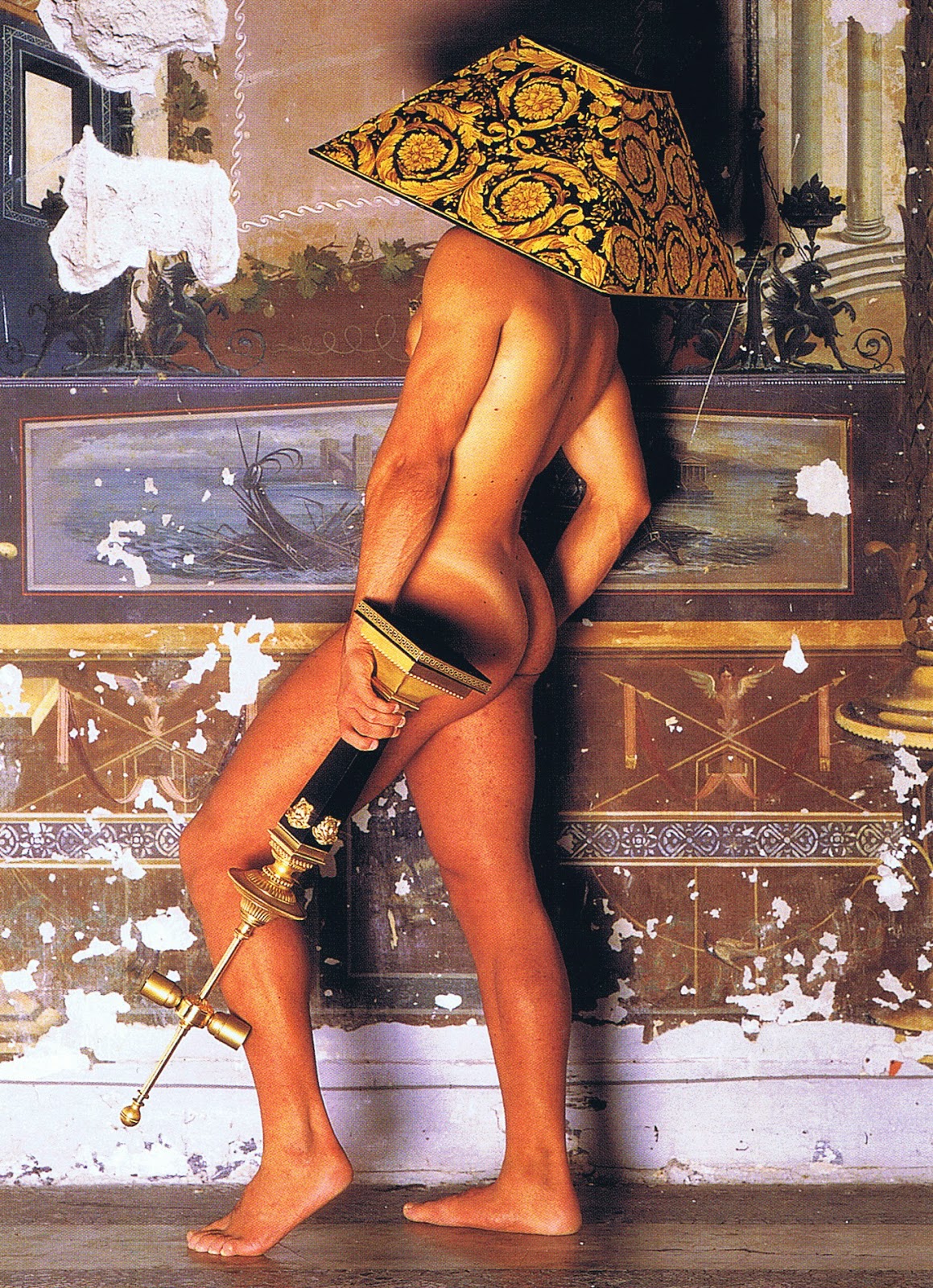
Actually, it was not. Built in 1930, Casa Casuarina, as the home was known, was inspired by Christopher Columbus’s son Diego’s residence in the Dominican Republic. In the courtyard of the 20,000-square-foot villa were busts of Columbus, Pocahontas, Mussolini and Confucius (all of which Versace kept). After Versace bought the property in 1992, he spent a million dollars restoring it. An army of artists and artisans filled the place with murals, mosaics and baroque furniture. Versace published a typically bizarre coffee-table book about his many bonkers properties in 1996, and in it you can find photos of the family frolicking poolside at Casa Casuarina alongside busy interiors and shots of naked men ironing. My favorite page shows a close-up of a burger, fries and a milkshake served on gilded Versace china, atop an ornate gold table. America! If you can’t track down a copy, this Google Image search should give you an idea. Look, here’s a bare-assed dude with a lampshade over his head! See you next week!

Recapping the First Episode of ‘American Crime Story: The Assassination of Gianni Versace’