How ‘American Crime Story’ Re-created Versace’s Death — on the Designer’s Own Front Steps

[This story contains spoilers from the premiere of FX’s The Assassination of Gianni Versace: American Crime Story.]

From the start, the producers behind FX’s The Assassination of Gianni Versace: American Crime Story wanted the series to be different than other true-crime shows.

“The series opens with the murder of Versace, and we made that decision for a couple reasons. One is that it’s the one fact that everybody knows about this case — that Gianni Versace, if you know something, you know that he was murdered outside his mansion. We felt like, instead of waiting eight episodes to get to that, let’s go right toward that, which then led to this backwards storytelling. We’re telling this season backwards,” executive producer Brad Simpson tells The Hollywood Reporter.

That’s why Wednesday’s premiere opened with a lush, nearly eight-minute sequence detailing the final morning of the slain fashion designer’s life, culminating in the moment when 27-year-old serial killer Andrew Cunanan (Darren Criss) shot Versace (Edgar Ramirez) on the steps of the designer’s Miami Beach mansion — which the production re-created on the actual steps of the building.

“Everyone was very moved because we didn’t make the steps, we shot on those steps,” Ramirez tells THR. “He laid on those steps, and Antonio [D’Amico, his partner] might have picked him up in the way Ricky [Martin, who plays D’Amico] did with me. And there’s something very moving and interesting and disturbing to me because Gianni was shot around 8:30 or so that morning … so he was alive. I was playing somebody who’s dying, I wasn’t playing dead.”

Says Martin, “It was very dark. It was very heavy and dark days because it was back to back, the actual finding of the corpse and then the investigation where the FBI just drills him, merciless. But I loved it because the mission was important in a sense — I’m telling this story because people need to know this story.”

Season two of the FX anthology from exec producer Ryan Murphy was a big departure from the franchise’s O.J. Simpson-focused first season, when the Emmy-winning limited series re-created most of its major locations on soundstages.

“What’s important about filming at the mansion is that it reflected how Versace lived his life,” Simpson says. “Versace’s mansion is in South Beach, right on a public beach. You open the door, and the entire world is out there. That’s how he wanted to live — not just authentically, but openly. He loved stepping outside and being among all the different characters in South Beach — the multiple ethnicities, people who were open with their sexuality — it was part of what inspired him. That walk that he did every morning, the walk that we begin with to get the newspaper, was something he hadn’t been able to do for several years because he had been sick, and now he was better. It meant so much to him. The tragedy that this thing that he loved, the openness with which he could live, is how he was able to be murdered, was incredibly important to represent.”

But being in the actual house, which Versace created himself, was invaluable to the show’s creative team.

“When we were in there with our craftsmen and our writers and everything, you felt that vibe coming through, and it felt important to shoot it there,” Simpson says. “At the same time, it’s incredibly chilling. The day that we re-created it, we created it as it happened. Everyone was very somber. People were crying because you could feel the energy of what we were re-creating right there in the moment.”

For Criss, the most striking part of filming that scene in the actual location was the fact that he gained the access to Versace’s life that Cunanan desperately craved.

“I so freely walked in. Me, Darren, just walking right through the gates and into a nice air-conditioned room on a really hot summer’s day,” Criss tells THR. “Andrew never made it inside, which has a more symbolic meaning — he literally and figuratively never got to go inside. There I was, dressed in the same clothes that he was in, re-enacting the scene that would forever define him in opposition of the Versaces, and there I am, walking in their house.”

“That felt very strange to me,” he continues. “It was surreal, but it made it very real, for sure. Being in that house was almost like being in a church because Versace was so present in that house. I found myself saying a silent prayer to Gianni and asking his forgiveness, not on behalf of Andrew, but I guess of hoping that he would be trusting of us telling this story and that we would try and create something with light that had so much darkness.”

How ‘American Crime Story’ Re-created Versace’s Death — on the Designer’s Own Front Steps

American Crime Story: Versace Is Pure Miami, Whether You Like It or Not

Murphy understands that Miami is as gaudy, gay, and greedy as the characters he’s put onscreen. Yes, we certainly have more depth than that (as numerous films, from the Oscar-winning Moonlight to Borscht Corp’s award-winning shorts, have shown). But the surface-level charm is prevalent, often hiding that depth from outsiders. In Versace, Murphy leans deeply into the façade.

Still, Versace, like Miami, seems to promise more than surface-level charms. It’s not just the gorgeous visuals or Penélope Cruz playing Donatella Versace without attempting to hide her Spanish accent. It’s not just Édgar Ramírez working on beautiful Versace costumes for an opera or having his shirt logo sliced open on a hospital table in the most heavy-handed death scene ever. And it’s not just Ricky Martin as Antonio D’Amico wailing for an ambulance while holding his dying lover as though they were Michelangelo’s Pietà. Versace writer Tom Rob Smith has used Maureen Orth’s book Vulgar Favors: Andrew Cunanan, Gianni Versace, and the Largest Failed Manhunt in U. S. History as a jumping-off point to create a portrait of this place that’s as loving and as critical as it should be.

The beauty of the pilot episode is in the details, its slow but smart establishing of the period we’re entering. This is the queer ‘90s: There’s sex, nightlife, and drugs. There’s also an AIDS epidemic that people still had no real clue how to deal with. It’s implied in scenes showing Versace pulling up his robe to reveal a lesion and taking medication that he was dealing with AIDS. That unease buzzes beneath scenes in which a police officer can barely communicate with D’Amico during questioning because he can’t grasp the concept of two men dating, much less two men in an open relationship. It’s in the word “faggot” written on a public beach bathroom wall.

With the episode “The Man Who Would Be Vogue,” American Crime Story delivers a promising premiere, one that announces an unashamed exploration of what it meant to be gay in the 1990s, even if it’s told partially through the lens of a sociopath who murdered at least five people during that period. We can only hope the rest of the series is as exciting as the first episode.

American Crime Story: Versace Is Pure Miami, Whether You Like It or Not

‘The Assassination of Gianni Versace: American Crime Story’ Episode 1 Recap: Starting With a Bang

Mere minutes pass in The Assassination of Gianni Versace: American Crime Story until Andrew Cunanan (Darren Criss) assassinates Gianni Versace (Edgar Ramirez). This is your first clue that you’re not really watching a show about Gianni Versace.

Welcome to Ryan Murphy’s latest exploration of 1990s celebrity crime. After sufficiently dazzling everyone with his take on a well-known story — the murder trial of O.J. Simpson — Murphy has chosen to take a broader, more difficult swing. He’s named the series after the murder of fashion designer Gianni Versace, I assume largely because it was Cunanan’s most high-profile killing. But Cunanan, and thus Criss, takes center stage in this story. The relatively balanced storytelling that puts both Cunanan and the Versaces in the spotlight this episode won’t return until we’re nearly through our nine-episode-long journey.

Criss gets plenty to do in this premiere installment: the killing, meeting Versace at a nightclub in San Francisco, stalking him to the San Francisco Opera, and even revealing his butt! But we’ll be talking mostly about him in the following weeks.

So let’s take this opportunity to focus on the Versace side of things; in particular, Penelope Cruz as Gianni’s sister, the iconic Donatella Versace.

Cruz as Donatella doesn’t step into the episode until it’s nearly over, arriving in Miami Beach via private plane upon hearing of her brother’s murder. Murphy, who directed this episode, frames her in a way perhaps only a gay man could: reverent, awestruck. Even the stairs descending from her private plane are shot with epic sweep. You’d feel compelled to let out a YAS if she weren’t there to identify the body of her dead brother.

Donatella is emotional upon arrival in her face, but none of that carries over to her body. She’s outfitted in the House of Versace’s finest, her long, blonde hair cascading over gorgeous leather. When she steps out of her limo upon arriving at the Versace residence at night, She wears sunglasses, so as to hide her tear-filled eyes from the paparazzi.

She is a wounded warrior; her brother’s clothes are her armor.

When you first hear Cruz’s take on Donatella’s accent, it sounds downright bizarre. It’s like she’s taken a long drag of a cigarette and is holding the smoke in her throat at all times. But that’s fitting; Donatella’s is a nearly impenetrable accent, which the fashion icon herself knows all too well.

Explaining her method of replicating Donatella’s speech back in October, Cruz told People she thinks the female Versace’s accent is “Italian with a very international flavor — very rock ’n’ roll.” That description doesn’t really mean anything until you hear it; once you do, it makes perfect sense, and matches the character’s presentation perfectly. Donatella sounds hardened, but her voice falters easily. She’s strong, but with tremendous emotion bursting at the seams.

After a few scenes of barely holding it together, Donatella lets her guard down, if only slightly, in a meeting with Versace’s board. She speaks emotionally but firmly about her brother, and the ways in which he will live on through his brand. “I will not allow that man, that nobody, to kill my brother twice,” she says, words trembling as they leave her mouth, tears welling in her eyes.

In her final scene of the episode, Donatella shuts down the planned public offering of the House of Versace. Gianni wanted it, and delaying would likely prevent the House from trying again for years. (Indeed, the company is still working to go public in present day.) It’s bad for business, but right for the moment.

“This is not a time for strangers,” Donatella insists. “This is a time for family.” And that’s Murphy and writer Tom Rob Smith’s idea of her in a nutshell: Donatella loves her brother deeply, and loves the people who work at the House. But she trusts no one else — her armor is fully secured to avoid giving the public an inch of herself.

Cruz will pop up in a few scenes here and there over the next few episodes, including one crucial story about Donatella and Gianni’s creative collaboration. But this first impression was her moment: how Donatella, icy goddess with a fiery heart, protected herself against the pain of her brother’s death.

‘The Assassination of Gianni Versace: American Crime Story’ Episode 1 Recap: Starting With a Bang

Recapping the First Episode of ‘American Crime Story: The Assassination of Gianni Versace’

The first thing you need to know about FX’s American Crime Story: The Assassination of Gianni Versace is that it’s not really about Gianni Versace. While O.J. Simpson—and his fame, his race and his abusive history—were central to Ryan Murphy’s true-crime anthology in its first season, this story focuses on the man who killed Versace and the society that aided in that murder.

The new season is based on Vulgar Favors: Andrew Cunanan, Gianni Versace, and the Largest Failed Manhunt in U.S. History, a 450-page tome the journalist Maureen Orth published in 1999. Much of the book is devoted to the life story of Cunanan, the 27-year-old spree killer who shot Versace in 1997. Her reporting is thorough and revealing, but much of her analysis is dated. When Orth explores Cunanan’s demimonde of meth, escorts, sugar daddies and BDSM, it feels as though she’s unaware that this milieu isn’t representative of gay male culture as a whole.

Especially considering that Murphy—who is gay and has created some groundbreaking queer characters—has also been known to perpetuate the occasional homophobic stereotypes, the interplay between the book and the series is bound to give us plenty to discuss. At the very least, Vulgar Favors is handy for determining which parts of the show are confirmed fact and which are purely conjecture. (I’ll also be using Deborah Ball’s House of Versace, a breezy history of Gianni, his family, and the brand from 2010, along with a few other sources.)

I don’t want to call these recaps “fact-checks,” though, because fiction doesn’t have any responsibility to stick to the official record. Instead, I’ll look at how the discrepancies between what Orth dug up and what Murphy depicts reveal the show’s real agenda. These pieces may take a different form from week to week, but since the premiere was mostly a reenactment of the crime and its immediate aftermath, we’ll start with some pretty basic background stuff.

July 15, 1997

Orth’s book ends with the death of Versace and the intensified hunt for Cunanan, who had already killed four men by the time he came to Miami Beach. American Crime Story begins with the murder and goes backward from there. It’s a promising approach, because the real suspense here is in the question of how the smart, charismatic, cultured young man we meet in flashbacks ended up on the FBI’s Most Wanted list.

The show sticks fairly close to the facts in recounting what happened on the day Gianni Versace (Édgar Ramírez) died. He really was returning home from an early-morning excursion to buy magazines when Andrew, played by Darren Criss in a performance that’s already riveting, gunned him down on the steps of his palatial home (more on that later). One bullet also killed a turtle dove—a symbol that initially led authorities to suspect a Mafia hit. While Versace’s longtime partner, Antonio D’Amico (Ricky Martin), stayed at the designer’s side, the couple’s neighbor Lazaro Quintana chased Andrew until Andrew pulled a gun on him. Versace was rushed to Jackson Memorial Hospital, where he was declared dead at 9:21 AM.

Cops really did spot someone who matched Andrew’s description on the roof of a parking garage around the same time, but he escaped. (Orth doesn’t mention them tackling the wrong man.) It’s not clear what he was doing later that day, when police found the stolen red truck Andrew had abandoned and he became the suspect. The scenes that show him changing into fresh clothes and watching gleefully as the media descends on Versace’s house aren’t just plausible; they underscore how easily Andrew blended in among the town’s gay beachgoers.

One character to keep an eye on is FBI agent Keith Evans (Jay R. Ferguson). The Bureau was searching for Cunanan long before he killed Versace, and Evans was its man in Miami. Sadly, he was also inexperienced and unfamiliar with the city’s gay community. Sgt. Lori Wieder, the lesbian cop played by Dascha Polanco, wasn’t on the scene that day, but the officers who were there did find boxes of undistributed Wanted flyers in Evans’ trunk. The scene where the pawnshop owner complains to police about the legally mandated transaction form she’d filed a week earlier, which included Cunanan’s full name, is another embarrassing real-life detail. But the emphasis Murphy, who directed the episode, places on Evans’ neglect of his assignment is crucial, because it’s the first suggestion that law enforcement’s homophobia—its literal fear of engaging with gay men—contributed to its failure.

October 1990

Did Versace really know his killer? Well, sort of.

It’s true that Versace designed the costumes for a production of Capriccio at the San Francisco Opera, and stayed in the city during its run in 1990. At the time, Cunanan was living rent-free in Berkeley with his friend Liz Coté (Annaleigh Ashford), who Orth describes as a “rich and spacey debutante,” and her husband, Phil Merrill (Nico Evers-Swindell)—the couple we see in the flashback. A fixture in SF’s gay scene, Andrew met Versace at a club called Colossus. But, Orth reports, it was the designer who approached him: “I know you,” said Versace. “Lago di Como, no?” he asked, referring to his Italian lake house. It was, most likely, a flimsy pickup line. Andrew, who’d never been to Italy but had also never heard a flattering lie he couldn’t get behind, went along with it. On another night, Versace, Andrew, and a local playboy named Harry de Wildt were spotted together in a limo.

That dreamy encounter after the opera, though? It’s pure fantasy, although Andrew was known to lie about his Filipino father knowing Imelda Marcos, owning pineapple plantations and having a boyfriend. What’s important here is the conversation about Andrew’s future. “You are creative?” Versace asks, and his date answers in the affirmative. In fact, the only things Andrew ever created were fictions about himself, passed off as fact. (I won’t get too deep into that, because his lying is sure to come up later in the show.) “I’m sure you’re going to be someone really special one day,” says Versace. The distance between Andrew’s ambitions and the life he ended up with—as well as the reasons why he was such a failure—is going to be important.

The Family Business

The episode’s strangest divergence from the facts comes during the same scene. Versace explains the history of his company’s Medusa logo, recounting that he first spotted the image while playing in ruins as a child in Calabria. In fact, as Ball notes in House of Versace, he borrowed his logo from a door knocker at the Milan palazzo he bought in 1981. Perhaps we’re supposed to suspect Versace is a liar, too, but I’m inclined to believe the line is pure exposition, a hint of the designer’s humble beginnings that will soon become relevant to Andrew’s story.

Meanwhile, Versace’s mourning siblings/business partners, Donatella (Penélope Cruz) and Santo (Giovanni Cirfiera) provide some insight into the company’s status in 1997. Poor Cruz, normally a fantastic actress, has a thankless role (and a distracting accent) in this episode. All she does is sob, scream and provide dry background info that writer Tom Rob Smith doesn’t bother surrounding with believable human dialogue. For the record, it’s true that Santo, the oldest Versace sibling and the company’s most pragmatic voice, wanted to take the business public. And Gianni, after accepting a large dividend to subsidize his lavish lifestyle, agreed to do so. The plan was to make an initial public offering in the summer of 1998. It never happened. Two decades later, Gianni Versace S.p.A. remains a billion-dollar private company. None of this is particularly interesting, so here’s hoping it becomes relevant to the Cunanan story eventually!

Gianni Versace’s Fucking Insane House

There isn’t much art in this workmanlike premiere, but it does begin with a shot of the clouds painted over Versace’s bed that leads to a lovely, nearly wordless sequence contrasting Gianni’s civilized morning with Andrew’s primal scream. If you paid attention to the Renaissance-style art and the stained-glass windows and the gold accents and the massive tiled courtyard, it probably occurred to you that Versace’s home was totally off the wall. (“If Donald Trump had taste,” I said to myself, “this is what Mar-a-Lago would look like.”) Surely it was exaggerated for TV?

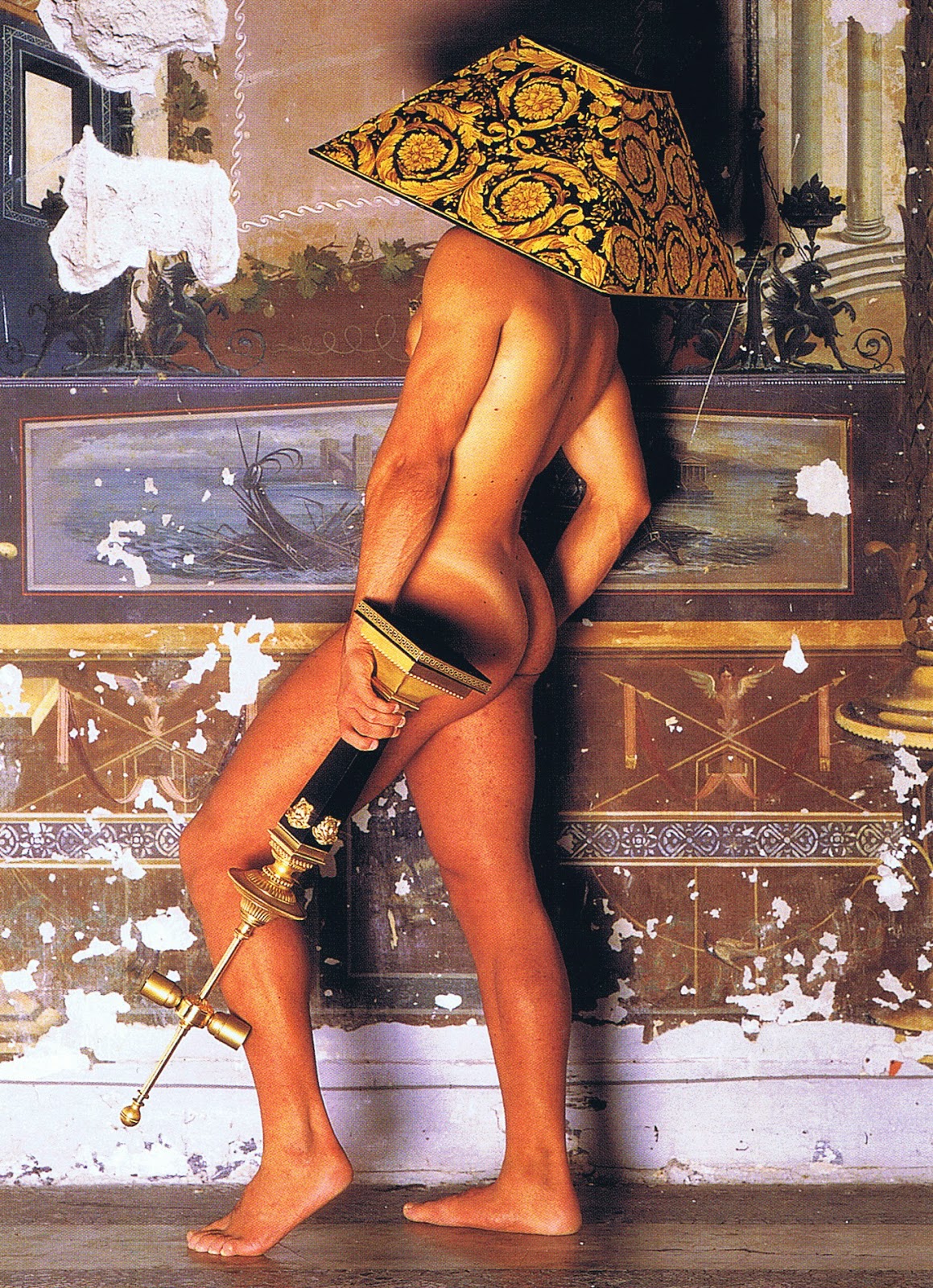
Actually, it was not. Built in 1930, Casa Casuarina, as the home was known, was inspired by Christopher Columbus’s son Diego’s residence in the Dominican Republic. In the courtyard of the 20,000-square-foot villa were busts of Columbus, Pocahontas, Mussolini and Confucius (all of which Versace kept). After Versace bought the property in 1992, he spent a million dollars restoring it. An army of artists and artisans filled the place with murals, mosaics and baroque furniture. Versace published a typically bizarre coffee-table book about his many bonkers properties in 1996, and in it you can find photos of the family frolicking poolside at Casa Casuarina alongside busy interiors and shots of naked men ironing. My favorite page shows a close-up of a burger, fries and a milkshake served on gilded Versace china, atop an ornate gold table. America! If you can’t track down a copy, this Google Image search should give you an idea. Look, here’s a bare-assed dude with a lampshade over his head! See you next week!

Recapping the First Episode of ‘American Crime Story: The Assassination of Gianni Versace’

Darren Criss’s killer performance — and the stories of lesser-known victims — are the main events of FX’s The Assassination of Gianni Versace: American Crime Story | Uncle Barky’s Bytes

FX’s second American Crime Story entry could be far more accurately titled The Dissection of Andrew Cunanan.

But in the realm of readily recognizable names, that doesn’t ring many chimes. So it’s The Assassination of Gianni Versace, even though Cunanan is the driving force while two of his other younger victims – there were five in all – get fuller treatments than the iconic fashion designer.

Former Glee star Darren Criss inhabits Cunanan with more flash and impact than any model who ever wore one of Versace’s creations. He’s alternately chilling, pathetic, conniving and deluded without ever being visibly remorseful. It’s a fully committed, crazily energetic performance that carries this nine-part miniseries through its peaks, valleys and at times disjointed timeline. Assassination of Gianni Versace also is very nice to look at, except when the corpses left behind are not.

Ryan Murphy, lately the busiest man in Hollywood, again shows that he’s generally on firmer ground when dramatizing real-life events rather than fictionally concocting them in series such as Nip/Tuck, Scream Queens, Fox’s new 9-1-1 and FX’s ongoing and very uneven American Horror Storyanthology series.

His first American Crime Story deservedly won a wealth of major awards with its up-close look at the O.J. Simpson trial. The deliciously bombastic Feud: Bette and Joan, likewise for FX, and the HBO movie The Normal Heart, also were almost uniformly critically praised. Murphy’s biggest fictional triumph, Fox’s Glee, notably stayed away from physical gore and succeeded as an empowering high school musical series.

Assassination of Gianni Versace, adapted primarily from Maureen Orth’s 1999 book Vulgar Favors, is fact-based but clearly not averse to taking liberties in depicting Cunanan’s “journey” from vainglorious poser to cold-blooded serial killer. Eight of the nine chapters were made available for review. And composition-wise, the storytellers err in waiting all the way until the eighth hour to detail Cunanan’s destructive upbringing at the hands of an abusive, duplicitous father (Jon Jon Briones as Modesto “Pete” Cunanan) and terrified mother (Joanna Adler in the role of Mary Ann Cunanan). The “sissy kid with a sissy mind,” as Pete puts it in a climactic scene, is put a path to self-destruction but never really toward self-awareness.

It all begins on July 15, 1997, with Versace (Edgar Ramirez) waking up to another day in his splendorous Miami Beach mansion. Servants await him. But he also willingly walks the nearby streets, giving off an air of accessibility while also politely declining an autograph request.

By the end of the first hour he’s dead and on a slab, his face gruesomely disfigured from a point-blank bullet wound. Versace’s partner of 15 years, Antonio D’Amico (Ricky Martin), is inconsolable. But the deceased’s steely sister, Donatella (Penelope Cruz), dismisses D’Amico with contempt as a leech whose contributions were less than minimal. She’s now determined to protect the Versace company by keeping it privately held.

“They’ll judge the killer, yes,” she says. “But they’ll judge the victim, too.”

This lays the groundwork of much of what is yet to come. Being gay in the late 1990s was still a considerable detriment, business-wise and otherwise. Versace, Cunanan and three of his other victims were all gay, with only the killer unabashedly coming out as a high schooler.

The subsequent story of Jeff Trail (Finn Wittrock) is especially poignant. He was proudly a Navy officer until being “found out” and thrown out. Trail’s eventual ill-fated involvement with Cunanan encompasses several episodes, as does the back story of David Madson (Cody Fern). Both ran afoul of Cunanan’s rages after recognizing him as a fraud and “betraying” him. Chapter 4, subtitled “House By the Lake,” telescopes Cunanan and David at the height of the latter’s fear of him. It’s one of the most powerfully chilling hours of television you’ll ever see – if you have the wherewithal to see it through.

Assassination of Gianni Versace includes two other veteran, recognizable actors, Judith Light and Mike Farrell. For an earlier generation they respectively were the stars of Who’s the Boss? and M*A*S*H. In Chapter 3, they’re paired as Chicago’s very prosperous Lee and Marilyn Miglin. She peddles her perfumes on home shopping networks while he’s a developer with designs on constructing the tallest building Chicago has ever seen. But Lee is also a closeted gay man who can’t get enough of Cunanan. They get together again while his wife is on a road trip. “I feel like I’m alive,” he tells Cunanan after they kiss. Well, not for long. Farrell’s performance is first-rate, but Light steals the episode as the all-business Marilyn, particularly after her husband’s mutilated body is found.

Although her time on-screen is limited, Cruz makes some strong impressions as the ever-demanding Donatella Versace. But Martin’s characterization of D’Amico is too one-note and largely inconsequential to really register. Ramirez has some solid scenes as Gianni, but doesn’t resonate nearly as strongly as Cunanan’s three other principal victims.

The pursuit of Cunanan, who’s already known to authorities before he murders Versace, is barely a subplot of the first eight chapters. Some viewers may become restive in the process. But the to-and-fro timeline serves both the stories of Cunanan and his victims. Cress’s performance is a force throughout, but not to the point of “humanizing” Cunanan at the expense of those whose lives he took with varying degrees of glee. The deaths of Jeff Trail and David Madson in particular hurt deeply.

This second installment of American Crime Story, which jumped ahead of a planned look at Hurricane Katrina and its aftermath, is unlikely to match the ratings or impact of the O. J. Simpson opener. Andrew Cunanan is a no-name killer in comparison, as are all but one of those whose lives he took so violently. So yes, Gianni Versace’s murder is the overall reason this miniseries came about in the first place. But no, he’s not nearly the half of it.

GRADE: B+

Darren Criss’s killer performance — and the stories of lesser-known victims — are the main events of FX’s The Assassination of Gianni Versace: American Crime Story | Uncle Barky’s Bytes

The Assassination of Gianni Versace: American Crime Story — Grade It!

Whether Darren Criss was shooting people in the face, puking in public bathrooms or casually rubbing his crotch while standing over a sleeping couple, he sure made Wednesday’s season premiere of American Crime Story feel like the darkest episode of Glee yet.

I’m half-joking, but considering this is Criss’ first series-regular TV role since Blaine Anderson warbled his final warble in 2015 (not to mention Criss’ first professional reunion with Glee boss Ryan Murphy), I trust you’ll overlook my inability to disassociate — at least in this first week.

Truth be told, Criss’ take on Andrew Cunanan — the sexually manipulative serial killer who murked fashion icon Gianni Versace in 1997 — is impressive, thoughtful and downright chilling, a far cry from the singing bottle of hair gel in a sweater vest he brought to life on the Fox comedy. Let’s discuss:

1990 | Wednesday’s premiere turned the clock back to the year Cunanan first encountered Versace (played by Edgar Ramírez) at a gay club in San Francisco. He was basically “that guy” at the party — the one who shows up uninvited, then proceeds to inject himself into strangers’ conversations — but his boyish charm and Harry Potter glasses worked their magic on Versace, earning him a date to the opera. I guess it helped that Cunanan presented a completely fictitious backstory, one that made him approximately 100 percent more Italian than he actually was.

Cunanan excitedly (and inaccurately) relayed this meeting to several of his friends the next day, a series of conversations that offered a glimpse into his twisted psyche. While speaking with a straight married couple, Elizabeth and Phil Cote (played by Annaleigh Ashford and Nico Evers-Swindell), he labeled Versace the F-word. But during a subsequent chat with a fellow gay, Cunanan had no problem referring to his and Versace’s opera meet-up as a date. “You tell gay people you’re gay and straight people you’re straight,” the friend protested. “I can’t keep up.”

1997 | Before diving into Versace’s history with Cunanan, the episode introduced us to the fashion icon in all his Miami Beach splendor. And despite his international fame, Versace was also painted as somewhat of a local celebrity — like a post-Christmas Carol Ebeneezer Scrooge, receiving hugs and hellos from all the Muppets people he encountered in town. And it was after one of these jaunty strolls that Versace was confronted by Cunanan, who shot him point-bank at the gate of his mansion. (The dead dove next to Versace felt a little on-the-nose, so I fact-checked — it really happened.)

Versace’s sister (played by Penelope Cruz) sauntered into the party about three-quarters of the way through the premiere, and while Donatella always commanded attention, most of her mourning breath was spent belittling her brother’s lover. When Antonio broke down in tears, her response was, “That’s not what I need from you right now.”

Speaking of Ricky Martin’s character, it was kind of shocking to hear how Donatella — and even the police — regarded his relationship with Versace. Donatella berated him for not protecting her brother, which she called his one job, and the police seemed far more interested in details about Versace’s sexual behavior than the details surrounding his untimely demise. 1997 doesn’t feel like it was that long ago… and yet it was.

The premiere concluded with Cunanan still at large, though the authorities — led by a mustachio’d Will Chase — were hot on his trail. (Also, yes, that was New Girl‘s Max Greenfield playing Ronnie, the guy found living at Cunanan’s last known address.)

Your thoughts on Crime Story‘s second season premiere? Grade the episode below, then drop a comment with your full review.

(A secret confession for those who have scrolled this far: Do you have any idea how difficult it was for me not to make a stupid joke about Darren Criss showing his butt in this episode? Believe me, I thought of ’em all, including “he put the ‘ass’ in ‘assassination.” But I refrained, for I am a professional… and that’s what Twitter is for.)

The Assassination of Gianni Versace: American Crime Story — Grade It!

American Crime Story premieres with a new murder, and a new approach

“The Man Who Would Be Vogue” B+

For the first 10 minutes of the pilot episode, it feels like The Assassination Of Gianni Versace: American Crime Story is going to be a different show. Based on the series’ first installment, it’s likely that after opening with a murder, the season would then continue on to the ongoing FBI investigation, the issues with the press, and the ensuing manhunt—one that was, as dubbed in the subtitle of the Maureen Orth book, “the largest failed manhunt in U.S. history.” Instead, it appears that this season is going to work backwards: Here’s the murder, and here’s what got us to that point.

What’s also clear, within those first 10 minutes, is that this season is going to be gorgeous to look at. The set of Versace’s mansion—which critics toured a bit of at last summer’s TCA press tour, and which left me breathless—is immediately memorable, painstakingly recreated to the last detail. The direction by Ryan Murphy (who should perhaps continue to focus on throwing around big ideas and directing episodes while leaving the actual screenwriting to others) is fluid and impressive, gliding as it follows Versace through his mansion, and featuring languid tilts above marble staircases.

Through both the direction and the writing, Assassination aims to set up parallels between famed designer Gianni Versace and his murderer Andrew Cunanan—reflecting what Andrew hoped were similarities, but actually depicting the reality of their differences—and for the most part, it’s successful. Versace gets his morning orange juice delivered on a platter while Andrew drinks from a cheap soda can; Versace is cool and casual as he buys magazines and exchanges pleasantries while Andrew is panicked and sweaty after vomiting in a bathroom with homophobic graffiti. Even their walks are contrasted: Versace strides on the sidewalk, looking straight ahead; Andrew trudges through the leaves, his head down.

The titular assassination comes quickly. Versace’s dead before the title card.

So, where does the episode go from here? Way back to 1990, Andrew jumping on the bed between his coupled friends, waking them up to reveal that he met Versace at a fancy gay nightclub—in the private members only section, of course. As Erik Adams put it in his pre-air review, writer Tom Rob Smith has to “fill in a lot of the blanks involving the relationships between predator and prey,” blanks that not even Maureen Orth could fill in Vulgar Favors. Did Andrew and Versace ever meet? (Versace’s family categorically denies this; Orth’s book asserts they did meet at a club before the opera’s premiere.) But the scene is mesmerizing despite the truth because it’s the first time we see Andrew’s brain at work: the persistence, the narcissism, the neverending lying, the slimy—but almost impressive—way he can sense an opening and jump in, confidently faking his way through any conversation. And Andrew is already telling his friends it happened differently.

“The Man Who Would Be Vogue” isn’t terribly subtle in setting up Andrew’s character when it comes to dialogue. The non-verbal cues, the props (the episode’s title paraphrases the title of Caroline Seebohm’s book about Condé Nast, which Andrew keeps in his backpack along with his gun), and the lingering moments (such as the camera’s slow zoom during the opera) all work better. Sometimes the dialogue is too expository (yes, sure, it’s a pilot): “You tell gay people you’re gay, and straight people you’re straight,” Andrew’s friend says to him. “Every time I feel like I’m getting close to you, you say you’re someone else.” No one really knows who Andrew is—least of all Andrew—and that’s part of what made his murders so bizarre and confusing. What we do know is what Andrew wants to be: He wants to be one of the elite, he wants to be someone everyone loves. He wants to be, in his own words, “impressive.” Through his “date” with Versace—which was surely a fantasy, no?—we gather more of what Andrew wants to hear. “You’re a creative, right?” Versace asks Andrew while pouring them champagne on the abandoned stage. “You’re handsome, clever. I’m sure you’re going to be someone really special one day.”

There’s not much time to linger on that past because the episode jumps back to 1997’s murder: Antonio hearing the shot, Andrew examining his work that includes a dead bird. While Andrew takes off running, Antonio tends to Versace’s rapidly dying body. A crowd starts to form as the police arrive; a man grabs his Polaroid to snap a photo of Versace being loaded into the ambulance. That one flash is a harbinger of what’s to come from money-hungry friends and strangers trying, often successfully, to profit off tragedy to the ways in which the media will interfere, undermine, and screw with the police’s investigation. Another forewarning is about the FBI’s ineptitude: piles of “Wanted By FBI” flyers featuring Andrew’s photos are untouched and undistributed, sitting in the trunk of Agent Evans’s car. Later, a pawn shop employee recognizes Andrew; she turned over his transaction forms (a requirement) to the police a week ago but nothing came from it. Would he have been caught earlier if people saw the flyers around and called the cops? Or if the police had read the pawn shop form—complete with a current address—a week prior and recognized his name? What Assassination might focus on, it seems, is if Versace’s murder could have been prevented.

It’s strange that in the first episode of a show titled The Assassination Of Gianni Versace, there isn’t too much to say about Versace himself, or his world. Donatella’s entrance is thrilling, and each move she makes is so deliberate, from putting on her sunglasses to fixing the marblehead that the detective turned askew. Antonio is similarly transfixing, and Ricky Martin displays impressive acting in this episode. It’s heartbreaking to watch him questioned by police who conflates “partner” with “pimp,” and who basically discounts Versace and Antonio’s relationship—partly, I assume, because it’s a homosexual relationship and partly because Antonio admits they brought other men into it. When he asks “the difference” between Antonio and the other men, Antonio replies—tearfully, exasperated, almost helplessly—“15 years!” It’s thankfully broken up by Donatella, who dismisses the detective and instructs Antonio to never speak to anyone about Versace without consulting her first. Donatella’s grieving but still knows the score: the police and the press will go through Versace’s life, “every discretion,” with a fine-tooth comb. She also knows that she has to keep Versace, the company, alive. “I will not allow that man, that nobody, to kill my brother twice.”

  • Welcome to weekly coverage of The Assassination Of Gianni Versace: American Crime Story, a title only a long-winded recapper could love! The O.J. installment was not only among my top shows of that year but probably the most fun I’ve had covering a show, so I jumped at the chance to dive into this one.
  • Did anyone else read the Maureen Orth book? Though it was certainly extensive and detailed, I was… lukewarm on it, to be honest, though mostly for spoilery (?) reasons relating to Andrew’s sexuality and sexual interests that I shouldn’t touch upon here but I’d love to know your thoughts!
  • It was nice to know a bit more about Versace through that “date” scene: his emphasis on family, how “maybe every dress” he makes is actually for Donatella, what he wants people to understand just by wearing his clothes.
  • Gianni Versace is a great follow-up to O.J. Simpson—and especially over a Hurricane Katrina season—for a number of reasons, but a big one is that the Simpson case (including the involvement of the press, how closely it was followed by normal people who were just watching television, and the failure to prosecute) were all still lingering in the minds of the FBI and local police departments when investigating these murders.
  • Two things I keep going back to: How long it took Antonio to wash Versace’s bloods off his hands, and Andrew explaining that his lies only matter if other people “know it isn’t true.”

American Crime Story premieres with a new murder, and a new approach

‘The Assassination of Gianni Versace: American Crime Story’ Season Premiere: Someone Really Special

A half-hour into the second season of FX’s “American Crime Story” comes a scene that is startling in its brazenness. A tourist, whose request for an autograph the designer Gianni Versace politely declined moments earlier, is gawking outside the Versace mansion. Versace has been shot to death on his own front steps, where a pool of blood remains after the body has been carried away. She dashes under the yellow police tape cordoning off the crime scene. She dips a page from a glossy magazine — could it be Vogue? — into the still-wet puddle and gingerly inserts her ghoulish souvenir into a transparent plastic pouch.

The murder of Gianni Versace outside his palatial Miami Beach home on July 15, 1997, had so many elements of a made-for-TV scandal — fashion, celebrity and psychopathy, all against the backdrop of a 1930 Mediterranean Revival villa where a room can now be had for $1,000 a night — that recounting it could easily devolve into a grotesque act itself, with the audience in the position of the memento-hoarding tourist. To its credit, “The Assassination of Gianni Versace” is related in a mostly respectful manner thus far, allowing this Verdian tragedy to unfold at a stately pace under the South Florida sun, though not in chronological sequence.

The season premiere works backward from the morning of the crime: Versace (Edgar Ramírez), having awakened in his mansion and eaten breakfast in a pink house robe, is gunned down as he returns from a stroll down the beach to buy some magazines. The killer is 27-year-old Andrew Cunanan (Darren Criss), whom we first see cradling a backpack stuffed with a handgun and a copy of Caroline Seebohm’s 1982 book “The Man Who Was Vogue: The Life and Times of Condé Nast” inside. Before steeling himself to commit murder, Cunanan takes the time to throw up in a public bathroom; we see that an anti-gay slur has been etched onto the stall.

The cliché of the homicidal (usually closeted) homosexual — driven to kill by envy, lust, self-loathing, etc. — is so common and tired that the heavy-handed bathroom-graffiti scene gave me pause: Are this serial killer’s motives sufficiently complex to sustain nine hours of television?

My concerns were allayed for now by the robust performances — Mr. Ramírez as the soft-spoken Calabrian genius, Mr. Criss (“Glee,”American Horror Story”) as the not-so-charming sociopath — and by Tom Rob Smith’s script and Ryan Murphy’s direction, which evoke a time that feels both recent and remote.

For those who could afford it, antiretroviral therapies had granted a reprieve from the death sentence that AIDS represented, but gay men were still routinely regarded with fear, if not contempt. Basic mainstream acceptance of their lives and relationships, much less legal recognition, was a ways off. A taint hung over discussions of gay sexuality, yet the yearning for companionship, love and joy had become far more open since the worst of the AIDS crisis a decade earlier.

Perhaps the most poignant scene in the episode is when the local police are interviewing Antonio D’Amico (Ricky Martin), Versace’s partner. His white tennis shirt and shorts encrusted with his lover’s blood, a forlorn and exhausted D’Amico is asked to explain why “dancers, models and escorts” have been in and out of the house.

“I was his partner, not his pimp,” D’Amico replies. He loved Versace. They were together for 15 years. The officer is mystified.

“The other men, did they consider themselves to be Versace’s partner too?” he asks.

Whether such a lack of understanding affected Cunanan’s evolution as a killer will presumably be a dominant theme for the rest of the season, which is loosely based on the journalist Maureen Orth’s “Vulgar Favors: The Assassination of Gianni Versace.” The first suggestion that he might be lacking a moral compass comes in a flashback to 1990, when a fawning and flirtatious Cunanan approaches Versace and his entourage in a crowded nightclub in San Francisco, but later tells his friends that it was Versace who initiated the conversation.

It emerges that Cunanan — who graduated from an elite private high school in San Diego and, after dropping out of college, lived off a series of benefactors — tells so many lies that even he may have come to believe them. A Catholic and a former altar boy, he passes himself off as a Jew. Asked why he tells straight people that he’s straight, and gay people that he’s gay, he replies, “I tell people what they want to hear.”

Versace invites the young fabulist to a night at the opera: a production of Richard Strauss’s “Capriccio,” for which Versace designed the costumes. They exchange origin stories. Versace’s centers on his muse — his sister, Donatella — and love of family. Cunanan’s outlandish tale involves a wealthy father who owned a pineapple plantation in the Philippines, became a pilot for Imelda Marcos, and later ran off with a farmhand, who also served as the chauffeur of his Rolls-Royce. Got that?

If Versace is incredulous, he’s too polite to say so. He is downright avuncular as he tells Cunanan, “You’re handsome, you’re clever, I’m sure you’re going to be someone really special one day.”

That’s some understatement: Returning to 1997, we learn that Cunanan was wanted for four other murders before Versace’s. A botched nationwide manhunt, it seems, has failed to prevent a serial killer from striking again. The F.B.I. has joined the Miami Beach police as they home in on Cunanan.

Meanwhile, Donatella Versace (Penélope Cruz) flies in from Italy and asserts control over her slain brother’s business empire, which was headed for an initial public offering on the Milan and New York stock exchanges. She comes across as fiercely protective of her brother’s legacy, if a little sinister. “My brother is still alive as long as Versace is alive,” she declares, making clear that the brand has transcended the man. She later brushes aside a grieving D’Amico, telling him: “This is not a time for strangers. This is a time for family.”

The term “assassination” is, so far, an enigma. The hotels of South Beach, the nightclubs of San Francisco, the gay demimonde and the Italianate arias so lavishly depicted in this series seem fairly removed from the world of politics, particularly at a time when AIDS had begun to recede as a public health crisis and when legal recognition of same-sex relationships still seemed like a distant prospect. How will this show’s creators define politics, including the politics of the closet? What criteria will it use to deem Gianni Versace’s death an assassination? Or — as the bloodied turtle dove found next to his body suggests — was it more like a martyrdom?

‘The Assassination of Gianni Versace: American Crime Story’ Season Premiere: Someone Really Special

American Crime Story: How Ryan Murphy Transformed Ricky Martin’s Real-Life Pain into Stunning TV

This post contains frank discussion of The Assassination of Gianni Versace: American Crime Story premiere: “The Man Who Would Be Vogue.”

Though he’s been in the spotlight for 35 years now, former Menudo member and “Livin’ La Vida Loca” singer Ricky Martin has always presented a comfortable and familiar on-stage persona. White teeth glinting, eyes sparkling, hair styled to perfection—when you see a showman like Martin, be it in Vegas or on Broadway, you know what you’re getting. But in the first Ryan Murphy-directed episode of The Assassination of Gianni Versace: American Crime Story, Martin gives his fans something they’ve never seen from him before: despair, and lots of it. The Puerto Rico-born Martin plays Antonio D’Amico, longtime lover of Gianni Versace, who—spoiler alert, if you ignored the title of this series altogether—dies on the front steps of the lavish house he and Antonio shared in the show’s opening scene.

Martin spends the rest of the episode grief-stricken and covered in Versace’s blood. In a striking, wordless, and unscripted moment, Martin lets his eternally optimistic mask slip off entirely and he’s fantastic. The gleaming smile gone and eyes sagging with exhaustion, Martin—wearing the personal grief of his own decades spent in the closet—stares at himself in the mirror. “I guess Ryan wanted to use and take advantage of that vulnerability,” Martin said in a new interview for Vanity Fair’s American Crime Story companion podcast, Still Watching: Versace. Approaching Martin after nine hours of filming both the discovery of Versace’s body and a confrontational police interrogation scene, Murphy said, “Rick, come on, let’s go to the bathroom. I want you to stand in front of the mirror. Wash your hands because you’ve been covered in blood for the last 10 hours and give me whatever you can in front of the mirror.” In that moment, Martin says, he was “exhausted, drained, and really sad.”

From the age of 12, Martin lived his life in the public eye—first as an earnest boy bander for the Latino pop group Menudo, and eventually as a worldwide solo-singing sensation. But until the age of 38, the Catholic-raised Martin kept the truth about his sexuality a secret. He tells Still Watching that he felt an “internalized homophobia,” which similarly plagued both Gianni Versace and his assassin: Andrew Cunanan. Martin describes those decades as “the most uncomfortable and saddest times of my life. I thought my emotions were evil because that’s what they told me. You’re not supposed to feel like this.” In past interviews, his familiar, comforting smile always in place, Martin has spoken of undiagnosed depressive periods that lifted significantly when he took to his own Web site in 2010 and came out of the closet.

Murphy’s choice of Martin for this role is genius casting for a series that explores the warping, damaging effect of closeted sexuality and aspirational lifestyles. Martin represents, for many, the epitome of the closeted 90s. Barbara Walters, who has expressed few professional regrets in her life, admitted in 2010 that she had pressed Martin too hard on the quasi open-secret of his sexuality in 2000, calling her line of questioning “inappropriate.”

The singer was living in Miami during Versace’s late-90s South Beach reign, and though the two never met—“I had a Giorgio Amani campaign at the time,” Martin explains—he was frequently invited to attend parties at the Versace mansion. As an out and proud designer, Versace was an anomaly even in the gay-friendly world of fashion. Though Versace’s open sexuality did nothing for Martin at the time (“on the contrary I was so locked in a closet”), the singer relates to the example Versace set, having done the same for many of his own fans in 2010. “No one knows how easy it is to come out until they do it.”

Martin finally showed up to the Versace house 20 years later, when, for two weeks last spring, American Crime Story moved into the designer’s old home on Ocean Drive (now a hotel) in order to meticulously re-create the scene of the crime. Martin said he “lived” as Antonio the entire time he was in that house—and unlike most of his co-stars, Martin was able to talk to the real person who inspired his performance.

Adopting a dramatic Italian accent, Martin tells Still Watching of Antonio’s initial disappointment with some photos that had leaked off the set: “Ricky! I never wear a green shirt!” But that early pushback from D’Amico turned into a close dialogue between Antonio and Martin, the man who would become him. Versace’s longtime partner answered Martin’s most difficult questions in painstaking detail, to the point where Martin was able to come armed with, perhaps, more firsthand insight than anyone else in the cast. “Everything that you see,” he says, “is based on the communication I had directly with Antonio D’Amico.”

The research Martin did paid off, as did his close friendship with Edgar Ramirez the actor playing Gianni Versace—whom Martin enthusiastically calls his “brother.” But Murphy’s stroke of genius in turning Martin’s real-life emotional exhaustion into theater is what delivers up the episode’s most arresting image. And Martin, who so bravely shared a closely guarded secret with his fans in 2010, shares yet another truth in the American Crime Story premiere: the traumatic toll that secret life took on him, even as he smiled broadly and shook his bon bon for all the world to see.

American Crime Story: How Ryan Murphy Transformed Ricky Martin’s Real-Life Pain into Stunning TV

‘The Assassination of Gianni Versace’ series premiere recap: Versace on the floor

We gave it an A-

Before we begin our recapping journey for The Assassination of Gianni Versace: American Crime Story, let’s be explicit about a few points. The Versace family has released a statement in opposition to the television show — which is based on the book Vulgar Favors by Maureen Orth — calling it a “work of fiction.” So I’ll be recapping this as a work of fiction; the people I’ll be discussing will be characters, based on the show’s portrayal of real-life people. I’m watching this as a television show loosely based on true events, as a piece of entertainment, and not as history. Good?

Right away, Murphy is doing what he does best with AGV: We open with a sweeping baroque string score, and a shot of Gianni Versace (Édgar Ramírez) waking up in his gilded palace, sliding his feet into slippers and gliding through his ornate home to a balcony where he overlooks Miami Beach like a king.

Down below, by the water, Andrew Cunanan (Darren Criss) wears a red hat, with a backpack by his side that contains a copy of The Man Who Was Vogue, and a gun.

The tension builds: Versace takes a pill; Cunanan screams in the ocean. Versace leaves his home and someone shouts his name, but it’s only tourists who want an autograph, which he politely refuses; Cunanan vomits into a toilet; and Versace continues his glide to a newsstand to pick up copies of magazines. Already, we know the intersection of these two men feels viscerally wrong; it’s as if they live in different galaxies, or entirely different parallel universes.

But then it happens. As Versace is reentering the gates of his home, Cunanan sees his chance. Cunanan walks towards him, arm outstretched, and shoots. There’s our introduction.

The episode immediately picks back up with Cunanan jumping into a bed where two of his friends are sleeping, bragging about meeting Versace. It takes a few seconds to register that this is a flashback — we’re now in 1990, in San Francisco — and it only takes a few more seconds to realize what sort of person Cunanan is. The real work in this scene is done by actress Annaleigh Ashford, whose polite smiles and subtle head tilts fully encapsulate a friend who’s gotten just a little bit fed up with that friend who’s too much.

Cunanan claims that he met Gianni Versace last night, and his friends humor him. He describes a scenario where Versace approached him and he rebuffed him with a perfectly flirtatious retort. As the audience, we’re privy to the real scene: Cunanan found Versace in the VIP section of a nightclub and talked his way next to him, pretending they had met before, bringing up his mother’s Italian heritage. This scene works on two levels: first, establishing that Cunanan actually did meet Versace, and second, establishing Cunanan as a liar, with delusions of grandeur and a remorseless way of ignoring the truth.

Our opinion of Cunanan is confirmed when we see him in conversation with another friend who calls him out: Cunanan has lied about being Jewish, he tells his straight friends he’s straight and his gay friends he’s gay. He lies so often that even we aren’t sure whether he’s telling the truth when he claims that Versace invited him to the opera, for which Versace designed the costumes. Andrew is there, in the next scene, but it’s possible the opera is just another place he manipulated his way into without an actual invitation. Maybe he just bought his own ticket.

But no, at the end of the opera, Versace is there, not surprised to see Andrew Cunanan. Their demeanor is flirtatious, and it’s implied that their relationship might have become sexual. Obviously, there are no witnesses here, and no way to confirm whether or not that actually happened, and so the show provides plenty of plausible deniability.

Back in the present (or rather, the 1996 present), we’re treated to some of the beautiful, slightly extra symbolism that feels so exquisitely Ryan Murphy: a bloody dove, also shot; the tourist who had asked for Versace’s autograph running past the police barricade to get his blood on her magazine page (beats a signature!); the medics cutting through Versace’s medusa logo on his T-shirt in the hospital.

Cunanan freaks out for a while in his car, and then pulls out a clean shirt — this was clearly a pre-meditated murder, not just an impulsive shooting. The police know the suspect is in the parking garage, and whether it was planned or luck, they end up tracking and tackling a stranger in an identical red shirt.

From the identification information on the car, the police are able to ID the suspect as Andrew Cunanan, already wanted for the murder from which he stole the truck. We learn Cunanan has already killed four people, but the FBI had apparently done an atrocious job of trying to track him down. No posters went out with his face on them. A woman who ran a pawn shop had reported him selling something a week before the Versace shooting (using his real name, and real ID) and no one followed up. It becomes sickeningly obvious that if anyone had been paying attention, Cunanan could have been stopped before his most famous murder.

Within the walls of the Versace compound, Gianni’s sister Donatella (Penelope Cruz) arrives to establish dominion over the Versace empire. The FBI have been interrogating Versace’s longtime partner Antonio D’Amico (Ricky Martin), trying to shift the conversation to frame him as a pimp or a cheater, and not as a boyfriend. It’s true that D’Amico brought men back for Gianni to sleep with, and their Greco-Roman inspired home was the site of all types of debauchery, but D’Amico tries to make it clear that he was different from the others. They lived together for 14 years.

Donatella is obviously not a fan of D’Amico. He symbolically extends his hand to her; she rejects him. And when she walks into a board meeting to discuss the future of the brand, she closes the door behind her, leaving D’Amico in the hallway. She doesn’t see him as a member of the family, and because the brand is Versace, he’s no longer relevant, especially because, in her view, he couldn’t accomplish his single task of keeping Gianni safe.

The FBI do manage to find Cunanan’s motel room, but when they break in, smoke and guns blazing, it’s not Cunanan in the bed but a twitchy junkie named Ronnie.

And there we have it: a pilot that sets all the pieces in motion and promises many more hours of fashion, intrigue, and stylistically splattered blood.

‘The Assassination of Gianni Versace’ series premiere recap: Versace on the floor